Portuguese
  Spanish


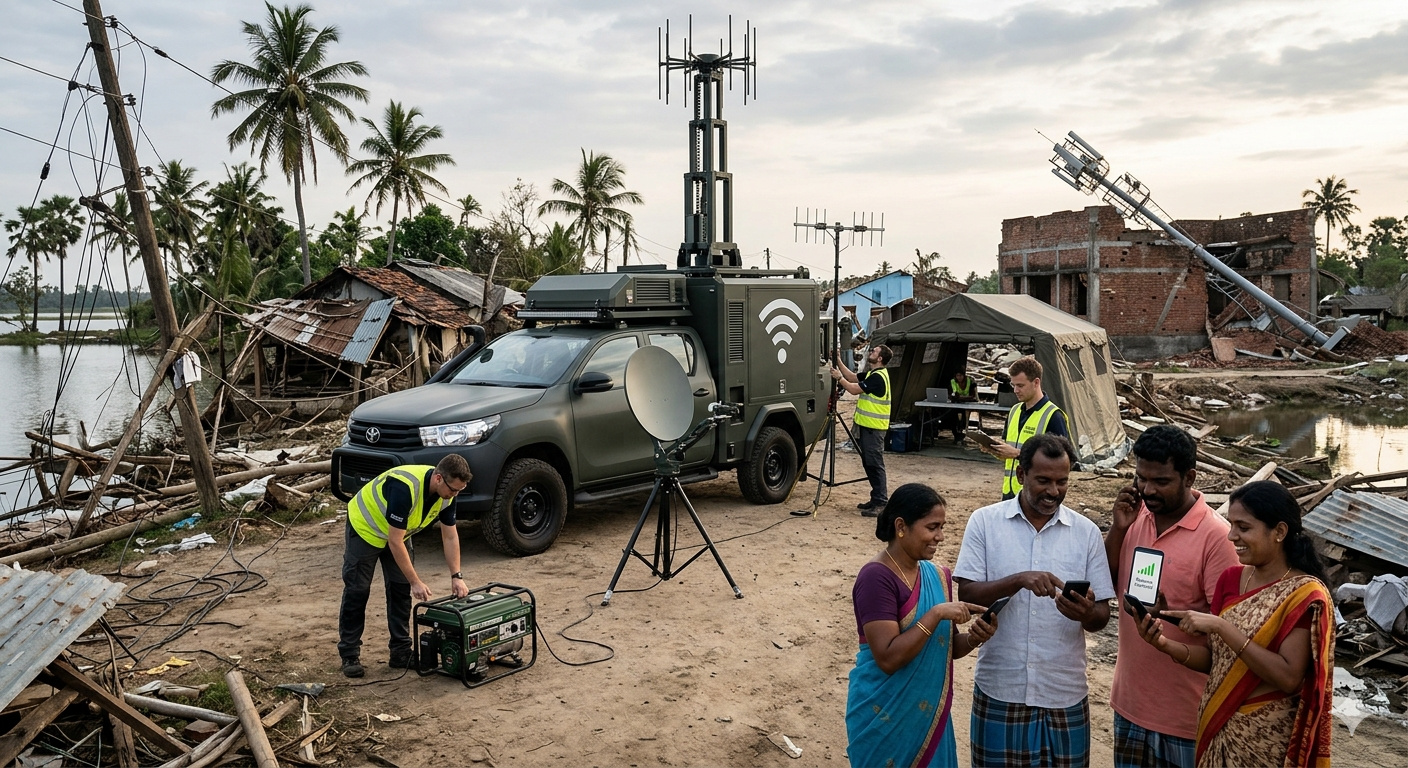

Vodafone’s portable system recreates mobile networks in minutes after disasters and has been used in over 40 countries to reestablish communication.
In 2023, the Vodafone Foundation, the social arm of the British operator Vodafone Group, highlighted recent advancements of the Instant Network Emergency Response (INER) initiative, a system designed to quickly restore connectivity in regions affected by natural disasters. The information was disclosed in institutional materials from the foundation, detailing the evolution of the equipment and its operational capacity in critical scenarios.
The main differentiator of the technology is its deployment speed. While traditional telecommunications systems can take days to be restored after the destruction of towers, cables, and power sources, the INER was developed to be operational within minutes of its arrival on site.
According to the Vodafone Foundation, the latest kits can restore essential services such as voice, SMS, and internet access in an extremely reduced timeframe, allowing immediate communication in emergency situations.
-
Giant Phantom Halo Appears Around Remote Pacific Islands, NASA Reveals It’s Created by Tiny Marine Organisms

-
Scientists Develop Method to Store Wind and Solar Energy by Liquefying Air for On-Demand Power Generation

-
Brazilian Engineer Who Grew Up Without Electricity Develops Software, Expands AltoQi to 67,000 Clients, Aiming for $21 Million by Digitizing Brazil’s Construction Industry

-
Spain Launches World’s Largest Floating Dry Dock: 56-Meter Giant Produces Massive Concrete Structures in A Coruña Using Technology Proven in Brazil


Technology replaces destroyed infrastructure and creates mobile network from scratch
In disaster scenarios, telecommunications infrastructure is often one of the first to be compromised. Earthquakes, floods, cyclones, and fires can topple towers, break cables, and interrupt the power supply.
The INER system was designed to operate independently of these structures. It functions as a compact mobile network, capable of creating temporary coverage without relying on pre-existing infrastructure.
In practice, the technology acts as a mobile base station, temporarily replacing all the conventional infrastructure needed for communication. This capability is crucial to ensure that rescue teams, authorities, and affected populations can communicate immediately after the event.
Equipment is portable and can be activated in different scenarios
The systems developed by the Vodafone Foundation are designed for mobility and rapid deployment. They can be transported by plane, truck, or even by smaller vehicles, depending on the version of the equipment.
Once on site, activation involves assembling antennas, connecting power sources, and configuring the system.
Technological evolution has significantly reduced installation time, which in previous versions could take more than a day, to just a few minutes in the latest models. This agility is a critical factor in situations where every minute can make a difference.
System has been used in more than 40 countries in different types of disaster
According to the Vodafone Foundation, the technology has been employed in more than 40 countries, in a variety of scenarios including earthquakes, floods, hurricanes, and humanitarian crises. These operations demonstrate the versatility of the system, which can be adapted to different geographical conditions and levels of destruction.
The experience accumulated over these operations has contributed to the continuous improvement of the technology, making it more efficient and reliable. Each mission provides data that helps optimize performance in future interventions.
Immediate connectivity improves coordination of rescue teams
One of the main impacts of the technology is on the coordination of rescue operations. In disaster situations, the lack of communication can hinder the mobilization of teams, the distribution of resources, and the assistance to the population.
With the rapid restoration of the mobile network, it is possible to coordinate actions among different teams, share information in real-time, and improve the efficiency of operations. Immediate connectivity also allows the use of digital tools, such as emergency management apps and location systems. This increases the accuracy and speed of responses.
System operates even without conventional electricity
Another relevant aspect of INER is its ability to operate in environments where the power grid has been completely interrupted. The equipment can be powered by generators, batteries, or other alternative energy sources, ensuring operation even in adverse conditions.
This energy independence is essential for maintaining communication in areas where basic infrastructure has been destroyed. Furthermore, it allows the system to be used in remote or hard-to-reach regions.
Technology evolved to reduce response time in emergencies
Since its creation, the INER system has undergone various updates. The initial versions required more installation and configuration time, which limited their efficiency in critical situations. With advancements in technology, the equipment has become more compact, automated, and easy to operate.
This evolution has reduced response time and expanded the reach of operations, allowing for faster and more effective interventions. The trend is that new improvements will continue to be incorporated.
Comparison with traditional systems evidences paradigm shift
In the conventional model, restoring mobile networks after a disaster involves rebuilding infrastructure, replacing equipment, and operational testing, processes that can take days or weeks.
The INER system breaks with this logic by offering an immediate solution. Instead of rebuilding, it creates a functional temporary network capable of meeting emergency needs. This paradigm shift changes the way disaster response is planned.
Technology paves the way for new emergency connectivity solutions
The experience of the Vodafone Foundation indicates that portable telecommunications systems can play a central role in emergency scenarios. In addition to natural disasters, these solutions can be applied in:
humanitarian operations, large-scale events, and areas without permanent infrastructure. The advancement of these technologies can lead to the development of increasingly flexible and adaptable networks. This expands the possibilities of connectivity in different contexts.
Case reinforces the importance of digital infrastructure in critical situations
Connectivity has become an essential element for the functioning of modern society. In disaster situations, its absence can further exacerbate impacts, hindering communication and access to information.
The ability to quickly restore the mobile network shows how digital infrastructure can be treated as a priority in emergency response strategies. This includes investments in technologies that ensure resilience and rapid recovery.
Could portable and rapid solutions like this become a global standard in disaster response, or do they still depend on investments and infrastructure that few countries possess?