Portuguese
  Spanish


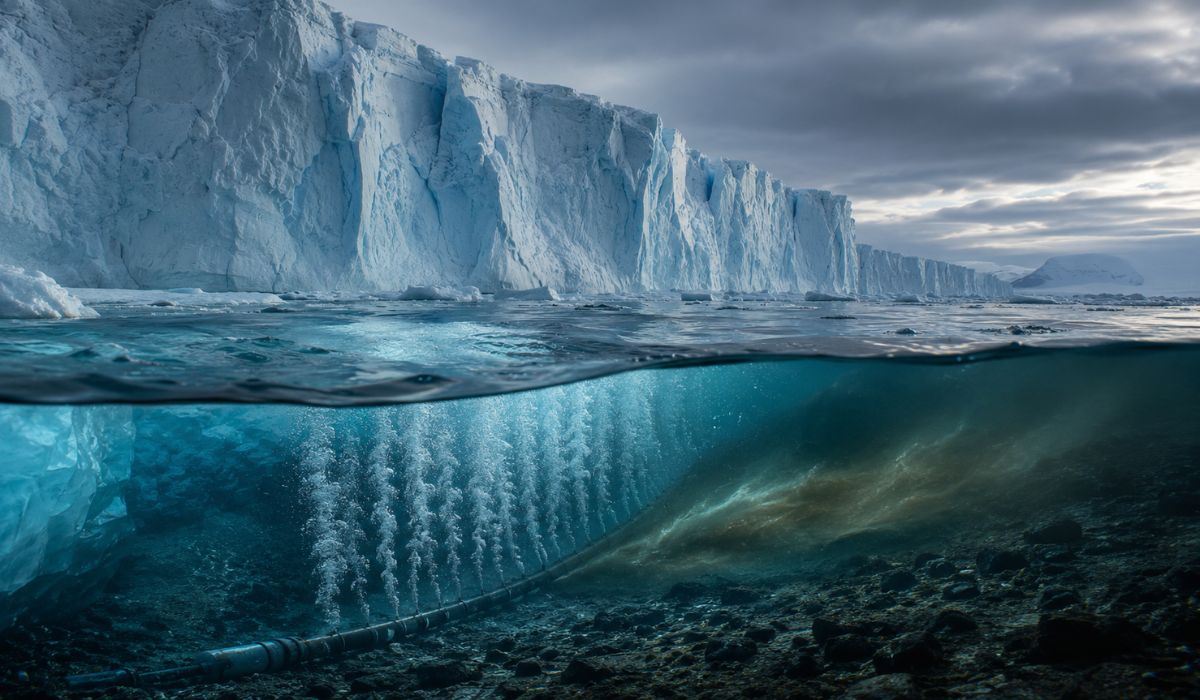
Two field experiments tried to contain Arctic melting by pumping seawater to create artificial ice, and results published in scientific journals show that the technique added 30 centimeters of thickness, but global warming eliminated the gains in weeks, exposing the limits of this strategy.
The idea behind artificial ice in the Arctic seems simple: drill holes in an ice sheet, pump seawater to the surface, and let the intense cold of the polar winter freeze everything, adding extra layers of thickness. If the ice gets thicker, it reflects more sunlight back into space and slows down the cycle of global warming that accelerates its own disappearance. The initial results of two field tests, published last week in the Journal of Geophysical Research: Oceans and accepted by the journal Earth’s Future, show that the technique works, but only for a limited time.
The 30 centimeters of artificial ice added equate to decades of thinning caused by climate change. However, ocean heat and the formation of dark sludge on the surface eliminated the protective layers shortly after their creation. The most concerning data is that areas with thickened ice did not last longer than areas without intervention, raising doubts about the viability of expanding the strategy across the Arctic.
How artificial ice manufacturing experiments work in the Arctic
The first test was conducted in April 2024 by a team formed by the Dutch startup Arctic Reflections and researchers from the Technical University of Braunschweig, led by coastal engineer Tim Hammer. The chosen scenario was a frozen lagoon in Svalbard, an archipelago off the coast of Norway. The team drilled into the ice and used a gasoline pump to launch 3,500 liters of seawater per minute onto the surface, flooding approximately 1,500 square meters over two sessions of two hours each.
-
$12 Billion Invested in AI Data Centers in Semi-Desert Mexican State, But 17 of 18 Municipalities Now Face Water Shortages, Residents Receive Water Only 3 Days a Week

-
How Much Does Starlink Satellite Internet Cost for Cars, Trucks, and RVs? Prices for Antenna, Accessories, and Plans

-
Scientists Convert Food Waste into Aviation Fuel, Successfully Test 50% Blend with Conventional Kerosene to Cut Emissions and Promote Sustainable Flights
-
OnePlus N6 Smartphone to Launch in India with 8,000mAh Battery and 45W SuperVOOC Charging, Lasting Up to Three Days



With external temperatures reaching -30ºC, the water froze quickly and deposited 30 centimeters of artificial ice on top of the existing layer. The immediate result seemed promising. However, by June, the entire lagoon had melted, and the thickened ice did not survive longer than the control areas that received no intervention. The main reason is that seawater, when frozen, leaves behind pockets of salt that act as melting agents, just like the salt spread on roads before snowstorms.
The large-scale test in the Canadian Arctic and its results
In the same year, a much larger operation was conducted in Cambridge Bay, along the southern coast of Victoria Island, in the Canadian Arctic. The team brought together the British startup Real Ice, the Climate Repair Center at the University of Cambridge, and other partners. The experiment flooded 250,000 square meters of sea ice during four-hour sessions, using four pumps connected to electric batteries.
The results followed the same pattern as the test in Svalbard: about 30 centimeters of artificial ice formed, but it all melted away when the bay’s ice fractured in the summer. Engineer Shaun Fitzgerald, director of the Climate Repair Center, acknowledged that experiments would need to be conducted on a much larger scale to produce lasting effects. Still, drone and satellite images showed that the thickened ice was 40% brighter than the surrounding areas, suggesting that increased reflectivity may be key to the future success of the technique.
Why Arctic ice matters for the global climate

The sea ice in the Arctic grows each winter until it reaches an extent nearly the size of Russia and recedes in the summer. This natural cycle has been declining for decades. The loss of ice fuels a dangerous climate feedback loop: as the white surface reflects sunlight, its reduction exposes the dark ocean, which absorbs more heat and accelerates global warming even further. The less ice there is, the faster the planet warms.
The problem is not limited to polar bears and Arctic wildlife. The melting of sea ice influences climate patterns on a global scale, affecting ocean currents, rainfall regimes, and temperatures at distant latitudes. The creation of artificial ice has emerged as an attempt to interrupt this cycle, but tests show that nature resists simple solutions. Glaciologist Leigh Stearns from the University of Pennsylvania classified the possibility of scaling the technique to the entire Arctic as unfeasible, given the colossal effort required even to cover small areas.
The technical challenges that prevent artificial ice from working on a large scale
The main obstacle is salt. When seawater freezes at the surface, pockets of brine trapped within the artificial ice stimulate internal melting and create a dark sludge that reduces reflectivity, negating the very benefit that the technique aimed to generate. Fitzgerald believes that pumping the water earlier in the winter may partially solve this problem, allowing more time for the salt to percolate through the ice before spring arrives.
There is also the energy and ecological issue. Researchers still need to assess whether pumping will bring microbes and phytoplankton to the surface, disrupting the local ecology. The replacement of gasoline pumps with wind energy is a possibility under study, but it would add logistical complexity to an operation that is already extremely difficult to execute in polar conditions. Glaciologist Sridhar Anandakrishnan from Pennsylvania State University compared the initiative to trying to contain the ocean with a teaspoon.
What lies ahead and why the battle for the Arctic is not over yet
Despite the limited results, funding for research continues. Fitzgerald secured £10 million from the UK’s advanced research agency to continue field testing and modeling on the thickening of artificial ice in partnership with Real Ice and Arctic Reflections. The researcher himself acknowledges that the technique will not maintain ice cover in the Arctic indefinitely, but believes it can buy humanity a few decades.
The underlying issue, however, remains unchanged. Even if large-scale pumping operations were implemented throughout the Arctic, experts insist that reducing fossil fuel emissions is the only comprehensive solution to ice melting and global warming. Artificial ice may be a stopgap measure in confined areas, but it does not replace the need to address the root cause of the problem. The distance between thickening a pond in Svalbard and saving the entire Arctic remains, for now, greater than any layer of ice that human engineering can produce.
Do you believe that creating artificial ice in the Arctic is a valid way to buy time against global warming, or does this type of intervention divert attention from the real solution? Leave your opinion in the comments, we want to know what you think about the limits of climate engineering.