Portuguese
  Spanish


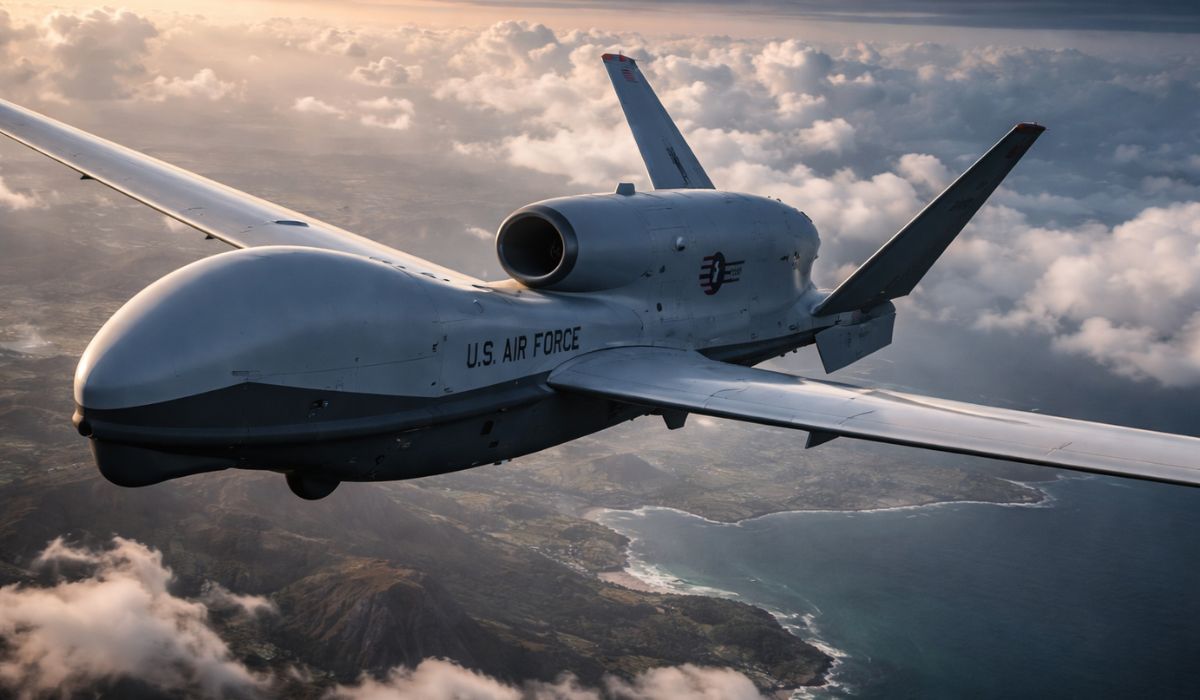

An unmanned aircraft, with dimensions similar to those of a commercial airplane, combines extended endurance, high-altitude sensors, and remote operation in surveillance missions that place the RQ-4 Global Hawk among the most well-known systems in military technology.
The RQ-4 Global Hawk is a long-range military surveillance aircraft developed for intelligence, reconnaissance, and monitoring missions over large areas.
With no pilot on board, the model operates at high altitude, stays in the air for more than 30 hours, and transmits data to ground teams almost in real-time.
The combination of high endurance, integrated sensors, and remote flight has made the aircraft a benchmark in aerial surveillance operations for the United States.
-
Abandoned Building in Brazil to Become Biotechnology Unit with $10 Million Investment, Bridging Science, Industry, and Public Health

-
Netherlands Builds Giant 240-Meter Inflatable Barrier That Rises to Protect Cities from Storm Surges

-
Brazilian Submarine Robot “FlatFish” Operates Independently at 3,000 Meters Depth to Inspect Seafloor Pipelines Without Support Vessels
-
Eufy Unveils Omni S2: Advanced Robot Vacuum with 30,000 Pa Suction, Self-Cleaning Mop, AI Obstacle Avoidance, 12-in-1 Station, and Built-In Fragrance Dispenser



The topic appeared in a video from the channel The Daily Aviation, which has 2.56 million subscribers on YouTube and describes the aircraft’s operation, its structure, and the role it plays in military and monitoring operations.
The presentation highlights the size of the device and its ability to cover large areas of territory in a single mission.
Global Hawk has dimensions similar to those of a commercial airplane
Although referred to as a drone, the Global Hawk has proportions similar to manned aircraft.
According to the technical specifications from the United States Air Force, the wingspan reaches 39.8 meters, a measurement close to that of single-aisle commercial models, while the length is 14.5 meters.
The operational ceiling reaches 60,000 feet, equivalent to about 18.3 kilometers in altitude.
This size helps to gauge the scale of the equipment within unmanned military aviation.
The manufacturer Northrop Grumman defines the system as a persistent surveillance platform, capable of operating in different weather conditions, during the day and at night, with high-resolution image collection over large land areas.
In the original text, the reference to “14 tons” is close to the maximum takeoff weight, which is 14,628 kilograms, or 14.6 tons.
The basic weight of the aircraft is lower: 6,781 kilograms, according to the U.S. Air Force.
How the remote flight of the RQ-4 Global Hawk works
Despite not carrying a pilot on board, the RQ-4 does not operate without human supervision.
The model is classified by the U.S. military as a remotely piloted aircraft.
The system operates with a ground team divided between the element responsible for takeoff and landing and the mission control core.
According to the U.S. Air Force, the remote crew involves three main functions: launch and recovery pilot, mission control pilot, and sensor operator.
In practice, the flight can follow programmed routes and execute much of the mission with a high degree of automation, but always under human supervision.
NASA, which also uses variants of the Global Hawk for atmospheric research, reports that the aircraft autonomously executes the flight plan loaded before the mission.
Still, the route and systems are monitored from the control station via satellite communication links and line-of-sight.
This automation was designed to reduce the need for direct intervention and allow for long missions in remote areas.
At the same time, the system reduces crew exposure to areas classified as hostile in monitoring and reconnaissance operations.
High-altitude sensors expand aerial surveillance
The Global Hawk was designed for ISR, which stands for intelligence, surveillance, and reconnaissance.
The U.S. Air Force reports that the platform can operate with imaging sensors, signals intelligence, and tracking of moving targets.
In the more advanced versions, the aircraft combines electro-optical sensors, infrared, synthetic aperture radar, and, in some blocks, signals collection capability.
This set allows for the production of detailed images of the terrain, identification of changes in extensive areas, and tracking of moving targets.
Among these features, the synthetic aperture radar, known by the acronym SAR, enhances the observation capability in unfavorable lighting and weather conditions.
The technology is used to map areas and generate images with greater accuracy even in limited visibility scenarios.
Territorial coverage is another frequently cited data point about the model.
The technical specifications from the U.S. Air Force indicate that the Global Hawk can inspect up to 40,000 square miles per day, equivalent to about 100,000 square kilometers.
This is a vast area, although the number does not literally correspond to the surveillance of an entire continent in a single flight.
Extended flight endurance supports long-duration missions
The main differentiator of the RQ-4 is its time aloft.
Northrop Grumman claims that the system can fly for more than 30 hours, while the U.S. Air Force records more than 34 hours of endurance.
The official documentation also mentions that a Block 40 completed a flight of 34.3 hours without refueling in 2014.
This level of autonomy changes the profile of operations.
Instead of short and repeated missions, the aircraft can maintain prolonged surveillance over the same area, a feature used in military operations, disaster response, maritime route search, and crisis monitoring.
Moreover, Northrop Grumman reports that the platform has already been employed in activities related to humanitarian assistance, search and rescue, and the collection of meteorological and atmospheric data.
Therefore, its use is not restricted to conflict scenarios.
Another important piece of information is the range.
The U.S. Air Force reports a range of 12,300 nautical miles, which helps explain why the aircraft can take off from a base, complete long-distance missions, and return without intermediate stops, depending on the operational profile.
U.S. military technology goes beyond combat use
The Global Hawk began operational use in 2001 and was incorporated as a high-altitude surveillance tool for operations in peacetime, contingency, and war.
Since then, according to the manufacturer, the fleet has accumulated over 320,000 flight hours, with missions in regions such as Iraq, Afghanistan, North Africa, and the Asia-Pacific.
For the U.S. Department of Defense, the proposal is to expand information gathering without exposing crews to prolonged missions over sensitive areas.
The institutional documentation also indicates the platform’s use in support of civil authorities during natural disasters and in expanded monitoring missions.
More than its size or range, the Global Hawk has come to be identified by its ability to remain at high altitude for long periods, with sensors aimed at continuous data collection and transmission to command centers at long distances.
This operational model helps explain why the aircraft continues to be mentioned in discussions about surveillance, military technology, and the strategic use of unmanned systems.