Portuguese
  Spanish


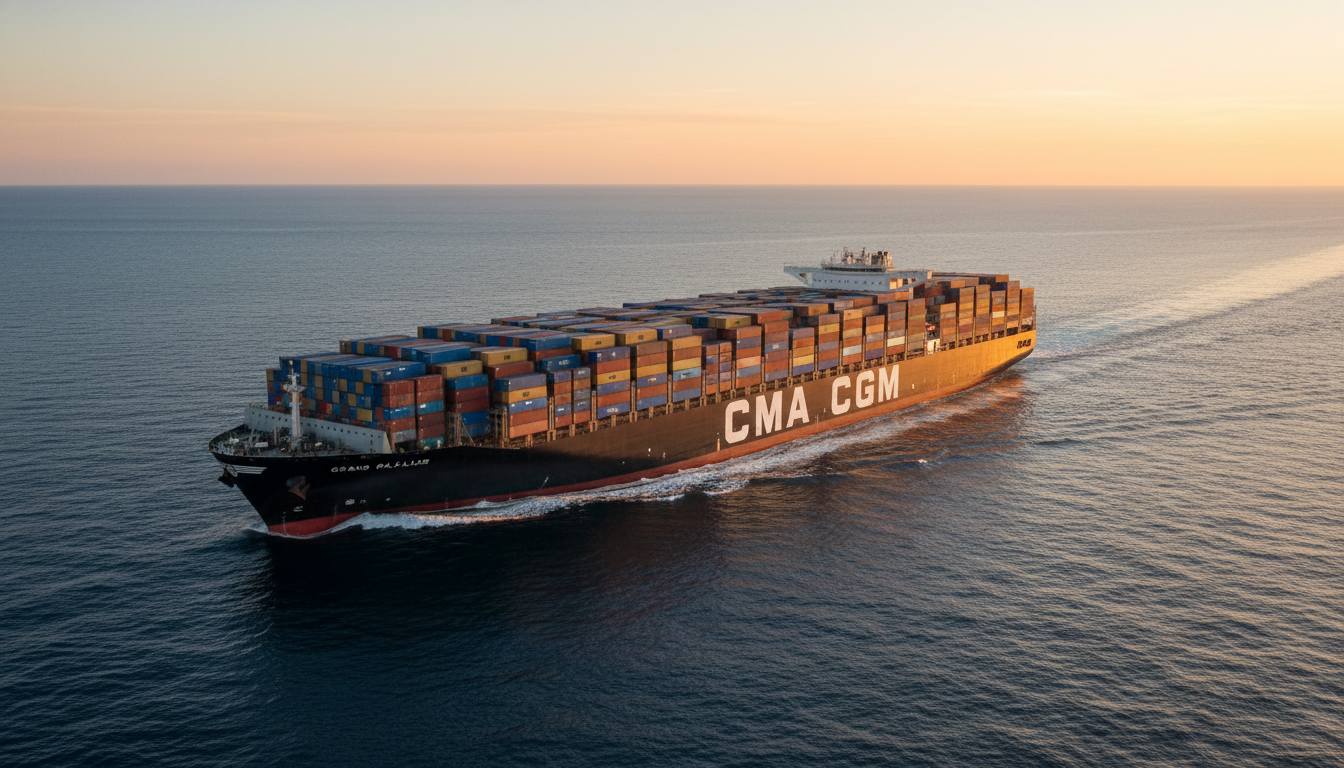


CMA CGM Grand Palais crosses the Suez with 400 meters, 23,876 containers, and LNG propulsion, the largest container ship in the world
On May 3, 2026, the CMA CGM Grand Palais completed its first crossing through the Suez Canal and debuted as the largest LNG-powered container ship in the world.
As reported by The Maritime Executive, the French cargo ship transited in the south convoy heading to Asia.
The ship is 400 meters long and 61.3 meters wide, equivalent to four football fields lined up.
-
Volvo’s New Loaders Feature Obstacle Detection, Automatic Braking, and 360-Degree Operator View

-
Chinese Manager Accused of Whipping Worker Sparks Protest by 1,200 Employees at Major Brazilian Factory

-
The FLIP: A 108-Meter Ocean Laboratory That Stood Vertically for 60 Years, Dismantled in 2023

-
France Revamps 530 Social Housing Units with Large Balconies and Glass Facades Without Demolishing Existing Buildings



According to Container News, the capacity reaches 23,876 TEU and the gross tonnage sums up to 220,923 tons.
The cargo ship was built by the Chinese shipyard Hudong-Zhonghua, of the state-owned CSSC, and was delivered on March 17, 2026, seven months ahead of schedule.
Therefore, the transit through the Suez Canal also marks the gradual return of CMA CGM giants to the Egyptian route after the detour via the Cape of Good Hope.
CMA CGM Grand Palais uses 400 meters of hull to cross the Suez Canal in the south convoy
The south convoy departed from Port Said on the morning of May 3. Subsequently, the giant entered the canal waters accompanied by other cargo ships.
According to data released by the Suez Canal Authority, the vessel followed a route of approximately 193 km to the Red Sea.
Compared to most ships crossing the canal, the 16.5-meter draft required continuous monitoring.
Therefore, support tugs accompanied the transit from the northern entrance to the Great Bitter Lake reservoir.
On the other hand, the operation followed standards already tested in other ultra-large container ships (ULCS) that passed through the route.
In fact, the canal has already received ships of the Ever Ace class and the Mediterranean Shipping Company with similar drafts in 2024 and 2025.

Hudong-Zhonghua delivers the CMA CGM Grand Palais seven months early and expands dual-fuel series
The Hudong-Zhonghua shipyard is located in Shanghai and belongs to the state-owned China State Shipbuilding Corporation (CSSC).
According to CSSC, the ship was delivered on March 17, 2026, ahead of the contractual deadline.
In other words, the Chinese team anticipated by seven months an order placed by the French shipowner.
As reported by Daily News Egypt, the cargo ship is part of a series of ten ultra-large units contracted by CMA CGM.
On the other hand, the Chinese shipyard also accelerated other dual-engine orders between 2024 and 2026.
Other vessels in this line operate on similar standards, such as the Celsius Georgetown, the largest LNG ship in China, which entered operation in May.
Therefore, Hudong-Zhonghua establishes itself as a reference in LNG propulsion for large ocean cargo ships.
LNG propulsion of the CMA CGM Grand Palais cuts emissions and meets IMO targets
The heart of the ship is the dual-fuel LNG engine combined with conventional bunker.
According to CMA CGM, the system operates predominantly with liquefied natural gas on ocean routes.
Compared to traditional heavy fuel, LNG reduces emissions of sulfur oxides, nitrogen oxides, and particulate matter.
Additionally, natural gas reduces the ship’s direct carbon footprint by about 20% per trip.
Therefore, the cargo ship aligns with the International Maritime Organization (IMO) goals of achieving net-zero emissions in ocean transport by 2050.
Similarly, CMA CGM aims for biomethane and e-methane in the next stages of fleet decarbonization.
Subsequently, the company plans to test green ammonia in orders starting in 2028.

- Length: 400 meters (four football fields)
- Width: 61.3 meters
- Gross tonnage (DWT): 220,923 tons
- Capacity: 23,876 TEU
- Propulsion: dual-fuel (LNG + conventional bunker)
- Shipyard: Hudong-Zhonghua (CSSC, China)
Suez Canal recovers traffic after detour via the Red Sea and attacks in Yemen
The Suez Canal lost participation in global trade starting at the end of 2023.
At that time, drone and missile attacks by Houthi groups in the southern Red Sea forced shipowners to detour via Africa.
According to the Suez Canal Authority, the canal’s revenue fell by about 60% between 2023 and 2024.
In comparison, the detour via the Cape of Good Hope added 10 to 14 days of transit between Asia and Europe.
Therefore, operational costs increased for CMA CGM, Maersk, MSC, and Hapag-Lloyd throughout 2024 and 2025.
According to official Egyptian data, traffic began to recover in early 2026 after ceasefire agreements and reduced attacks in the region.
“The gradual return of major operators to the Suez Canal confirms the strategic role of the route for global trade,” stated the chairman of the Suez Canal Authority in a statement.
CMA CGM, the third largest in the world, orders a series of ten 23,000 TEU units
The French CMA CGM is currently the third largest container ship operator in the world.
According to the company, the fleet totals more than 660 ships on global routes.
According to the group, the program includes ten ultra-large units with LNG propulsion.
In other words, the French cargo ship inaugurates a series that will redefine the operator’s maximum size.
On the other hand, the French shipowner maintains logistical partnerships in Chinese, South Korean, Northern European, and Southeast Asian ports.
Therefore, the giant serves Asia-Europe, Asia-Mediterranean, and Asia-Middle East routes.
Similarly, CMA CGM is connected to the Brazilian market via terminals such as Santos, Suape, and Pecém.
In parallel, the operator monitors the movement of ports in the Northeast — a case portrayed in a report on the growth of Suape, Itaqui, and Pecém at the beginning of 2026.

Brazil depends on foreign operators to ship containers from Asia to the South Atlantic
Brazil does not operate ultra-large container ships on ocean routes.
According to Antaq data, the country moved about 13 million TEU in 2024 at public terminals.
In comparison, the Brazilian fleet totals less than 100 large merchant ships under the national flag.
Therefore, shipowners like CMA CGM, Maersk, MSC, and Hapag-Lloyd control container traffic between Santos, Suape, Pecém, Itajaí, and Asian ports.
According to logistical operators, limited drafts in some Brazilian ports still restrict the arrival of ships with more than 18,000 TEU.
In comparison, the container ship can only operate at full capacity in the world’s deepest hubs.
Similarly, the ship reinforces the trend of concentrating Asian cargo in a few global megaterminals.
Next steps for CMA CGM and the future of global ocean transport
CMA CGM is preparing the next deliveries of the series of ten ultra-large ships with Hudong-Zhonghua.
According to the disclosed schedule, new sister units will enter service between 2026 and 2028.
Subsequently, the French operator intends to migrate part of the fleet to biomethane and e-methane still in this decade.

On the other hand, there are recognized limitations. The supply of maritime LNG is still concentrated in some port hubs, which restricts refueling on some routes.
Similarly, the scenario in the Red Sea remains sensitive, and any resurgence of attacks could push the fleet back to the Cape of Good Hope.
At that time, operational costs rise quickly, spot freight accelerates, and the Suez Canal loses revenue again.
Therefore, shipowners monitor the regional security situation in parallel with the IMO’s decarbonization goals.
Still, there are limitations along the way. Delays in maritime LNG contracts could hold back the advancement of the series of ten ultra-large ships over the next two years.
It is worth remembering that the geopolitical scenario in the Red Sea remains sensitive, a point of attention that the sector monitors.
Will the return of heavy traffic to the Suez Canal sustain itself in this still unstable scenario?