Portuguese
  Spanish


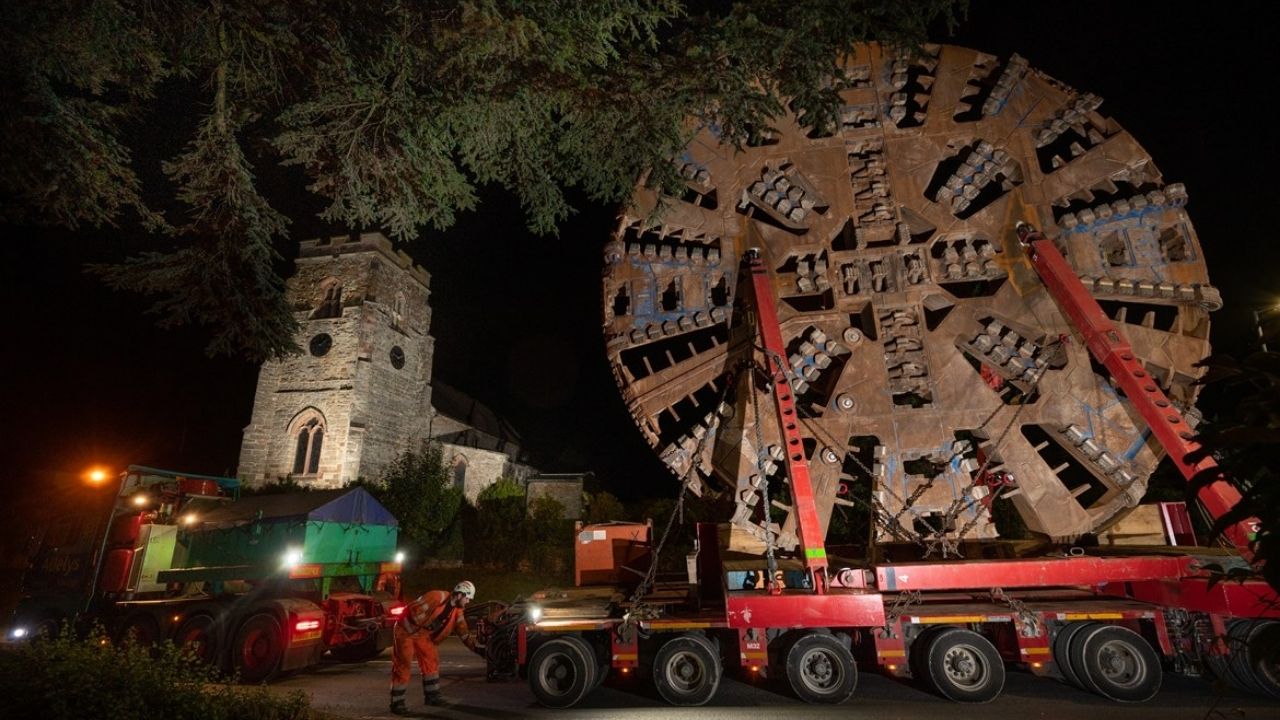


The tunnel boring machine Dorothy used in HS2 had its 10-meter, 160-ton cutting head dismantled, lifted vertically, and transported at night for 4 kilometers in Warwickshire on a 48-wheel self-propelled platform to return to the north portal and open the second tunnel of Long Itchington Wood.
The tunnel boring machine Dorothy, used in the HS2 works in the United Kingdom, needed to be dismantled after completing the first drilling of the Long Itchington Wood tunnel in Warwickshire. The operation took place on the night of September 21, 2022, arriving at the destination at 3 AM on September 22.
According to information released by High Speed Two (HS2) Limited, the most impressive part was the transportation of the cutting head, a piece weighing 160 tons and 10 meters in diameter, carried upright on local roads on a 48-wheel self-propelled trailer. The goal was to return to the north portal of the tunnel to reassemble the machine and start the second excavation.
Cutting head emerged from the tunnel as a giant piece of engineering

After completing the first drilling in July 2022, the tunnel boring machine Dorothy did not simply move forward to open another tunnel. As the project planned for a second parallel excavation, the front part of the machine had to be dismantled at the south portal and transported back to the starting point.
-
Cost of Installing Electric Fences in 2026: Price Per Meter and Factors Affecting Installation

-
Retired Builder Constructs House Using Over 4,000 Milk Cartons in Brazil, Engineer Estimates Structure Could Last 100 Years

-
Concrete-filled PVC homes could be cheaper than traditional masonry, UPF research finds; with ready modular panels, less waste, and faster construction, the Concrete-PVC system aims to cut costs and transform affordable housing in Brazil.
-
Brazilian House Built with 32.8 Tons of Construction Debris Offers Affordable Housing Solution



The cutting head is the part that directly faces the ground. It is the part that rotates, breaks the terrain, and allows the tunnel boring machine to advance meter by meter during excavation. Therefore, moving a structure of this size requires much more planning than just placing it on a truck.
The piece was positioned vertically on a 12-meter-long self-propelled platform with 48 wheels. This configuration helped distribute the weight and allowed the load to advance with control during the nighttime journey.
The route was about 4 kilometers, passing through the A425 and the village of Ufton in Warwickshire. The journey took approximately 180 minutes, a low speed but necessary to maintain safety and reduce risks during the movement.
Night operation reduced impacts for the community

The movement was carried out at night to reduce disruptions to local traffic. In an operation of this magnitude, every curve, narrow stretch, and urban passage needs to be studied before the move.
The choice of timing was not a logistical detail, but part of the safety strategy. Transporting a 160-ton cutting head upright, on dozens of wheels, requires route control, technical monitoring, and coordination with local authorities.
The responsible team worked in partnership with the local authority, Warwickshire Police, and British Transport Police. The goal was to ensure that the load passed safely through the route to the north portal.
In addition to the cutting head, a rear structure of the tunnel boring machine, weighing about 120 tons and 10 meters in diameter, was also moved in the same operation. This shows that the challenge did not involve just a single piece, but a sequence of giant components.
Self-propelled trailer avoided major road alterations

The use of the self-propelled trailer was essential to transport the piece without relying on more complex temporary adaptations to the road layout. In works of this type, specialized equipment can reduce interventions in streets, intersections, and nearby villages.
The 48-wheel platform allowed controlled maneuvers and weight distribution of the load. This is important because a 160-ton structure cannot exert excessive pressure on specific points of the road during the move.
According to the project plan, eight other large pieces of the tunnel boring machine’s front and central shields had already been transported by similar equipment. The intention was to keep the operation efficient without causing significant changes to the route through Ufton.
This type of logistics reveals a less visible part of major infrastructure works. Opening a tunnel is just one step; dismantling, moving, and reassembling the machine is also part of the project.
Dorothy still needed to be reassembled for the second tunnel

After transporting the main parts, the rest of the tunneling machine, about 120 meters long, would be pulled back through the 1.6 km tunnel by a special conveyor system. The expected speed was 150 meters per day.
Reassembly at the north portal was necessary before starting the second drilling. Instead of using a new machine, the project repurposed Dorothy herself to open the second parallel tunnel.
This process requires precision. Each component needs to return to the correct position so that the machine can operate again with safety, alignment, and sufficient strength to face the terrain.
The expectation was that, once reassembled, the tunneling machine would start the new excavation still in 2022. When both tunnels were completed, the Long Itchington Wood section would become the first fully completed double tunnel of the HS2 project.
HS2 shows the scale of railway works in the United Kingdom
HS2 is one of the main railway projects in the United Kingdom, and operations like this show the scale involved in building new high-capacity links. Even an isolated piece of the tunneling machine is large and heavy enough to become a special operation.
The 10-meter diameter cutting head gives an idea of the size of the tunnel being opened. It is not just a mechanical component; it is the face of the machine advancing underground.
The construction of the Long Itchington Wood tunnel required coordination between engineering, logistics, road safety, and environmental planning. Each stage depends on different teams working in sequence.
Night transport in Warwickshire also shows that major works do not only happen within the construction site. Often, they cross roads, communities, and public routes before going back underground.
A short but extremely complex operation


The 4-kilometer journey may seem small in distance, but it was enormous in complexity. Moving a 160-ton piece upright, overnight, through local roads, requires minimal margin for error.
The success of the operation was in the sum of details. Weight, height, width, stability, speed, escort, route, communication, and safety needed to work together.
The logistics manager of Balfour Beatty VINCI highlighted that the operation was meticulously planned and used specialized equipment to transport the large and heavy pieces safely.
The image of the cutting head passing through Warwickshire on 48 wheels sums up this type of work well: before the train exists, there is a silent engineering that moves giant machines at a slow and controlled pace.
What the journey of the tunnel boring machine reveals about infrastructure
The journey of the tunnel boring machine Dorothy’s cutting head shows that tunnel construction depends as much on excavation as on logistics outside the tunnel. The machine opened the first section, was dismantled, crossed roads, and needed to return to the starting point to begin again.
It is an operation that transforms an industrial piece into an engineering spectacle. For those who see the image, it seems just a giant load. For the work, it is an essential step to complete the second tunnel.
The case also reveals how modern railway projects require integrated planning. It’s not enough to drill the ground; it’s necessary to move machines, protect communities, coordinate authorities, and maintain the schedule.
Do you find the tunnel boring machine digging the tunnel more impressive, or the logistics of transporting a 160-ton cutting head upright through narrow roads? Leave your opinion in the comments.