Portuguese
  Spanish


On the farm in Mato Grosso, an 85 m² house uses thermal panels with PIR, insulated roof, L-shaped porch, external laundry, two bedrooms, and a room adaptable for harvest. The quick construction reduces waste, avoids traditional masonry, and serves as family housing or rural accommodation with simple and functional finishing in the countryside.
A farm in Mato Grosso, in the municipality of Jaciara, received an 85 m² house built with thermal panels filled with PIR, designed for family use or harvest support. The project was presented by engineer Antônio Cortes, from the channel Engenharia do Agro, in a video published on May 31, 2026.
According to a video published by the channel Engenharia do Agro on YouTube, the project was executed by PCA Engenharia and showcases a completed single-family residence, with an L-shaped porch, external laundry, two bedrooms, bathroom, and adaptable living room. The configuration allows for a family living on the property or functioning as accommodation for the team during harvest periods.
House with thermal panels replaces traditional masonry
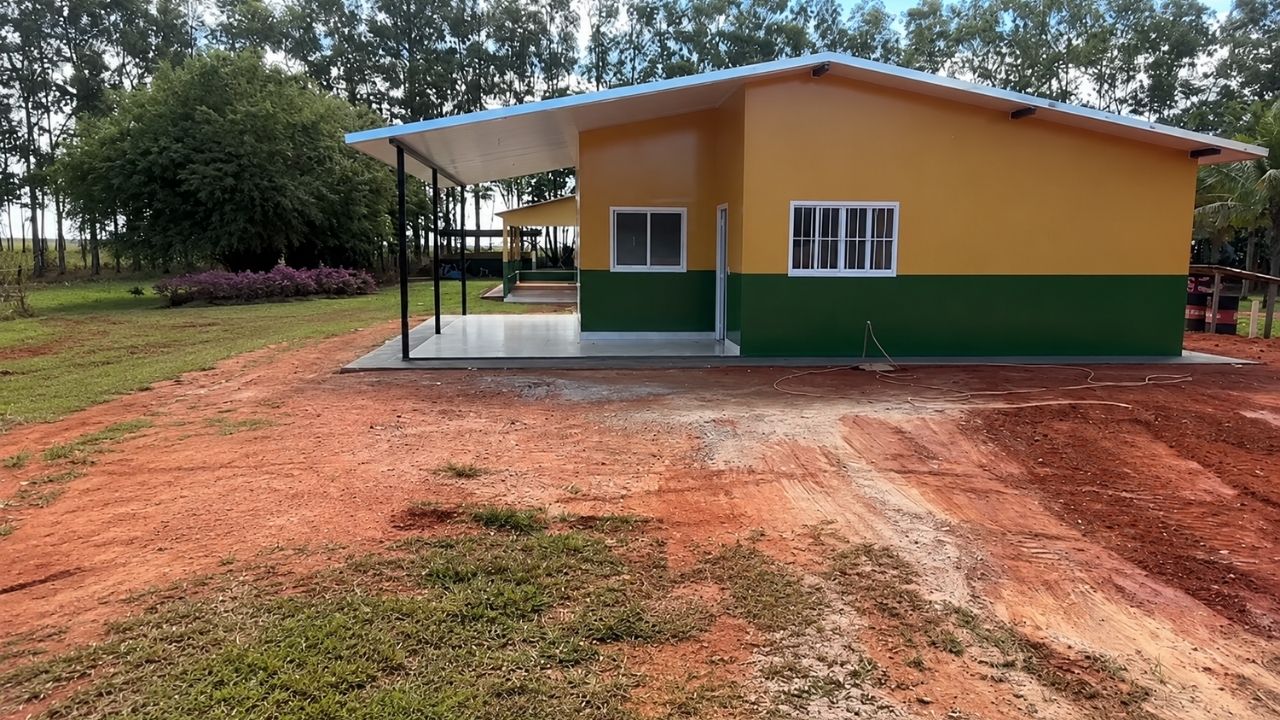
The construction drew attention for replacing conventional masonry with metallic thermal panels filled with PIR, a material used as thermal insulation. The proposal aims to combine quick execution, less waste generation, and a more competitive cost for functional rural housing.
-
Brazilian Researchers Develop Plant Fiber Cement Absorbing 100 kg of CO2 per Cubic Meter, Aiming for Low-Carbon Construction

-
Brazil’s Largest Sewage Plant Boosts Capacity with New High-Performance Pumps, Treating Over 1 Billion Liters Daily
-
Brazilian Mother and Homemaker Becomes Bioconstructor, Builds 24-Ton Earth Dome and Teaches Technique Across Argentina
-
Manchester Builds 40 Furnished Homes for the Homeless Under Railway Arches, Complete with Community Hall, Laundry, Garden, and Sports Court


In practice, the house was designed to be simple, efficient, and easy to maintain. According to the presentation, the panels have a metallic structure on the faces and an insulating core in the middle, while the roof also uses trapezoidal tiles with PIR.
This type of solution can be especially useful on a farm, where the construction needs to meet practical needs and does not always require high-end finishing. The idea is to deliver a residence with thermal comfort, internal organization, and a visual suitable to the property’s standard.
Even with a more industrial appearance, the house was painted in farm colors and received finishes that soften the metallic look. On the outside, the division between the panels is barely noticeable, which helps the property visually resemble a traditional construction.
85 m² Project Designed for Family or Harvest
The residence is 85 m² and was planned as a single-family home. The design includes a kitchen integrated with the dining room, TV room, two bedrooms, bathroom, external laundry, and an L-shaped porch that extends the daily use of the house.
The key feature is the flexibility of the space. The TV room, according to the engineer’s explanation, has a dimension similar to the bedrooms and could be enclosed with a wall and a door if the house needed to function as accommodation.
This configuration allows the property to accommodate a family throughout the year and also host workers during harvest periods. In rural properties, this versatility can be important because the demand for housing changes according to the farm’s operation.
The solution reflects a common logic in the countryside: the house needs to be practical, durable, economical, and adaptable. It is not a luxury project but a functional building for real use in a rural routine.
L-shaped Porch Expands Social Use and Also Shelters Vehicles
The L-shaped porch appears as one of the most interesting elements of the project. It can function as a shelter for a car or motorcycle, but also as a social area on weekends, holidays, or restful evenings.
This outdoor space allows for placing chairs, having a barbecue, or simply enjoying the covered area. On a farm, the porch is often more than just circulation: it becomes an extension of the house and a meeting point.
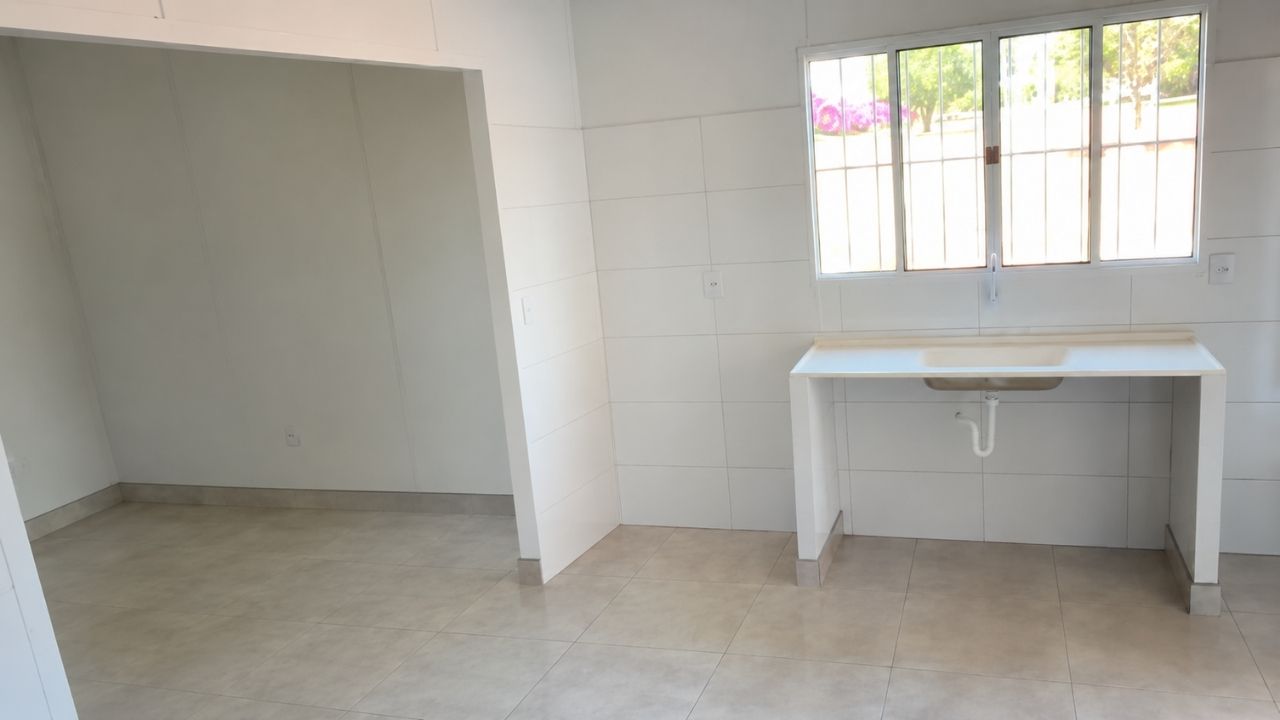
The laundry was also positioned with external access. The environment includes a sink, space for a washing machine, and an area for a cleaning materials storage cabinet, keeping service functions separate from the social area.
Another functional detail is the window in the laundry. The workbench, sink, and machine face the opening, allowing for lighting, ventilation, and visual contact with the outside during use of the space.
PIR Ensures Insulation Without Relying on Slab or Ceiling
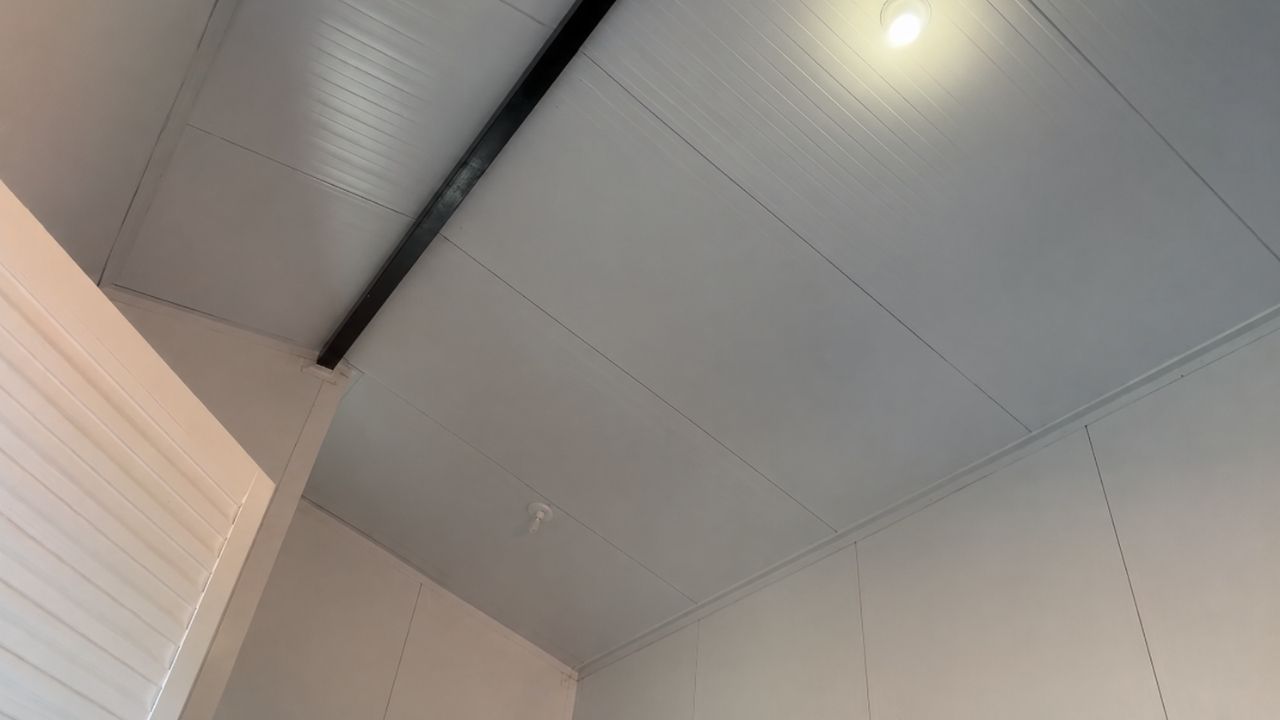
The project does not use a slab or ceiling under the roof. According to the technical explanation, this was possible because the panels and tiles with PIR already provide thermal insulation, reducing the need to create an extra layer for comfort.
The decision is also directly related to rural reality. On farms, slabs and ceilings can accumulate insects, birds, bats, and dirt in hard-to-reach spaces, which leads to maintenance and inconvenience over time.
With the exposed and well-finished roof, the house avoids this type of closed gap. The underside of the tile is visible, and the metal structure is designed not to create open points of accumulation.
The higher ceiling height arises as a consequence of the roof’s slope. Besides the structural function, this provides a visual sense of spaciousness inside, without relying on a traditional slab to organize the ceiling.
Installations were planned before the assembly of the panels
Since the house is assembled with panels, the electrical and plumbing parts need to be well planned before execution. The engineer highlighted that the conduits were embedded inside the panels, instead of leaving loose wires at the junctions of frames or finishes.
This choice facilitates future maintenance. If it is necessary to replace wires or install a new system, the system allows more suitable access, bringing the experience closer to that of a conventional masonry house.
The technical care prevents the speed of construction from turning into improvisation. The proposal for a quick build does not mean giving up planning, especially in installations that can cause problems if poorly executed.
The foundation was made in a slab, with different levels already planned in the concrete. In the bathroom, shower, and transition between the porch and the internal area, the unevenness helps control water and prevent infiltration during wind-driven rain.
Finish seeks a simple but well-resolved appearance
The house received ceramic flooring, conventional baseboards, aluminum doors, and finishes compatible with a functional farmhouse dwelling. The goal is not to create a sophisticated residence but to deliver a clean, organized, and durable set.
The panels allow the application of ceramic coating directly on the surface, which can bring some environments closer to the appearance of a masonry house. This helps reduce the impression that industrial material limits the finish.
The final aesthetic lies between functional rural and well-finished industrial. On the outside, the paint in the property’s colors helps integrate the house with the farm complex, while inside the spaces are simple and straightforward.
The windows in the bedrooms and living room have been fitted with metal shutters, a feature that can eliminate the need for curtains in some uses. This detail helps darken the rooms and can also offer more practicality in accommodations.
Quick construction can be an advantage in rural areas


In rural properties, building quickly can be a necessity. The construction needs to accommodate residents, employees, or temporary teams without creating a long, expensive, and waste-filled site.
The thermal panel house precisely meets this type of demand. Fewer traditional steps, more direct assembly, and integrated insulation can reduce the time and complexity of construction.
Another point is predictability. Since part of the components arrives already manufactured and ready for assembly, the process can be more controlled than a conventional construction, provided the project is well-detailed.
Even so, the model requires correct technical execution. Slab, installations, sealing, metal structure, and finishes need to be planned precisely so that the initial savings do not cause problems later.
Farmhouse shows how the countryside also seeks efficiency
The construction in Jaciara shows that the modern farm does not rely solely on barns, machines, and crops. Rural housing also counts towards efficiency, especially when it needs to accommodate family, workers, and harvest periods.
The use of thermal panels with PIR shows an alternative to traditional masonry for those seeking a quick, economical, and less wasteful construction. The project does not aim to impress with luxury but with practical solutions.
With 85 m², an L-shaped porch, external laundry, two bedrooms, and an adaptable living room, the house was designed for a flexible routine. At times, it can be a family residence; at others, support for rural accommodation.
And you, would you live in a thermal panel house on a farm, or do you still prefer traditional masonry? Leave your opinion in the comments and tell us which model seems safer, more economical, and comfortable for the countryside.