






 Portuguese
  Spanish
  8 min of reading
  0 comments


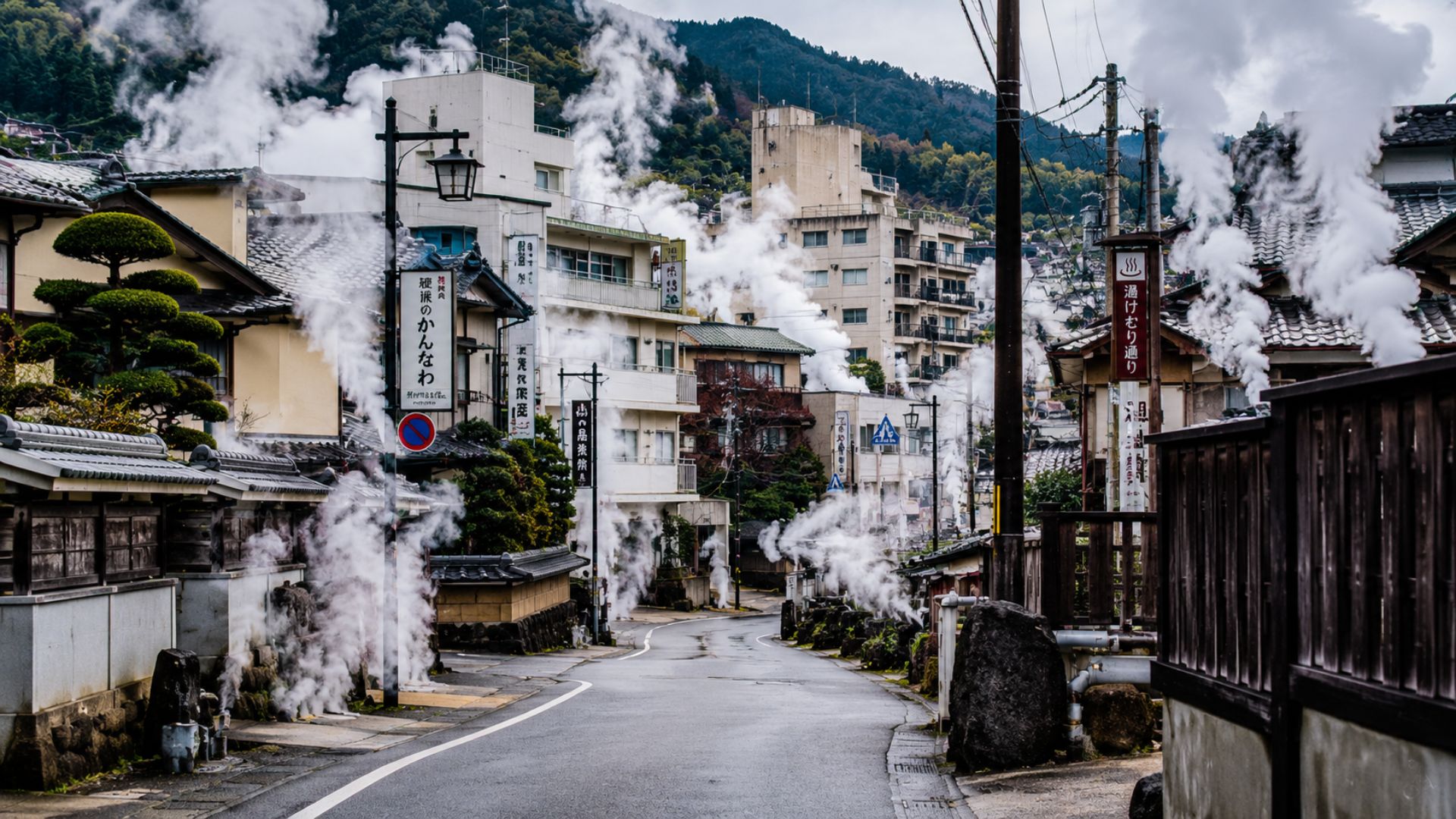
Beppu is the Japanese city nicknamed the Japanese Hell due to the impressive local geothermal activity. The municipality is home to more than 12 active hot springs, considered the largest concentration in Japan, with hot water naturally emerging from the ground, from the pipes of ordinary residences, and even from manholes in the central streets.
The image of traditional Japan often blends ancient temples, cherry blossoms, and Tokyo’s futuristic technology. There is, however, a lesser-known destination among international tourists that offers a completely different experience, and this Japanese city called Beppu is located on the coast of Kyushu island, south of the archipelago, and is locally nicknamed the Japanese Hell.
The reason for the name appears right at the exit of the train station. Water at almost 100 degrees Celsius gushes directly from the ground, smoke rises from manholes on the sidewalks, and even the pipes of ordinary residential houses release steam into the open air, a landscape that looks like a fiction script, but is part of the daily routine of the region’s residents.
Why Beppu earned the nickname Japanese Hell

The name causes strangeness at first glance, especially for visitors from countries with a Christian tradition. The explanation lies precisely in this cultural difference, as the concept of hell in local Japanese religion does not have the same demonic connotation as in the Western tradition.
-
Federal Police involved in the case to identify the person responsible for hacking the Civil Defense system, which sent ten false alerts, frightened residents of different capitals, and turned messages about real risks into notifications with “misanthropy” and even alien attacks.

-
Extreme drought causes ghost village to reappear at the bottom of the reservoir that supplies Athens, revealing houses, a school, and ruins swallowed since the 1980s as the lake shrinks and exposes the water crisis threatening the capital of Greece.

-
An entire village lay asleep at the bottom of a lake for 3,000 years: divers suction sediments in Italy and reveal more than 600 wooden stakes, bronze tools, and traces of a Bronze Age settlement hidden underwater.
-
They call it the “Shopee house” and even cardboard, but the R$ 20,000 house is a certified Wood Frame from Alea, financed by Minha Casa Minha Vida: understand if it’s worth more than masonry.


The idea of hell in Beppu refers to the extreme heat and constant smoke that appears throughout the city. The geothermal activity is so intense that it gives the place the appearance of a supernatural setting, with steam coming out of unexpected points at any time of day, in streets, sidewalks, gardens, and facades of old residential houses.
Even with the strong name, the city embraces the nickname as a tourist attraction. Shops sell cute devil souvenirs, and the main tourist spots are officially called Jigoku, a Japanese word that means exactly hell in direct translation to English.
The geological explanation is simple and impressive. Japan is a country with intense volcanic activity throughout almost its entire territory, and Beppu is located in a region where this activity reaches above-normal levels, generating the largest concentration of hot springs in the entire country in a single location.
More than 12 hot springs and the famous public onsens

The scale of geothermal activity in Beppu impresses even those who have seen other thermal regions in the world. Local estimates point to more than 12 active hot springs within the municipality, a number that places the Japanese city in a unique position within the national territory.
Each of these springs feeds the so-called onsens, public hot baths that have been part of Japanese tradition for centuries. Onsens are considered an essential part of local culture and function both as hygiene spaces and as points of relaxation and socialization among neighborhood residents.
The difference of Beppu compared to other Japanese cities with onsens lies in the quantity and variety of options. There are communal baths, private spaces for couples or families, mixed options, gender-separated options, and even small free community pools scattered along the sidewalks of the central streets.
Entry to these public baths is usually very affordable. Some simpler options charge only about 100 yen, equivalent to approximately 3 reais at the current exchange rate, a value that gives local residents the privilege of taking daily hot baths in natural springs without any additional cost for electric or gas heating.
The freedom with tattoos that makes Beppu different


Another reason makes Beppu especially attractive to foreign tourists. Most traditional Japanese onsens prohibit people with tattoos from entering, a cultural rule based on the historical association between tattoos and the yakuza, the old Japanese mafia.
In Beppu, flexibility is greater than the national average. A good portion of the city’s thermal baths accept tattooed visitors without restriction, a characteristic that changes the game for many Western tourists who love onsen culture but are often turned away in other Japanese locations.
This cultural openness transforms Beppu into a special destination for those traveling with large tattoos or tattoos in places difficult to cover with stickers. In other cities, it’s common to have to cover body marks with medical tape, a rule that only works for small, isolated tattoos, without being able to cover designs on entire backs, arms, or legs.
The city’s more open policy reflects the municipality’s tourist character. As Beppu’s economy relies on thermal tourism, there is a local effort to welcome diverse visitors without unnecessary barriers, a stance reflected in the number of different onsens offered by the region’s public and private networks.
Cuisine cooked in the natural steam of hell
Another peculiarity of the Japanese city lies in its local cuisine. Several restaurants in Beppu take advantage of the natural heat from the thermal springs to cook food directly in the steam rising from the ground, a technique called Jigoku Mushi.
The method is traditional and centuries-old. Foods are placed in bamboo baskets and exposed directly to the steam rising from the thermal springs, reaching temperatures close to 100 degrees Celsius, a perfect environment for cooking vegetables, fish, eggs, and meats without losing the original flavor of the ingredients.
In some restaurants, the customer cooks their own meals. The establishment provides the structure with the steam vent and a timer to mark the correct cooking time for each food, creating an interactive experience that blends gastronomy with scientific curiosity in a single meal.
Typical dishes include sweet potato, pumpkin, broccoli, corn, various meats, stuffed dumplings, and rice wrapped in a vegetable leaf. The leaf plays an interesting role in preparation, transferring its flavor to the rice during cooking, a result that eliminates the need for any additional seasoning and maintains the natural character of the local cuisine.
The seven Jigoku that are official tourist spots
For those visiting Beppu, there are seven officially named Jigoku tourist spots that operate as paid attractions. Each charges about 500 yen for individual entry, and there is a combined pass for all seven for 2,400 yen.
The Jigoku display different forms of local geothermal activity. One of them offers a geyser that erupts at regular intervals, with jets of water that could reach 30 meters in height if there wasn’t a ceiling controlling the spray installed for visitor safety reasons.
Other Jigoku show bubbling mud in different colors. The water from each spring takes on specific hues according to the mineral composition of the subsoil, creating red, blue, brown, or whitish lakes, a landscape that looks like an abstract painting viewed from above.
There are also spots where visitors can drink thermal water directly from the source, after paying 10 yen for a disposable cup. The drink has a strongly salty taste, similar to homemade saline solution, and consumption in large quantities can cause digestive problems, a warning that is usually indicated on local signs spread throughout the Jigoku area.
The magic of smoke and the scientific explanation
At some of these tourist spots, a local guide performs demonstrations that seem like magic. The professional can make special smoke appear in the air with simple gestures, a spectacle that usually impresses unsuspecting visitors.
The technical explanation involves physical principles similar to cloud formation. The phenomenon occurs when warm, humid air encounters specific temperature and pressure conditions, generating visible condensation that creates the effect of magical smoke appearing out of nowhere for the audience.
Historically, this type of demonstration may have helped ancient leaders establish themselves as powerful spiritual figures. A master who had mastered the technique centuries ago could have been seen as a wizard, sorcerer, or even a deity, mobilizing entire communities based on natural phenomena that seemed supernatural to those who didn’t know the scientific explanation.
The presentation is still taken seriously by the professionals who conduct the tours. Even with the technical explanation available, the skill requires training, knowledge of the correct times for geothermal activities, and mastery of the exact points where the magic works best, transforming science into a tourist spectacle.
Accessibility, transport, and how to get to the city
Despite being far from Japan’s major tourist centers, Beppu is relatively accessible for those with an international train pass. The Japanese city is about 1,000 kilometers from the main tourist routes, a distance covered by bullet trains in approximately 6 hours of travel.
Local public transport works with a card. The same card used on the Tokyo subway is accepted on Beppu buses, and some lines even accept international credit cards like Visa and Mastercard, a convenience that helps foreign tourists unaware of the destination’s specific logistics.
Accessibility within the city also positively impresses. Beppu surprises visitors with its infrastructure adapted for wheelchair users, with free thermal baths prepared to receive people with mobility difficulties, a policy not always found in other thermal cities around the world.
The total cost of the experience is also considered accessible. Private one-hour baths can cost around 400 yen per person, which is approximately 75 reais per couple, a value similar to a meal at an American fast food chain, but which delivers much more cultural experience to the visitor.
Daily life between hot pipes and steaming manholes
For Beppu residents, geothermal activity is an invisible part of their routine. Most houses have plumbing that uses natural hot water directly from the ground, eliminating gas or electricity costs for heating bathrooms and kitchens.
The result is a differentiated household economy. Families do not need to pay water heating bills, an economic advantage that remains year after year and helps explain the popularity of onsens among local residents, who make hot baths a part of their daily neighborhood routine.
The counterpart of this domestic use appears in the air vents scattered throughout the streets. Houses need to release excess steam at some point, creating those characteristic wisps of smoke that rise from external pipes, manholes, and even small chimneys installed in gardens and backyards.
Beppu is, therefore, a rare case in which the planet’s geological activity enters urban routine naturally. The city has learned to live with the constant boiling of the subsoil and transform it into economy, tourism, gastronomy, and culture, a formula that makes the destination unique among all Japanese cities that receive foreign visitors in search of authentic experiences.
And you, would you like to visit this Japanese city where boiling water comes directly from the streets, house pipes, and manholes, and where residents have transformed geothermal activity into part of daily life?
Tell us in the comments if you would be willing to take a bath in a communal onsen following the Japanese tradition of being completely naked, if you have ever visited a thermal region in Brazil or abroad similar to Beppu, and what geothermal experience you would like to have if you were to spend an entire week in the so-called Japanese hell. The discussion helps to understand how Brazilians view these trips off the conventional tourist route of present-day Japan.




Be the first to react!