Portuguese
  Spanish


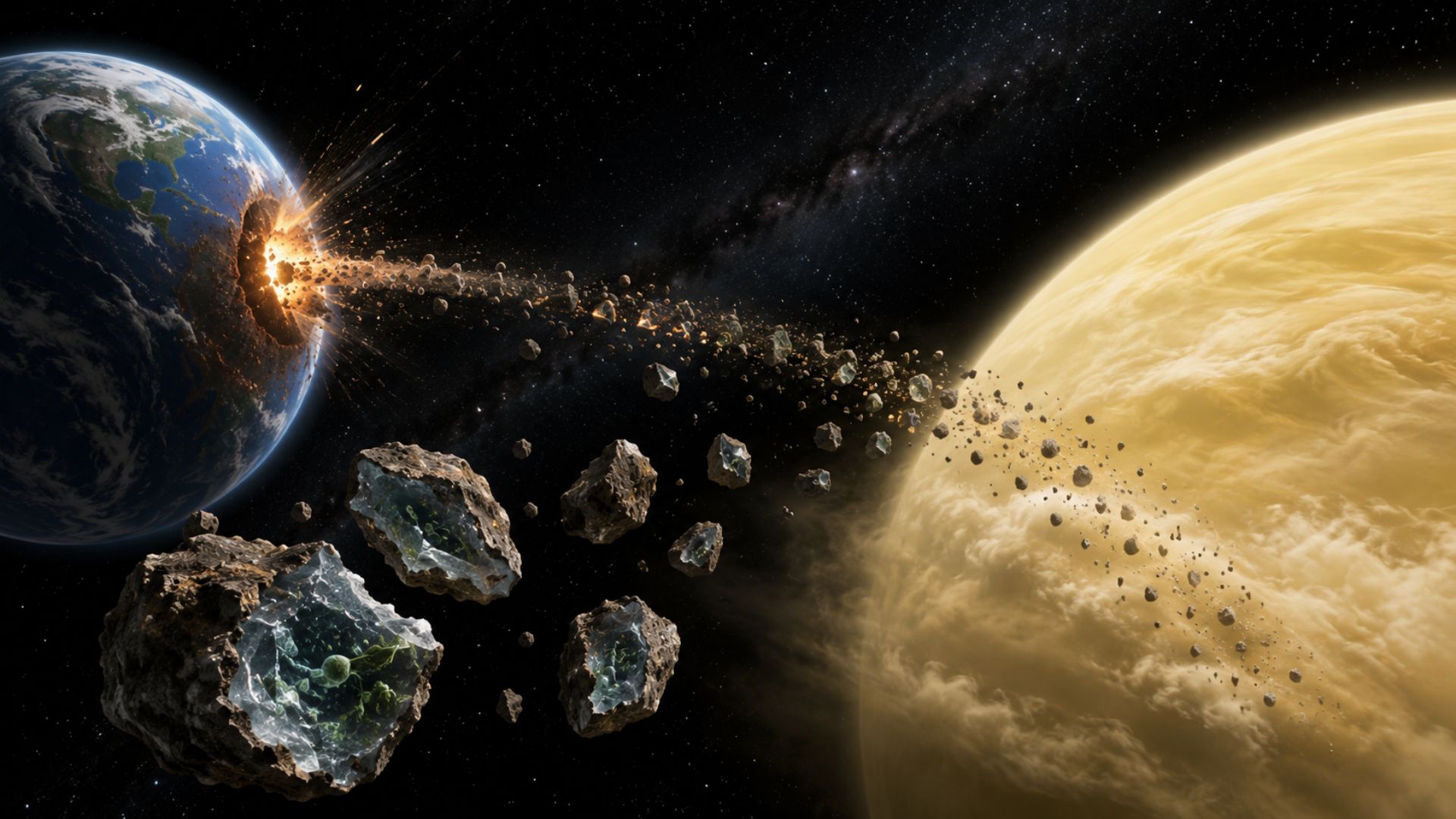

The idea is breathtaking: collisions on Earth would hurl rocks with dormant bacteria that would cross space and reach the neighboring planet. But it’s just a mathematical model, and no one has found life on Venus to date. The team itself admits that the uncertainties are enormous, as in the famous Drake equation.
A study published by American researchers raises the hypothesis that Earth may be seeding life in the clouds of Venus. According to the modeling, asteroid impacts on our planet could eject microbes that would survive protected within rocks until reaching Venus’s atmosphere, although it is crucial to highlight that no form of life has been confirmed on the neighboring planet to date.
The work, titled “A Panspermia Origin for Venus Cloud Life,” was published on March 31, 2026, in the scientific journal Journal of Geophysical Research: Planets and presented at the 2026 Lunar and Planetary Science Conference. Before proceeding, the most important warning: this is a theoretical study, based on mathematical models and full of uncertainties acknowledged by the authors themselves. In other words, it is a fascinating possibility, not the discovery of life on Venus, something that remains without any proof.
What the hypothesis says about Venus

The study investigates whether the so-called panspermia, the transfer of life from one planet to another via asteroids, comets, and space debris, could carry microbes from Earth to the clouds of Venus, something that had never been thoroughly investigated for present-day Venus, according to the researchers from the involved American institutions.
-
Stingless Bee Honey from Brazil Can Cost Up to $120 a Liter, Surprises with Flavors of Wood, Citrus, and Even Cheese

-
Woman Claims to Have Spotted a Technical Pattern in Recent FIFA Tournaments, Predicts Possible World Cup Winner
-
Chevrolet Offers Chance to Win a 2026 Sonic RS for Free via WhatsApp
-
Earthquake vs. Tsunami: Which Causes More Destruction and Why One Can Be Even More Dangerous


The calculation presented is impressive: the model estimates that, every billion years, about a billion tons of material would be ejected from Earth and delivered to Venus’s atmosphere.
It is important, however, to approach these numbers with caution, as they are estimates generated by simulations that, as the authors themselves acknowledge, simplify many aspects of reality and carry large margins of uncertainty.
An Unlikely Journey Inside the Rocks
The most curious point of the hypothesis is how life would survive the journey.
According to the model, extremophile microbes, organisms accustomed to extreme conditions, could enter a deep dormancy state inside the ejected rocks, using the mineral interior as a natural shield against space radiation during the long journey to Venus, preserving their vital functions.
Upon reaching Venus’s atmosphere, these fragments would undergo intense fragmentation and heating, and the friction with the gases would disperse the material through the higher layers.
The hypothesis points to the cloud layer located about 50 to 60 kilometers in altitude, where the pressure and temperature resemble those on Earth’s surface.
Even so, surviving the journey is one thing, thriving in the new environment is quite another, as we will see.
The “Equation of Life” Behind the Calculations


To reach their conclusions, the team resorted to a specific tool.
The researchers used the so-called Venus Life Equation, a model created in 2021 and inspired by the famous Drake Equation, which is used to estimate the possibility of intelligent civilizations in the galaxy, by breaking down a complex problem into smaller, more manageable factors, such as the origin, robustness, and continuity of life.
But this is where one of the greatest cautions that the news requires lies.
Just like the Drake Equation, this formula depends on variables that are still largely unknown, meaning that its results are exercises in probability, not concrete measurements.
The authors are explicit in stating that each parameter is subject to deep uncertainties, reinforcing that the study opens a discussion but is far from providing a definitive answer.
Why No One Can Say There Is Life on Venus
This is the warning that needs to be absolutely clear to the reader.
So far, no form of life has been detected or confirmed on Venus, and the study does not claim otherwise: it merely calculates that if life is ever found in the Venusian clouds, there is a chance it came from Earth, rather than having originated there independently.
There is still an important obstacle pointed out by the research itself: the amount of water available in the droplets that form the clouds of Venus would be less than the necessary limit for life as we know it on Earth.
In other words, even if microbes reach there, there is no guarantee that they could survive and multiply, which keeps the question completely open and in the realm of scientific speculation.
What this changes for the search for life in space
Despite all the caveats, the hypothesis has interesting implications for science.
If future exploration missions actually find signs of life in the clouds of Venus, scientists will have to consider the possibility that these organisms share the same genetic code as terrestrial life, rather than representing a completely independent biological origin, which would change the way the discovery is interpreted.
The study also raises a practical point about planetary protection, the set of precautions to avoid contaminating other worlds with terrestrial microbes brought by probes.
Currently, Venus is in a category of low biological cleanliness requirement, and the work suggests that this topic might deserve new discussions, even though the classification has not been formally changed until early 2026. It is worth remembering that panspermia is historically more debated between Earth and Mars.
The hypothesis that Earth might be seeding life on Venus is one of those scientific exercises that combine mathematical rigor and imagination, broadening our view of how life could, in theory, travel through the Solar System.
Even so, the most important message is one of caution: it is a theoretical model, full of uncertainties, and not a proof that there are microbes on Venus.
Until future missions go there to investigate closely, life on the neighboring planet remains one of the great open questions of astrobiology, now with an additional chapter to spark curiosity.
And you, what do you think of the hypothesis that life on Venus, if it exists, may have come from Earth? Do you believe we will find some type of microbe on other worlds in the Solar System? Leave your comment, tell us what this idea awakens in you, and share the article with those who love astronomy, space, and the mysteries about the origin of life.