





 Portuguese
  English
  Spanish
  5 min of reading
  0 comments


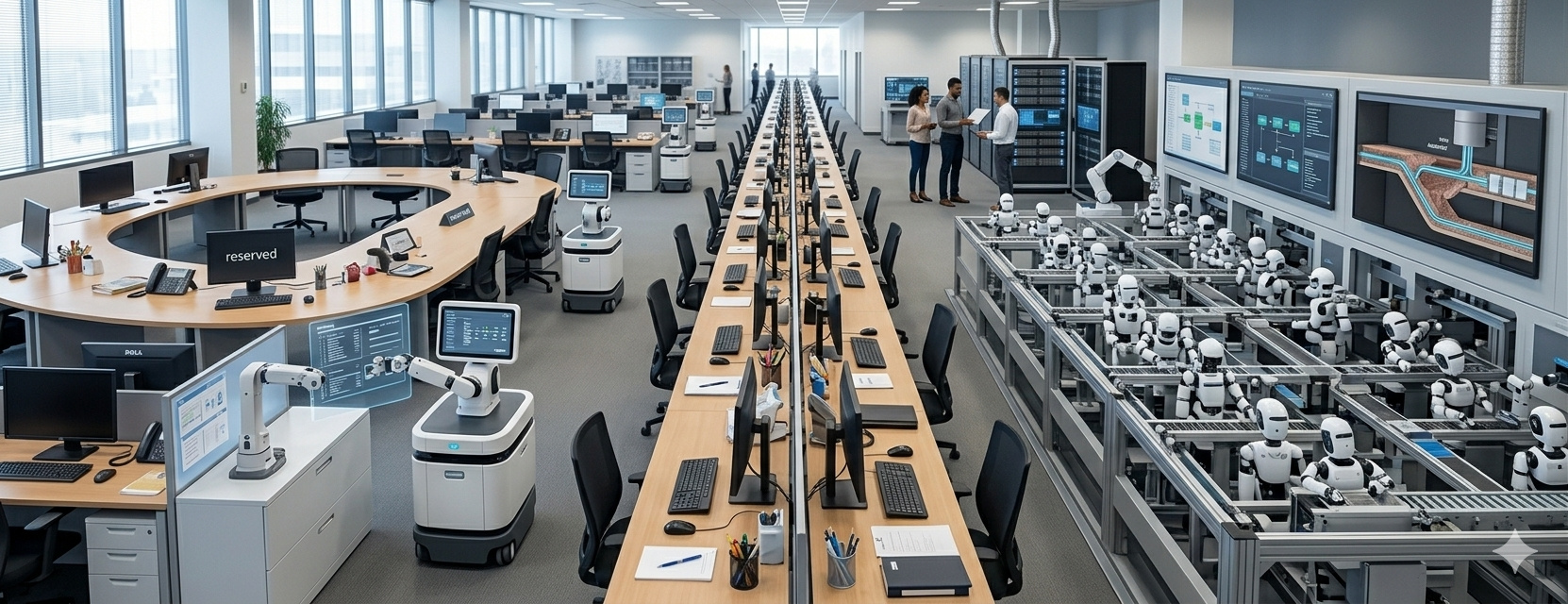
BT announced job cuts of up to 55,000 by 2030 and the use of artificial intelligence could eliminate 10,000 positions in a major restructuring in the United Kingdom.
In 2023, BT Group plc officially announced, during the presentation of its annual results in London, a plan to reduce its total workforce from 130,000 to somewhere between 75,000 and 90,000 by 2030. At the time, then-CEO Philip Jansen stated that the company would operate with a much leaner structure, in a move that quickly resonated in the market and international press. The plan aimed to eliminate up to 55,000 positions, including contractors, in a restructuring linked to the advancement of digitalization, the simplification of operations, and the increasing use of technologies such as automation and artificial intelligence.
According to a Reuters report, around 10,000 positions could be replaced by automation and AI, while another 10,000 would no longer be necessary with the operation of more efficient digital networks, particularly affecting areas such as network engineering and customer service. The magnitude of the cuts places BT at the center of a global movement where large companies are redesigning their structures based on automation, digitalization, and operational efficiency.
Artificial intelligence and automation begin to replace human processes on a large scale
CEO Philip Jansen himself stated that BT will be “a huge beneficiary of artificial intelligence,” highlighting that the technology will enable productivity gains and reductions in operational costs across various areas of the company.
-
Scientists in Saudi Arabia create an “electricity-free refrigerator” that uses a chemical reaction to lower the temperature from 25°C to 3.6°C in 20 minutes and then uses the sun itself to restart the system without a compressor, outlet, or generator.

-
MIT study creates method to search for dark matter in gravitational waves and finds possible evidence in black hole signal

-
After 107 years at the bottom of the Atlantic, divers find the wreck of the Tampa, a World War I ship torpedoed with 131 people on board.
-
Scientists test 24 million routes and discover the most economical way to reach the moon using less fuel




In practice, this means that functions traditionally performed by humans are being progressively replaced by automated systems. This includes everything from customer service centers, where chatbots and automated response systems are gaining ground, to technical operations that can be monitored and managed by algorithms.
However, it is important to highlight that this replacement does not occur immediately or absolutely. A significant portion of the cuts will come from the so-called natural reduction of the workforce, through the non-replacement of positions and retirements, combined with the gradual adoption of new technologies.
Still, the impact of artificial intelligence is direct: it reduces the need for labor in repetitive, operational, and support functions.
Restructuring is also linked to the end of technological cycles and infrastructure projects
Another central factor in understanding the extent of the cuts is the closure of important technological cycles within the company. BT has been completing large infrastructure projects, such as the expansion of fiber optic networks and the decommissioning of older technologies, such as 3G networks.
These movements naturally reduce the need for certain types of professionals, especially engineers and technicians linked to technologies that are being replaced or have already been implemented.
Furthermore, the company seeks to simplify its organizational structure by eliminating redundancies and integrating areas that previously operated separately. This shows that the cuts are not motivated solely by artificial intelligence, but by a combination of technological, operational, and strategic factors.
Cost reduction and efficiency increase are at the center of the strategy
BT’s restructuring is directly linked to the need to improve margins and increase competitiveness in an increasingly cost-pressured and competitive sector.
Telecommunications companies face high investments in infrastructure while needing to offer faster, more stable, and accessible services. In this context, reducing operational costs becomes essential.
The adoption of artificial intelligence and automation allows the company to operate with fewer human resources while maintaining or even increasing efficiency. This includes network optimization, automation of internal processes, and improvement in customer service through digital systems. The logic is clear: do more with less, using technology to replace processes that previously relied on large teams.
Social and economic impact raises concerns in the United Kingdom
The scale of the cuts announced by BT has raised significant concerns in the United Kingdom, especially regarding the impact on the labor market.
The elimination of up to 55,000 jobs represents one of the largest workforce reductions ever announced by a British company. This raises questions about the future of employment in highly technological sectors and the ability to absorb these workers in other areas of the economy.
Experts point out that many of the affected professionals will need to undergo reskilling processes to adapt to new market demands, especially in areas related to technology and digital services. The case of BT exemplifies a broader phenomenon: digital transformation is creating new opportunities but also rapidly eliminating traditional roles.
BT movement reflects global trend of workplace transformation
BT’s decision is not isolated. Companies across various sectors, especially technology, telecommunications, and services, have been adopting similar strategies, reducing headcounts and investing in automation.
Global giants have announced cuts of thousands of jobs in recent years, often associated with the adoption of artificial intelligence and the digitization of processes.
This movement indicates a structural change in the labor market, where skills related to technology, data analysis, and system development are becoming increasingly important, while operational and repetitive roles are losing ground.
The restructuring of BT is a clear example of how artificial intelligence is no longer just a promise but is beginning to have a direct and measurable impact on employment.
Company bets on a new slimmer and more technological phase
With the reduction of the workforce and the adoption of new technologies, BT aims to position itself as a more agile, efficient company, prepared for future challenges.
The strategy includes a focus on digital services, expansion of high-speed networks, and intensive use of data to enhance the customer experience. The company’s expectation is that by the end of the restructuring process, it will be more competitive in an increasingly dynamic and technological market.
This transformation represents not only an internal change but a redefinition of the company’s role in the telecommunications sector.
What this change reveals about the future of work and how you see this advance of AI
BT’s decision to cut up to 55,000 jobs and incorporate artificial intelligence on a large scale raises a central question about the future of work. If large companies can replace a significant part of their operations with technology, the impact on the labor market could be profound and lasting.
At the same time, digital transformation creates new opportunities, requiring rapid adaptation from professionals and institutions.
The case of BT shows that artificial intelligence is no longer a distant trend but an active force that is reshaping entire sectors of the economy.
In light of this scenario, an inevitable reflection arises: to what extent will automation and artificial intelligence redefine the balance between technology and human work in the coming years?







Be the first to react!