Portuguese
  Spanish


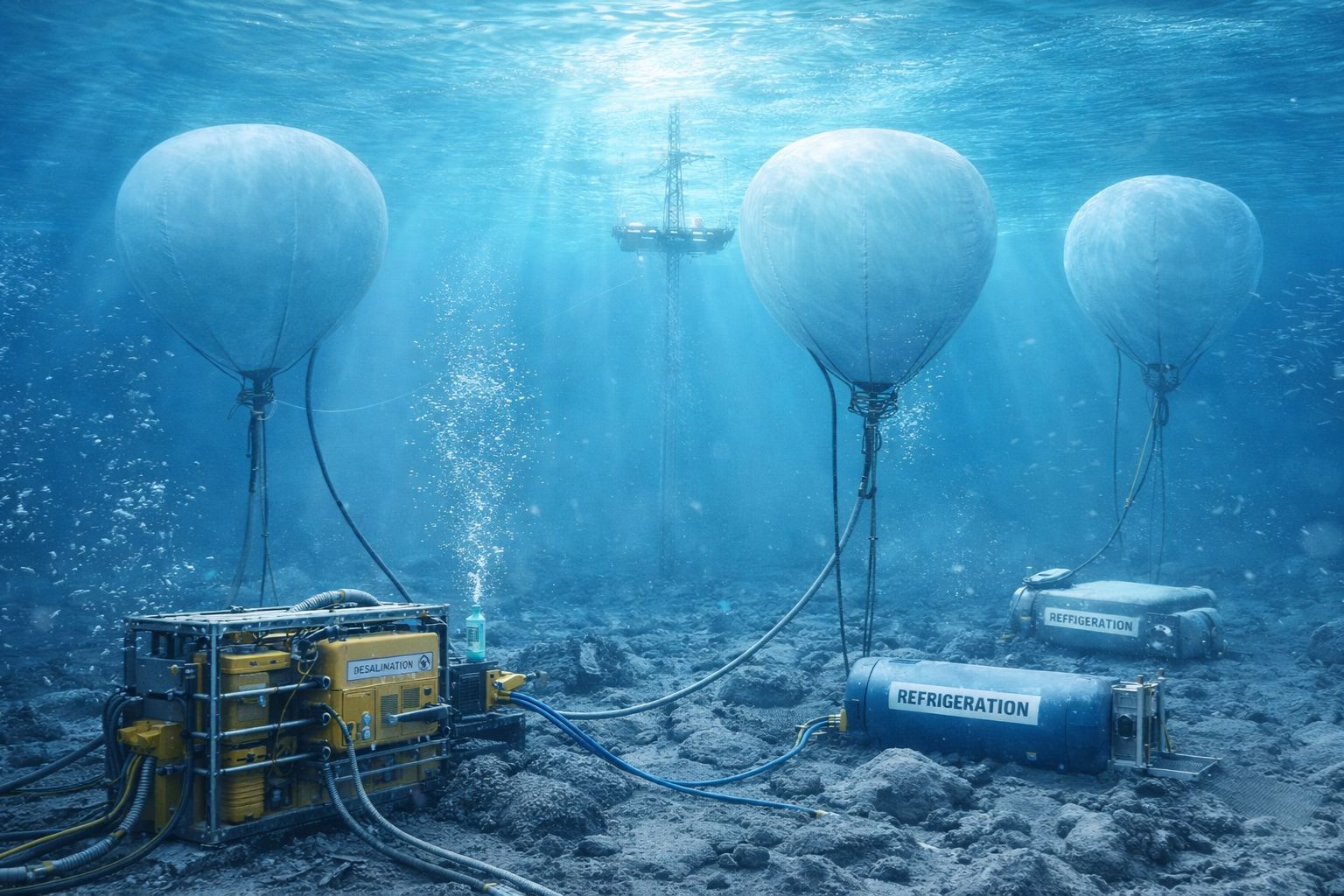


Researchers proposed to anchor gas storage balloons on the seabed and use hydrostatic pressure to compress air that then generates electricity. The UWCAES technology does not take up space on islands, stores energy for long periods, and also produces heat for desalination and cold for refrigeration as byproducts of the process.
Imagine giant balloons anchored to the seabed, inflated with air compressed by the water pressure itself, functioning as clean batteries that can power entire islands. This is not science fiction; it is the system proposed by researchers led by Qiang Lu, who published the results in the Journal of Renewable and Sustainable Energy in 2026. The method works by placing gas storage balloons deep in the ocean and allowing hydrostatic pressure to naturally compress the air inside them, creating a reserve of energy that can be released when the island needs electricity. “This technology makes intelligent use of the natural physical characteristics of the marine environment,” Lu explained.
The system was designed to solve a specific problem: islands do not have space to store energy on a large scale on land, and renewable sources like wind and solar are intermittent. Submerged balloons eliminate the space limitation by transferring storage underwater, where the available area is virtually unlimited. In addition to generating electricity, the heat recovered during the compression of air in the balloons can be used to desalinate seawater, and the cold energy generated by the expansion can be used for refrigeration. Lu emphasized that the technology “enables an integrated supply of electricity, drinking water, refrigeration, and heating.”
How submerged balloons store and release energy

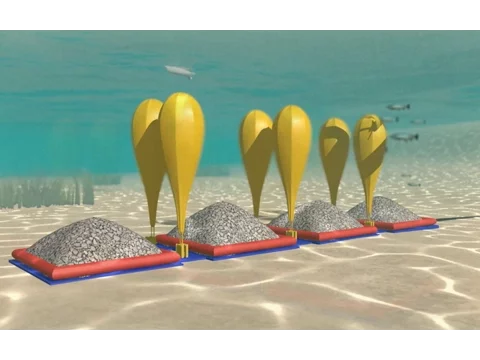
The operation of underwater storage balloons follows an elegant physical principle. When there is excess renewable energy available on the island, this energy is used to pump air into the balloons anchored on the seabed. Hydrostatic pressure, which increases proportionally with depth, compresses the air inside the balloons without additional energy cost, storing energy in the form of mechanical pressure.
-
Almost 1 billion euros, two gigafactories, and a million-dollar public investment, Chinese company aims to turn Spanish city into Europe’s new battery hub.

-
Advancement in the industry: Brazilian company creates ultralight material comparable to steel and paves the way for hydrogen cylinders up to 70% lighter, with a direct impact on logistics, the energy industry, and national competitiveness – learn about Forza Composites

-
In Brazil’s backyard: Tesla, by Elon Musk, announces official operations in Uruguay, where electric vehicles already make up 20% of new cars but still leaves out the largest market in the region.

-
This Mars rover may finally reveal if life ever existed on Mars.


When the island needs electricity and renewable sources are not generating, the compressed air inside the balloons is released and passes through turbines that convert pressure energy into electricity. The process reverses the charging cycle: instead of using energy to inflate the balloons, the energy stored in the form of compressed air returns to the system as electric current. The efficiency of this cycle is significantly improved by the natural pressure of water, which does the compression work for free that would require electric compressors in land-based systems.
Why submarine balloons are the ideal solution for islands
Islands face a triple limitation that makes energy management particularly challenging. Land space is scarce and contested between housing, agriculture, and infrastructure. The distance from the mainland complicates the import of fuels and connection to stable electrical grids. And the most viable renewable sources, wind and sun, are inherently intermittent, generating excess energy at some times and none at others.
Submerged balloons tackle these three limitations simultaneously. They do not occupy island land because they remain on the seabed, store energy for long periods with stability, and absorb the excess from renewable sources to release it when demand exceeds generation. Researcher Qiang Lu emphasized that the technology “does not occupy any valuable space on the islands,” a decisive advantage for island communities where every square meter of land competes among vital needs.
The combination that researchers found works best with the balloons

The research team did not rely solely on submerged balloons as an isolated solution. They compared three different energy scenarios for islands, combining wind, photovoltaic, wave energy, conventional batteries, and the UWCAES system of submerged balloons. The result indicated that the ideal combination is to use the balloons alongside lithium batteries, as the two technologies perfectly complement each other.
The reason is that each system has a different specialty. Batteries respond quickly to demand variations, providing almost instantaneous energy when a consumption peak occurs, such as when hundreds of households turn on air conditioning at the same time. Submerged balloons, on the other hand, store large volumes of energy for long periods, covering situations where the sun does not shine for several consecutive days or the wind stops for a week. Together, the two systems eliminate both short-term fluctuations and long-term gaps.
The extra benefits that submarine balloons generate beyond electricity
The generation of electricity is just one part of what submerged balloons can offer. During the air compression process, heat is generated as a byproduct, and this heat can be recovered and channeled to desalination systems that convert seawater into drinking water. For islands that rely on importing fresh water or energy-intensive desalination plants, this secondary benefit is as valuable as electricity itself.
In the reverse phase, when the compressed air is expanded in the balloons to generate electricity, the expansion produces cold. This cold energy can be harnessed for food refrigeration, fish storage, and climate control, reducing the need for compressors and air conditioning units that consume electricity. Subaquatic balloons transform what would normally be thermodynamic waste into usable resources, creating an integrated system that meets multiple needs with a single mechanism.
The strategic potential of submerged balloons for the maritime economy
Researcher Qiang Lu placed balloon technology in a broader context by stating that, “given the goals of reducing carbon emissions and achieving carbon neutrality, this technology can drive the transformation of islands into a zero-carbon economy.” Subaquatic balloons are not just a technical solution for energy storage; they are a platform that can enable an entirely new economic model for island communities that currently depend on imported fossil fuels.
If balloon technology moves from theory to large-scale implementation, thousands of islands around the world could become energy self-sufficient using only the sun, wind, and the natural pressure of the sea that surrounds them. The study, published in 2026, still needs validation on a real scale, but the concept is robust enough to attract the attention of engineers and policymakers seeking alternatives to the diesel that currently powers most of the world’s islands.
Scientists want to anchor giant balloons on the seabed to store clean energy for islands. Do you think this technology has a future? Would it work on Brazilian islands like Fernando de Noronha? Share your opinion in the comments.