






 Portuguese
  Spanish


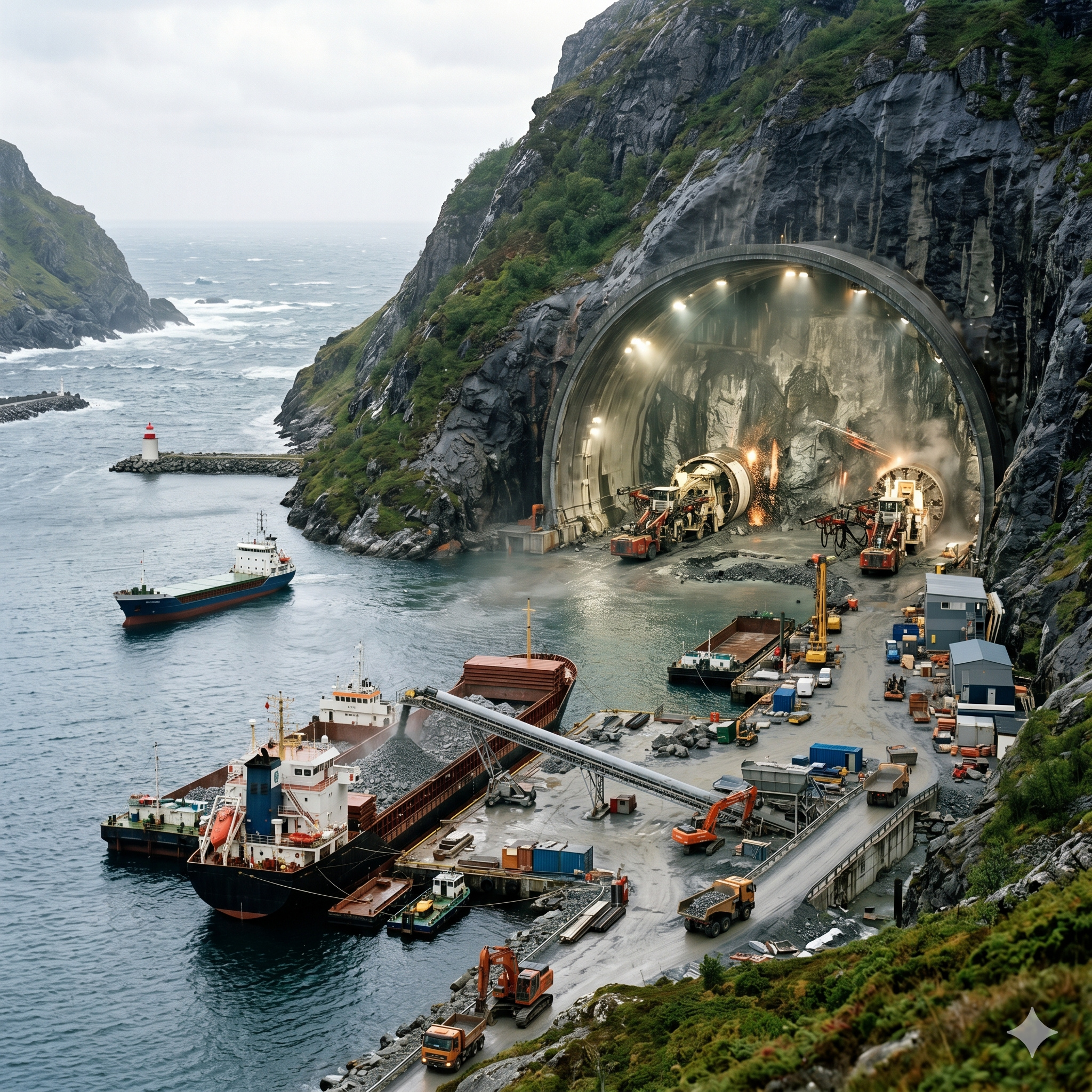


Naval tunnel in Norway to excavate 3 million m³ of rock to allow safe passage for ships and avoid one of Europe’s most dangerous maritime areas.
In one of the most challenging stretches of European coastal navigation, the Stad Ship Tunnel, designed by the Norwegian Coastal Administration (Kystverket), was conceived to address a historical problem on Norway’s coast: the crossing of Stadhavet, described by the maritime authority itself as the most exposed and treacherous stretch of sea on the entire Norwegian coast. According to the project’s official page, updated by Kystverket in March 2026, the tunnel was planned to create a safer passage in the Stad region and is expected to become the world’s first full-scale maritime tunnel.
The project is located on the Stadlandet peninsula, at the narrowest point between Moldefjord and Kjødepollen, where vessels currently have to navigate around a stretch of open sea directly exposed to the North Atlantic, without the natural protection of the fjords that characterizes much of the Norwegian coast. This geographical configuration intensifies the simultaneous action of waves, currents, and winds, creating a notoriously difficult and sensitive navigation scenario for maritime traffic.
On the same official basis, Kystverket states that the central objective of the undertaking is to improve the navigability and safety of maritime transport around Stad, eliminating a historical bottleneck in an area that has challenged ships, operators, and coastal authorities in Norway for decades.
-
China’s Engineered Bamboo: The “Material of the Future” Stronger Than Steel and a Sustainable Wood Alternative

-
Egypt’s “New Nile”: 170 km Artificial River Aims to Turn Desert into Farmland, but Water Supply Concerns Loom
-
Unable to secure a mortgage as a self-employed single mother, she designed her own floating home from a 20-meter boat and now lives “off-grid” with her two children and solar panels on an English canal.
-
Man Transforms Rusty Shipping Container into Luxury Home with Insulated Walls, Large Windows, and Drywall Finish, Surprising Onlookers



1.7-kilometer excavation will require removal of 3 million cubic meters of rock
The Stad Ship Tunnel will be a structure excavated directly through the solid rock of the peninsula, approximately 1.7 kilometers long, creating a navigable passage that connects two protected coastal areas: Moldefjord and Kjødepollen.
To make this work feasible, the project foresees the removal of approximately 3 million cubic meters of rock, a volume equivalent to hundreds of thousands of loaded trucks.


The tunnel section was designed with sufficient dimensions to allow the passage of medium-sized commercial vessels. The structure will be approximately 50 meters high and 36 meters wide, dimensions that ensure safe space for ships to operate within the excavated channel.
This scale transforms the project into something unprecedented in modern maritime engineering, as it is not a road or railway tunnel, but a navigable passage excavated in solid ground.
First attempt to create a full-scale naval tunnel for commercial navigation
Although artificial canals and small rock-cut passages for vessels exist, the Stad Ship Tunnel is often described as the first full-scale naval tunnel designed specifically for continuous commercial traffic.
Unlike traditional canals, which generally follow sea level and require open horizontal excavations, the Stad Ship Tunnel will be completely enclosed and protected from external conditions.
This means that ships will be able to cross the peninsula without being exposed to waves, wind, or currents, navigating in a controlled environment.
The proposal represents a paradigm shift in how maritime infrastructure can be conceived, replacing adaptation to nature with direct intervention in geography.
Stadhavet concentrates extreme conditions that make navigation risky for much of the year
The main reason for the tunnel’s construction lies in the unique conditions of Stadhavet. Unlike most of the Norwegian coast, which is protected by fjords and islands, this region is directly exposed to the open ocean. This allows for the formation of long, high waves, which combine with strong winds and complex currents.
This combination can create situations where vessels are forced to wait for favorable weather windows to cross the stretch, which directly impacts the transport of cargo and passengers.
In many cases, the crossing can be considered unsafe or even impossible, leading to route cancellations or significant delays.
Naval tunnel in Norway will allow continuous navigation and reduce dependence on weather conditions
With the construction of the Stad Ship Tunnel, the goal is to allow vessels to cross the region regardless of open sea weather conditions.
This represents a significant change for Norway’s coastal logistics, which relies heavily on maritime transport.

The new route will allow ships to completely avoid the most exposed stretch of Stadhavet, reducing operational risks and increasing travel predictability.
The main transformation is not just in travel time, but in the regularity and safety of maritime operations, critical factors for logistics chains.
Project was planned to serve coastal route ships and commercial vessels
The tunnel was dimensioned to allow the passage of ships used on the traditional Norwegian coastal route, such as those operated by Hurtigruten, as well as medium-sized cargo vessels.
The infrastructure was designed considering safety, visibility, and traffic control criteria within the tunnel. This includes lighting, monitoring, and navigation control systems, ensuring that vessels can safely cross the channel.
Operation within the tunnel will be highly controlled, with specific rules for entry, transit, and exit, reducing the risk of accidents.
Naval tunnel engineering faces challenges related to excavation, stability, and drainage
The construction of the naval tunnel Stad Ship Tunnel involves significant technical challenges. Excavation in solid rock requires advanced drilling and controlled blasting techniques, in addition to constant monitoring of structural stability.
Another critical point is water management. Even though it is a navigation tunnel, it is necessary to control water flow during construction and ensure that the final structure is stable and safe.
The combination of large scale, maritime environment, and the need for precision makes this work one of the most complex in contemporary European engineering.
Environmental and logistical impact is part of the debate about the project
Like any major intervention in a natural environment, the Stad Ship Tunnel also involves discussions about environmental impact. The removal of large volumes of rock, the alteration of local geography, and the creation of a new maritime route require detailed studies to minimize impacts on the ecosystem.
At the same time, project proponents argue that reducing maritime risks and decreasing detours can generate indirect benefits, such as lower fuel consumption and reduced emissions on certain routes.
The balance between environmental impact and logistical gain is one of the central points of the debate surrounding the project.
Project is part of a broader strategy for modernizing coastal infrastructure
The Stad Ship Tunnel is part of a broader strategy for modernizing Norway’s maritime infrastructure. The country has one of the longest indented coastlines in the world, with a strong reliance on maritime transport to connect communities and sustain economic activities.
In this context, investing in safer and more efficient routes is seen as a way to strengthen national logistics.
The tunnel represents a specific solution to a specific problem, but it also symbolizes a more ambitious approach to engineering applied to geography.
Project raises discussion about the future of maritime engineering in extreme environments
The proposal to excavate a navigable tunnel through a peninsula raises broader questions about the future of engineering.
If projects like the Stad Ship Tunnel prove viable and efficient, they could pave the way for similar solutions in other regions of the world with comparable geographical challenges. This includes areas with dangerous seas, congested routes, or natural limitations that hinder navigation.
The idea of creating protected artificial passages could redefine how maritime transport deals with extreme natural obstacles.
Given this advance, how far can engineering go to reconfigure geography itself
The Stad Ship Tunnel is not just an infrastructure project, but an example of how modern engineering can directly intervene in geography to solve historical problems.
By replacing a stretch of open sea with a passage excavated in rock, the project completely transforms the logic of local navigation.
The question that arises from this type of initiative is inevitable: if it is already possible to cross mountains with trains and now allow ships to cross peninsulas through rock, to what extent will engineering be able to redraw the physical map of global routes in the future?







