






 Portuguese
  Spanish
  4 min of reading
  0 comments


Operation carried out in August 1948 transferred 76 beavers to the Chamberlain Basin and recorded the survival of 75 animals.
One of the most curious operations in American environmental conservation occurred in Idaho, United States, at the end of the 1940s.
The Idaho Department of Fish and Game transported 76 beavers by airplanes and parachuted the animals over a remote region.
The mission began in August 1948 and was destined for the Chamberlain Basin, located in the center of the state.
-
Trailblazing Brazilian Mother of Three Becomes First Woman to Drive BYD Electric Truck, Inspiring Her Daughter to Follow Suit

-
6-Year-Old Boy Finds 1,000-Year-Old Viking Sword During School Activity in Norway

-
Mother Who Orchestrated Her Daughter’s Genius Education Enters History After Crime That Still Mystifies Spain

-
Brazil to Allocate 3% of Affordable Housing Program in 38 Cities for Homeless, Paving Way for First Property Transfers to Formerly Unhoused Residents


The result attracted attention. Of the 76 beavers transported, 75 survived the transfer, while only one animal died during the procedure.
Rural expansion caused conflicts with the beavers
The occupation of rural areas increased in the United States after the Second World War.
New residents and farmers began to live near areas traditionally occupied by beavers.
The dams built by the animals started to block irrigation channels used on the properties.
A case reported in 1949 described a farmer who removed a barrier from his main ditch daily.
The beavers rebuilt the structure overnight, causing the problem to reappear every morning.
The elimination of the animals was often the most common response. Environmental authorities, however, began to recognize the risks of this practice.
Ecological importance prevented extermination
Decades of hunting and fur trading drastically reduced beaver populations in different North American regions.
The species was considered locally extinct in Connecticut, in 1842.
Researchers began to recognize that beaver dams fulfilled important environmental functions.
These structures retain sediments, conserve moisture, and help form reservoirs in dry regions.
The environments created by beavers also benefit wildlife and human activities, including livestock farming.
Transferring them to remote areas emerged, therefore, as a more suitable alternative to extermination.
Land journeys caused stress and deaths
Authorized hunters captured the beavers and began long journeys on roads.
Horses and mules transported the animals during the final part of the journey, usually on hard-to-access trails.
The method required time, resources, and great logistical effort.
Many beavers died due to excessive heat and the stress caused by travel conditions.
Elmo W. Heter, an employee of the Idaho environmental agency, presented an unusual solution to reduce these losses.
The proposal involved using airplanes and parachutes to take the animals directly to new habitats.
Beaver Geronimo tested the adapted boxes
The responsible team evaluated different containers before the start of the operation.
The first boxes were made with woven branches. However, the beavers managed to gnaw through the material during transport.
The final model resembled a suitcase and had hinges installed at the bottom.
The box remained closed during descent and opened automatically upon touching the ground.
Weights and dummies were used in the initial evaluations of the system.
A beaver nicknamed Geronimo participated in the subsequent tests at an airfield.
Heter reported that the animal got used to the procedure after several launches.
Geronimo was retrieved after each landing and placed back in the box for another test.
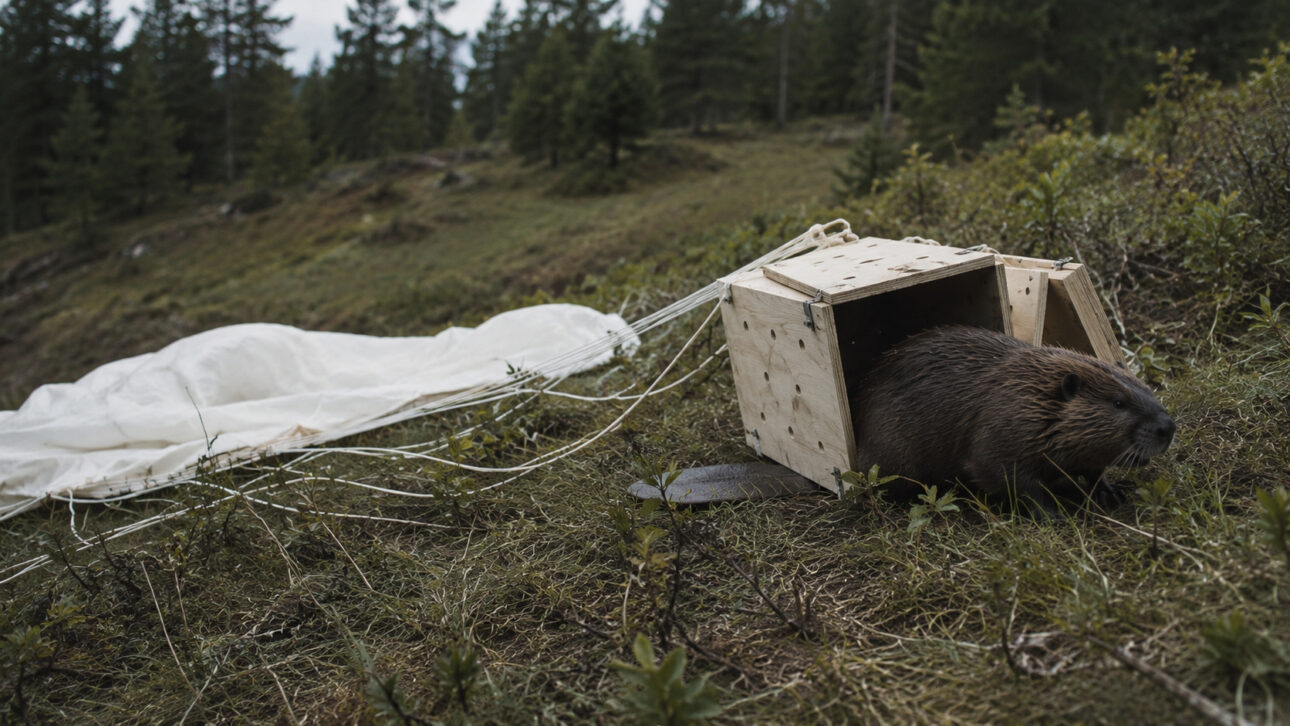
Operation took 76 animals to the Chamberlain Basin
The large-scale transfer began in August 1948.
The beavers traveled in pairs inside the adapted boxes before being released over the Chamberlain Basin.
The survival rate exceeded the expectations of the responsible team.
Heter considered that the ideal formation to establish new populations consisted of one male and three females.
Geronimo also received this composition during his definitive transfer.
Magazine revealed the parachuting beavers to the public
The magazine Popular Mechanics published, in April 1949, the report Moving Day for the Parabeavers.
The content presented details of the mission conducted by the Idaho Department of Fish and Game.
The story remained little known for decades, despite the unusual nature of the operation.
Historical film was rediscovered in 2015
The historian Sharon Clark found, in 2015, a 16-millimeter film that had been incorrectly cataloged.
The documentary Fur for the Future was approximately 14 minutes long.
The footage showed the launches, the automatic opening of the boxes, and the beavers’ exit after landing.
Some of the scenes may have been recreated for the cameras, a common practice in documentaries of that period.
The Idaho State Historical Society later made the film available on YouTube.
The record transformed the mission of the Idaho parachuting beavers into one of the most well-known episodes of American environmental conservation.
Did the operation represent a creative solution to preserve the beavers or should another method have been used? Leave your opinion.





Be the first to react!