Portuguese
  Spanish


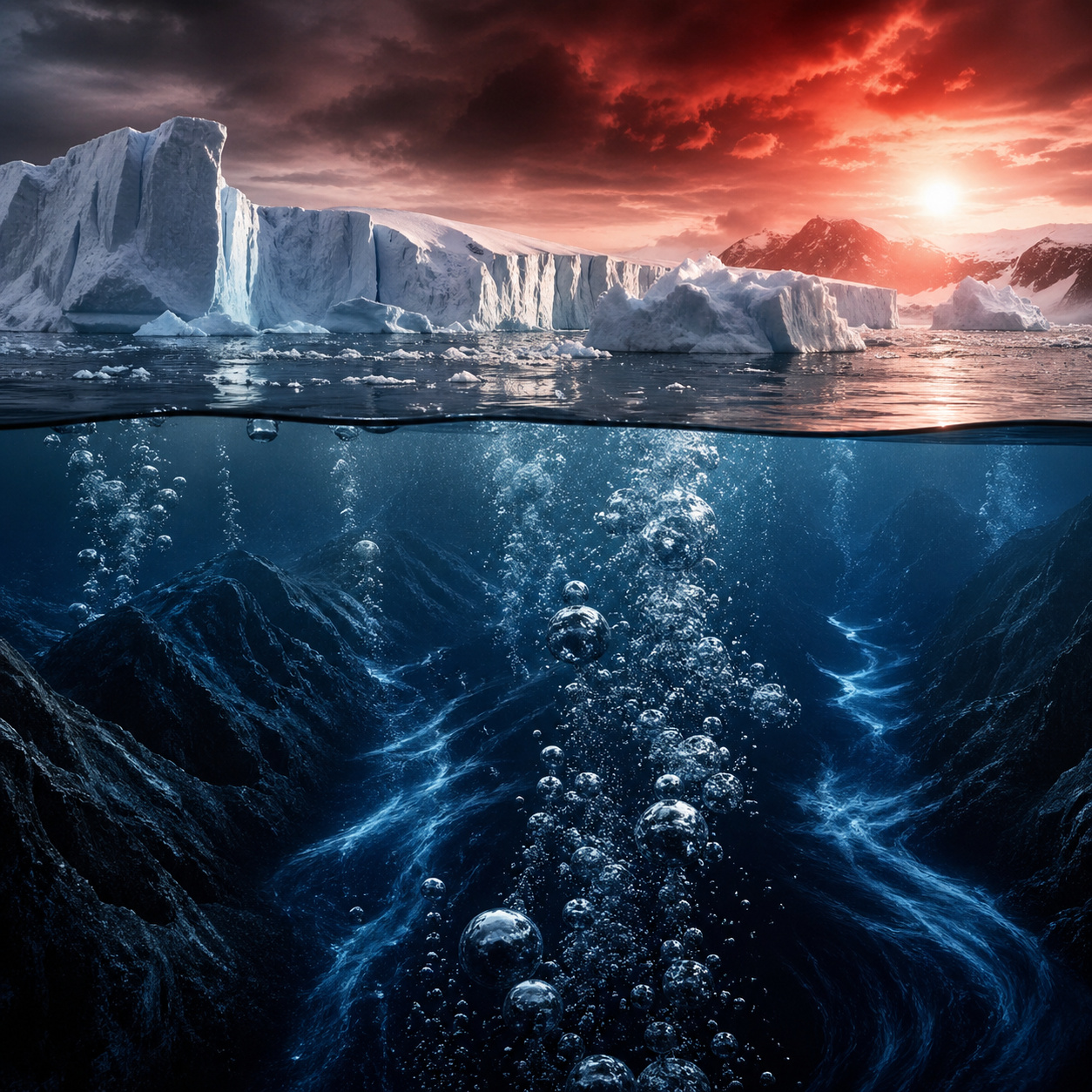

2025 Study Shows Deep Ocean Released CO₂ at the End of the Glacial Era and May Repeat the Process in Current Global Warming.
According to GEOMAR — Helmholtz Centre for Ocean Research Kiel, a study published on December 2, 2025, in the journal Nature Geoscience reconstructed the exact role that deep ocean circulation around Antarctica played at the end of the last glacial era — and found that this role was much larger than previously assumed. Led by Dr. Huang Huang from the Laoshan Laboratory in Qingdao, China, with the participation of geochemist Dr. Marcus Gutjahr from GEOMAR, the study traced the extent of Antarctic Bottom Water over the last 32,000 years using ocean floor sediments as a geological archive.
What it found rewrites the established narrative about the end of the glacial era and casts a direct shadow on what is happening in the oceans now. “Comparisons with the past are always imperfect,” said Gutjahr, “but ultimately, it all comes down to how much energy is in the system.”
Deep Ocean Functioned as a Natural Carbon Storage Chamber During the Glacial Era and Kept the Planet Cool
During the last glacial era, which peaked about 20,000 years ago, the Earth was between 4°C and 7°C cooler than today on a global average.
-
Nigeria Dumps 120 Million Tons of Sand into Atlantic to Build Massive City with 8.4 km Sea Wall for Protection Against Ocean Waves and Erosion

-
German Engineer Developed Diesel Engine Running on Vegetable Oil Decades Before Electric Cars Became Popular; Can This Forgotten Idea Work in 2026?

-
James Webb Telescope Uncovers Unexpected Clues on Mysterious Moon, Potentially Redefining Planetary Origins

-
$1.5 Billion Sleipnir Vessel Transforms Ocean into Floating Construction Site with 12 Hybrid Engines and Capacity to Lift 20,000 Tons


Ice caps covered much of the northern hemisphere. Sea levels were 120 meters below current levels. And atmospheric CO₂ was around 180 parts per million — approximately half of the current level of 423 ppm.
For decades, paleoclimatologists knew that the difference between these glacial 180 ppm and the pre-industrial 280 ppm, the CO₂ that “was missing” from the atmosphere during the glacial era, was hidden somewhere.
The dominant hypothesis was that the deep ocean had captured and stored this excess carbon, but the exact mechanism by which it was being held at the bottom and the process by which it was released remained incomplete.
Deep Circumpolar Water Accumulated Carbon for Centuries Without Ventilation and Created a “Carbon Chamber” in the Oceans
The study by Huang and Gutjahr provides the missing piece. During the glacial era, the Deep Circumpolar Water, a water mass that circulates in the deep ocean for very long periods with little exchange with the surface, occupied large parts of the deep ocean of the Southern Ocean.
By remaining in the depths for centuries without ventilation, this water mass accumulated enormous amounts of dissolved CO₂ produced by the decomposition of organic matter sinking from the surface layers.


Since the carbon was trapped in the depths and did not reach the surface where it could balance with the atmosphere, atmospheric CO₂ levels remained low — keeping the planet cool.
It was a natural carbon chamber, sealed by ocean stratification, containing decades and centuries of CO₂ accumulation in the ocean depths around Antarctica.
Expansion of Antarctic Bottom Water Broke the Isolation of Deep Carbon and Released CO₂ into the Atmosphere
Between 18,000 and 10,000 years ago, as the Earth gradually emerged from the glacial era driven by Milankovitch astronomical cycles that altered the distribution of solar radiation, something changed in the deep ocean circulation around Antarctica.
In two distinct phases that coincided with known warming events in Antarctica, the Antarctic Bottom Water, the coldest and densest water mass in the global ocean, which forms around the continent and sinks to the bottom, expanded significantly.
This expansion displaced the carbon-rich Deep Circumpolar Water that had dominated the ocean depths during the glacial era.

As the new Antarctic Bottom Water advanced through the Southern Ocean, vertical mixing increased — the barrier between the carbon-rich depths and the surface became more permeable. And the carbon that had been stored in the depths for millennia began to return to the atmosphere.
Half of the CO₂ increase occurred in just two millennia, revealing unexpected speed of the geological process
The study quantified the speed of this process in a way that surprised the authors themselves.
Suddenly, on a scale of about two millennia, which is sudden in geological terms, this mechanism accounted for half of all the CO₂ increase over the full 8,000 years of deglaciation. What took eight millennia to happen was, by half, produced in two.
New evidence shows that Antarctic dynamics played a central role, reducing the importance of the North Atlantic
The discovery also reverses a dominant assumption about who controlled deep circulation during deglaciation.
Many previous studies assumed that changes in the North Atlantic, especially the formation of North Atlantic Deep Water, were the main drivers of changes in the deep circulation of the South Atlantic. The new data indicate that the influence from the north was more limited than previously thought.
Up to this point, the study would merely be a contribution to understanding the past. What makes it urgent is the observation made by contemporary researchers: similar patterns are being observed today. The Antarctic Bottom Water is weakening.
Current warming reduces deep water density and decreases its capacity to sequester carbon at the bottom of the ocean
Recent observations show that it is losing density and volume as the Southern Ocean warms.
The mechanism is structurally similar to what was observed at the end of the ice age: warming reduces sea ice formation, melting releases fresh water, salinity drops, density decreases, and the water does not sink with the same efficiency.

The image used by the researchers is direct. Like removing the cap from a soda bottle, the retreat of sea ice reduces pressure on the CO₂ capture system. When the cap is removed, the trapped gas begins to escape.
The difference between past and present lies in the extreme speed of current warming compared to deglaciation
What differentiates the present from the past is the temporal scale. At the end of the ice age, the process took millennia. Today, warming occurs in decades, a speed at least a hundred times greater.
Climate models include the ocean as a carbon absorber. But the dynamics of Antarctic Bottom Water are still simplified.
The methodology used in the study demonstrates the power of geology. Researchers analyzed neodymium isotopes in ocean sediments, capable of identifying the origin of water masses.
The data show that the ocean is not passive. It can store carbon for millennia — and release it when the system changes. Evidence indicates that this risk exists.
In your view, has this process already begun or are we still only observing the first signs of this change?