Portuguese
  Spanish


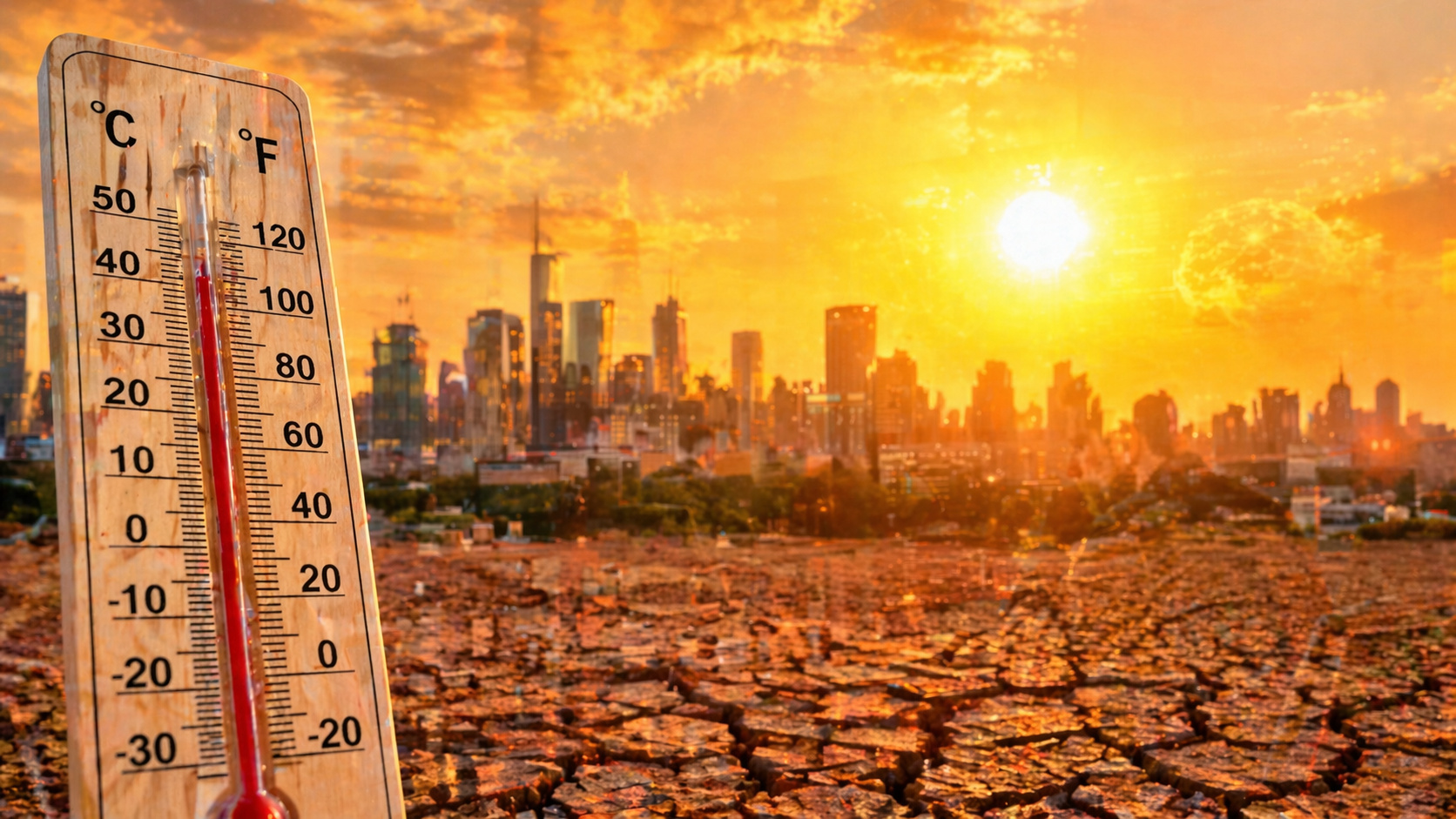

WMO alerts that April, May, and June 2026 will have above-normal heat in large parts of the planet, elevating the risk of heat waves and global impacts.
On March 23, 2026, the World Meteorological Organization (WMO) published the Global Seasonal Climate Update for the quarter of April, May, and June 2026, indicating a broad climate signal of above-normal temperatures in large parts of the planet’s land areas. According to the document, there is strong agreement among models for a rapid transition to El Niño conditions starting in May, while temperature forecasts show greater consistency over extensive areas of the Northern Hemisphere, especially at mid-latitudes between 30°N and 60°N. The update also points to high probabilities of above-average heat in southern North America, Central America, the Caribbean, Europe, North Africa, parts of South America, Equatorial Africa, and the Maritime Continent, reinforcing a globally distributed warming pattern.
This type of projection does not function as a short-term weather forecast but as a probabilistic reading of seasonal trends based on global climate models. The WMO itself explains that the Global Seasonal Climate Update combines international climate monitoring and forecasts produced by designated global centers for seasonal forecasting, consolidated by the WMO Lead Centre for Seasonal Prediction Multi-Model Ensemble, coordinated by the Korea Meteorological Administration and NOAA.
Therefore, when multiple models converge on the same signal, as in the case of the April-June 2026 quarter, the alert gains technical weight for heat-sensitive sectors, including energy, agriculture, public health, urban infrastructure, and climate risk management.
-
Netherlands Reports First Child Euthanasia Case Since Rule Expansion for Minors

-
Brazilian Innovator Survives Homemade Submarine Dive in Paraty Despite Hatch Leak and False Oxygen Alarm

-
China Develops Custom 140-Ton Electric Mining Truck with 770 kWh Swappable Battery, Deploys 290 Units in Xinjiang’s Largest Zinc Mine
-
Meta to Launch Arena, a New Prediction App Targeting 3.56 Billion Users, Competing with Polymarket and Kalshi




Climate models indicate a consistent warming pattern at mid-latitudes of the Northern Hemisphere
The WMO report highlights that the projected warming is especially significant among the mid-latitudes of the Northern Hemisphere, approximately between 30°N and 60°N. This range includes densely populated and economically relevant regions, such as North America, Europe, parts of Central Asia, and East Asia.


The forecast of above-average temperatures in these regions increases the risk of prolonged heat waves, especially during the transition from spring to summer in the Northern Hemisphere. This period is critical as it marks the beginning of the hot season, when extreme events can intensify rapidly.
In addition, subtropical and tropical areas also show a warming trend, although with less intensity compared to mid-latitudes. Still, the impact in these regions can be significant, especially in countries with less infrastructure to cope with extreme heat.
What does “above normal temperature” mean in climatic terms and real impact
In the context of the WMO report, the term “above normal” does not refer to a short-term variation of a few days, but rather to an average deviation from the historical climate pattern, usually calculated based on reference periods such as 1991–2020.
This means that, over the course of three full months, the average temperature tends to remain above the expected standard, creating favorable conditions for thermal extremes.
In practice, this scenario can result in:
- Longer periods of intense heat
- Increased frequency of days with high temperatures
- Reduced nighttime cooling
- Greater heat sensation in urban areas
This set of factors is what transforms a simple thermal anomaly into a concrete risk for populations, especially in dense cities and regions with limited infrastructure.
Heat waves may intensify based on the forecast for 2026
The WMO highlights that the increase in average temperature raises the probability of heat wave occurrences, phenomena characterized by prolonged periods of abnormal heat.
Heat waves do not depend solely on absolute temperature, but on the persistence and intensity of heat over consecutive days, which can lead to cumulative impacts on the human body.
In scenarios like the one predicted for 2026, there is a higher risk of:
- More frequent extreme heat events
- Longer periods without thermal relief
- Elevated nighttime temperatures, making recovery for the body difficult
These factors are directly associated with increased hospitalizations, heat stress, and mortality in vulnerable populations.
Prolonged heat pressures energy, water, and urban infrastructure systems
In addition to direct health impacts, above-average heat also affects critical infrastructure systems. The increase in temperature raises the demand for electricity, especially for cooling, which can overload electrical grids.

In regions where energy generation depends on water resources, heat combined with reduced rainfall can further worsen the scenario, creating a cycle of pressure on the energy system.
Heat also affects:
- Water distribution
- Efficiency of transportation systems
- Durability of urban materials
- Industrial operations
These impacts are amplified in cities, where the urban heat island effect further intensifies local temperatures.
Extreme heat is already considered one of the most lethal climate threats in the world
According to the WMO itself, extreme heat is currently one of the deadliest and least visible climate threats. Unlike events such as hurricanes or floods, heat does not leave immediate visible destruction but causes progressive effects on the human body.
The risk is heightened by the lack of immediate perception of danger, especially in enclosed environments or at night, when the body should be recovering.
The forecast for 2026 reinforces the need for preparation, as the increase in the global average temperature is directly linked to the intensification of these events.
Seasonal climate forecast requires careful reading and continuous monitoring
It is important to highlight that seasonal forecasts do not precisely determine where and when specific extreme events will occur, but indicate trends and probabilities.
The WMO itself emphasizes that, although the global warming signal is consistent, the intensity and exact distribution of heat events will depend on regional factors and the evolution of the climate over the months.
This means that the scenario should be continuously monitored by national and international meteorological services, which will issue more specific alerts as events approach.
2026 is part of a sequence of years with persistent global warming
The WMO alert for the April–June 2026 quarter does not occur in isolation. It is part of a broader context of ongoing global warming observed in recent years.
Recent reports indicate that the last decade concentrated some of the hottest years on record, with global temperatures frequently close to or above 1.4°C compared to the pre-industrial period.
This recent history increases the likelihood that extreme events will become more frequent and intense, reinforcing the weight of forecasts for 2026.
What to expect in the coming months in light of the global climate alert
Based on the data presented by the WMO, the coming months of 2026 should be monitored closely, especially in regions that already have a history of intense heat.
The combination of above-average temperatures, possible formation of climatic events such as El Niño, and accumulated ocean warming creates a favorable scenario for extremes.
Although not all regions are affected in the same way, the global pattern indicates a widespread increase in thermal risk, which requires preparation from governments, health systems, and populations.
Do you believe the world is prepared to face a global scenario of above-average heat?
The alert from the World Meteorological Organization places 2026 under a scenario of global attention. Heat ceases to be just a climatic variation and becomes a risk factor that can affect multiple sectors at the same time.
In light of this context, the question that arises is direct: are countries, cities, and populations prepared to deal with a scenario where extreme heat becomes increasingly frequent and prolonged?