






 Portuguese
  Spanish


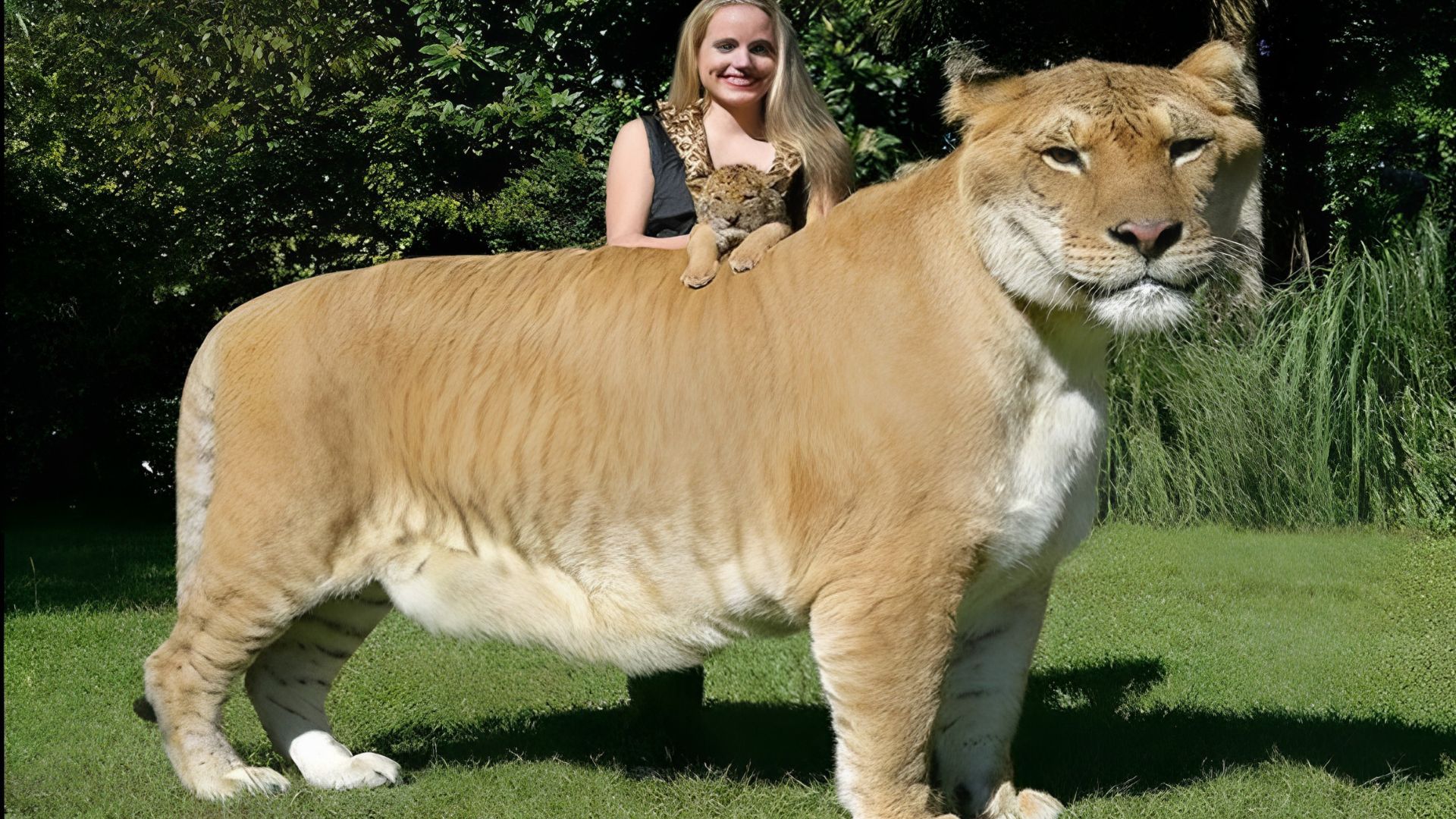
Hercules, the world’s largest liger, weighs 418.2 kg, measures 3.33 meters, and is recognized by Guinness as the largest non-obese living feline on the planet.
According to Guinness World Records, Hercules is officially the largest non-obese living feline on the planet, weighing 418.2 kg, with a total length of 3.33 meters and a height of 1.25 meters from the ground to the shoulder. The title is specific: he is not just the largest liger, nor just the largest feline in captivity, but the largest living feline in the world with healthy muscle mass and skeletal structure. Hercules lives at the Myrtle Beach Safari in South Carolina, United States, where he coexists with other animals requiring special care, such as hippos and elephants. In 2026, he will be approximately 24 years old, a remarkable longevity for an animal of his size.
To sustain 418 kg of muscle mass, Hercules consumes about 13.6 kg of meat per day, more than 400 kg per month. Wild adult lions typically eat an average of 5 to 7 kg per day, while male Siberian tigers consume between 6 and 10 kg. The data comes from the noticiabrasil portal.
What is a liger and why does this hybrid feline not exist in nature
A liger is the result of a cross between a male lion and a female tiger. It is different from a tigon, the inverse hybrid formed by a male tiger and a female lion, which generally does not grow beyond the size of its parents.
-
Cuba Implements Sweeping Economic Reforms, Legalizes Holdings and Corporations, Allows Foreign Investment in Private Companies, and Lifts Employee Limits After Over 60 Years

-
8-Year-Old Entrepreneur from Brazil Builds Poultry Business with 80 Birds, Aspires to Study Agronomy at Leading University
-
Couple Transforms School Bus into Mobile Home with Full Bathroom Using YouTube Tutorials, Invests $50,000

-
Chester County, USA, Achieves “Functional Zero” in Chronic Homelessness by 2026 with Housing First, Reducing Shelter Use by 52%




This cross does not occur naturally for a simple geographical reason. Lions live mainly in African savannas, while tigers inhabit Asian forests, meaning the two species do not meet in the wild.
In captivity, crossbreeding is possible because lions and tigers belong to the same genus, Panthera, and have the same number of chromosomes in their somatic cells: 2n = 38. This compatibility allows for the birth of hybrids, but the liger does not belong to any natural ecosystem.
Liger Hercules combines characteristics of lion and tiger in a colossal body
Ligers inherit visual characteristics from both parents. They usually display the golden coloration of the lion with soft tiger stripes superimposed on their bodies.
Male ligers do not develop the full mane of lions, but may have a denser layer of fur around their faces. They also tend to combine behaviors from both species: they like to swim like tigers and are sociable like lions.


Physically, they are too large for the Asian forest and too different for the African savanna. Hercules represents the extreme of this hybrid, with a body mass greater than any known living feline.
Genetics of gigantism explains why ligers grow so large
Hercules’ colossal size is not random. It results from a genetic combination that reduces the natural growth control mechanisms present in pure lions and tigers.
In lions, genes that limit growth are transmitted by the lioness. Since the liger’s mother is a tigress, this maternal brake typical of lions is not inherited. In tigers, the equivalent control comes from the male tiger, who also does not participate in the crossbreeding.
The cub receives active growth genes from the lion father, but does not receive the two genetic brakes that would limit its size. It is this combined absence of control that allows ligers to grow far beyond their parents.
World’s largest living feline surpasses Siberian tigers and African lions
The comparison between Hercules and the largest pure felines shows the dimension of gigantism. The male Siberian tiger, the largest living pure feline, weighs on average between 180 and 300 kg and can measure up to 3.3 meters.
The male African lion, another giant among felines, weighs on average between 150 and 250 kg. Hercules, at 418.2 kg, weighs almost double that of many adult Siberian tigers and lions.
The difference is also impressive when compared to the jaguar, the largest feline in the Americas, which weighs between 56 and 96 kg. A single Hercules can be equivalent, in body mass, to four or more adult jaguars.
Hercules eats over 400 kg of meat per month to maintain 418 kg
Sustaining the world’s largest living feline requires unusual food logistics. Hercules consumes approximately 13.6 kg of meat per day, usually in one or two meals.
The diet consists mainly of beef and chicken, with vitamin and mineral supplementation. This is necessary because the metabolism of a liger of this size has no direct equivalents in nature.
In a month, consumption exceeds 400 kg of meat, a volume equivalent to an entire calf per week. Hercules’ diet is an essential part of maintaining his size without turning the weight into obesity.
Ligers require special care, environmental enrichment, and constant management
In addition to feeding, ligers need environmental enrichment and careful management. They combine the sociability of lions with the independence and adaptability of tigers.
Without physical and cognitive stimuli, large felines in captivity can develop repetitive behaviors and signs of stress. Therefore, interaction with handlers, routines, and controlled activities are part of their care.
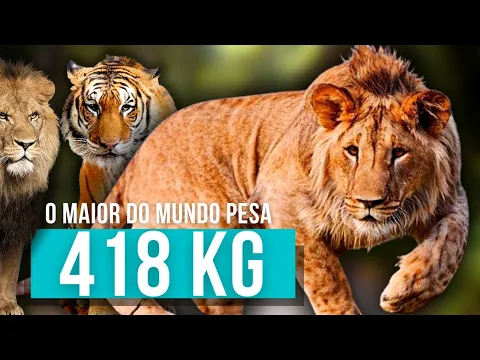
Myrtle Beach Safari documents that Hercules recognizes routines and responds to basic commands. These behaviors reinforce the cognitive complexity of a hybrid animal, giant, and dependent on highly specialized care.
White ligers and the approximately one thousand ligers existing in the world
Hercules is the most famous liger, but he is not the only one. It is estimated that there are about 1,000 ligers in the world, almost all in captivity in the United States, China, and some Middle Eastern countries.
In December 2013, Myrtle Beach Safari recorded the birth of the world’s first white ligers: Yeti, Odlin, Sampson, and Apollo. They were born from the crossbreeding of an African white lion and a white Bengal tigress.
This coloration is extremely rare because it requires both parents to carry recessive genes linked to white fur. White ligers are even more uncommon than common ligers, which already depend on artificial breeding in captivity.
Why the existence of ligers like Hercules generates ethical debate
Hercules is fascinating as a biological phenomenon, but the existence of ligers also generates ethical debate. Animal protection organizations criticize the deliberate production of hybrids that do not exist in nature.
The central argument is that ligers do not contribute to the conservation of endangered lions or tigers. Resources spent on food, facilities, veterinarians, and management could be directed to wild species at real risk of extinction.
Male ligers are also sterile, following Haldane’s Rule, which predicts infertility in the heterogametic sex in interspecific hybrids. This reinforces the criticism that the liger is an exhibition animal, not a conservation tool.
Extreme size of ligers can bring joint and cardiac risks
The gigantism of ligers also brings health challenges. Extremely large felines can develop joint, cardiac, and metabolic problems throughout their lives.
The ideal life expectancy for ligers in captivity is usually estimated between 15 and 20 years, depending on management, genetics, and care conditions. The fact that Hercules reaches about 24 years is exceptional.
This data is used by Myrtle Beach Safari as a demonstration of the standard of care offered to the animal. Still, the extreme size remains a sensitive biological factor and one of the reasons for the debate about the creation of these hybrids.
Hercules shows the limits of animal growth among felines
The existence of Hercules raises a rare question for biologists and paleontologists: what is the maximum size limit a feline can reach? The largest known extinct felines, such as the Smilodon populator and the European cave lion, weighed between 300 and 400 kg.
At 418.2 kg, Hercules surpasses this range and ranks among the largest felines ever documented. This does not prove that larger felines never existed, as the fossil record is incomplete, but it makes the liger an extraordinary biological case.
What it reveals is the strength of growth control genes in the evolution of big cats. When two natural limitation mechanisms are removed at the same time, the result can be an animal larger than any living feline in nature.


-

-

-

-

-

-

160 people reacted to this.