Portuguese
  Spanish


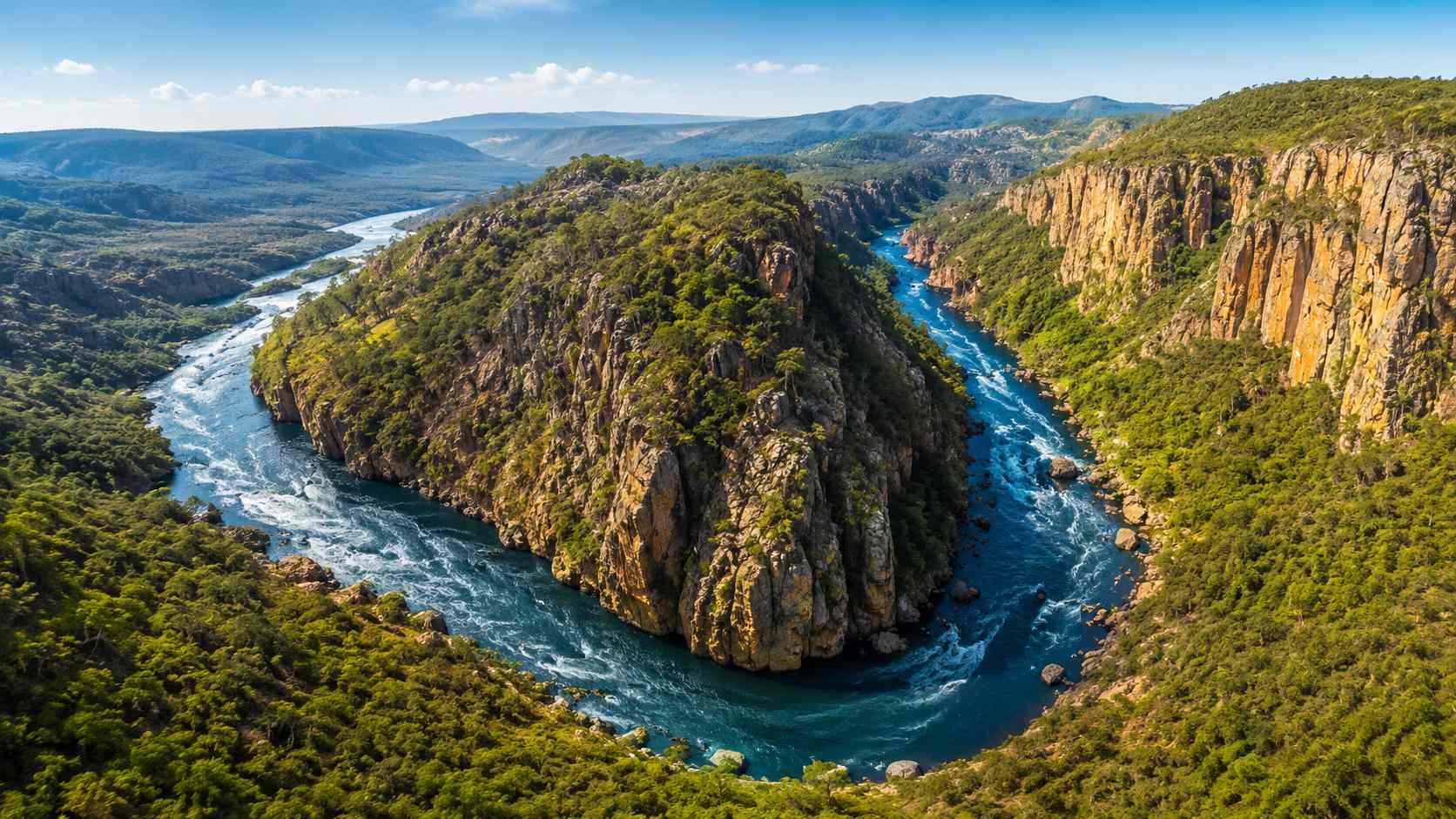


Considered the leading candidate for the world’s oldest river, the Finke River may be between 300 million and 400 million years old, traversing mountain formations, tectonic shifts, and even the Pangea era while maintaining its active drainage corridor in central Australia
The world’s oldest river may be the Finke River in central Australia, known by indigenous peoples as Larapinta. Geologists estimate its drainage system to be between 300 million and 400 million years old, surviving mountain formation, climate change, and continental rearrangements since the time of Pangea.
Scientists face difficulties in defining the age of a river because waterways constantly change. They excavate rocks, abandon old beds, create new paths, and can destroy the very evidence that would help prove how long they have existed.
The geological quest does not attempt to identify a channel that has remained unchanged for hundreds of millions of years. The goal is to find persistent drainage corridors, capable of continuing to carry water through the same landscape even after profound tectonic and environmental transformations.
-
China Develops Custom 140-Ton Electric Mining Truck with 770 kWh Swappable Battery, Deploys 290 Units in Xinjiang’s Largest Zinc Mine

-
Meta to Launch Arena, a New Prediction App Targeting 3.56 Billion Users, Competing with Polymarket and Kalshi

-
Scientist Challenges Famous Human Evolution Theory, Argues Homo Sapiens Evolved Gradually Over Thousands of Years
-
15-Year-Old American Builds Ocean Generator with PVC Pipe and 3D-Printed Propeller for $12, Wins National Prize, Presents at White House, and Makes Forbes 30 Under 30 List




How the Finke River became the leading candidate
For most of the year, the Finke River appears fragmented into waterholes, sandy areas, and dry stretches. When the rains arrive, the riverbed regains its flow, carrying muddy water through the gorges of the Australian desert.
The river originates in the MacDonnell Ranges in central Australia and flows south towards the Lake Eyre basin. Unlike many rivers, it cuts through mountain ranges instead of merely flowing around them, maintaining its course through the elevated rocks.
Geologists classify the Finke as an antecedent river. This means that the course already existed before the uplift of the mountains and continued to deepen its bed while tectonic forces elevated the surrounding landscape.
The geological history of the system is linked to the Alice Springs Orogeny, an event that deformed central Australia between approximately 450 million and 300 million years ago. Sediments found in the Amadeus Basin record ancient rivers and alluvial fans associated with the highlands of that era.
Experts emphasize that the current bends of the Finke are not hundreds of millions of years old. Nevertheless, evidence indicates that a drainage system occupying the same regional corridor has persisted since the deep Paleozoic.
Ancient river gravels near the river help reinforce this hypothesis. Some old deposits hardened with iron and silica after contact with groundwater, becoming more resistant than the surrounding terrain.
With the gradual erosion of the softer landscape, these deposits remained elevated above the modern riverbed. This phenomenon, called inverted topography, preserves traces of ancient channels abandoned by the river system over time.
The Finke River’s main claim to antiquity involves its possible direct link to the Pangea era. If parts of the system truly began between 300 million and 400 million years ago, its ancestors already existed before the emergence of dinosaurs.
Other ancient rivers dispute the title
The Meuse River, in Western Europe, frequently appears among the Finke’s main rivals. It originates in France, flows through Belgium and the Netherlands, and empties into the North Sea, cutting through the Ardennes mountains.
Researchers believe that the Meuse already existed when the Ardennes began to rise during the tectonic events of the late Paleozoic.
Despite this, there are important doubts about its geological continuity. Some authors point out that parts of the valley were covered by later seas, creating complications for the interpretation of the fluvial corridor’s persistence.
In the United States, the New River also appears on lists of the world’s oldest rivers. The National Park Service estimates its age to be between 3 million and 320 million years, depending on the geological interpretation considered.
The oldest hypothesis is based on the fact that the river cuts through the Appalachian Mountains. Some researchers understand that the course would have remained active while the mountains rose around it over time.
Other geologists disagree with this interpretation. They argue that the modern gorge would be more recent, formed after subsequent episodes of erosion and landscape reorganization in the eastern United States.
The Rhine, another frequently cited European river, has an estimated age of about 240 million years. However, its modern hydrographic system formed gradually, incorporating alpine drainages during more recent periods of geological history.
The Save River, also called Sabi, emerges as a possible survivor of the fragmentation of Gondwana. It originates in Zimbabwe, flows through Mozambique, and empties into the Indian Ocean, associated with ancient continental rifting zones.
Geologists link the Save Valley to structures formed when southern Africa and Antarctica began to separate. In this case, its antiquity does not depend on a single preserved channel, but on the persistence of the tectonic corridor.
Gondwana, India, and Ancient River Corridors
Gondwana united ancient continental masses such as Africa, South America, Antarctica, Australia, and India. During its fragmentation, fissures and zones of crustal weakness helped to direct long-lasting drainage systems in various regions.
The Narmada River, in India, is also linked to this ancient tectonic context. Its westward course follows a geological structure predating India’s collision with Asia, which was responsible for the formation of the Himalayas.
After separating from Gondwana, India drifted north until it collided with the Asian continent.
The Nile is popularly called the oldest river in the world, but this idea generally considers its historical importance to human civilizations. From a geomorphological point of view, the modern Nile is much more recent.
Part of its history dates back about 65 million to 75 million years ago. However, much of the current system is less than 2 million years old, far from candidates linked to the Paleozoic.
Why Few Rivers Survive
Rivers seem permanent on a human scale, but many disappear quickly in geological terms. River captures, glaciations, mountain formation, and tectonic shifts can destroy or redirect entire drainage systems.
Stream capture occurs when a river erodes towards a watershed and intercepts a neighboring system. From that moment, the water begins to follow a completely different path from the original.
Mountain formation can also reorganize rivers. Before the uplift of the Andes, South American drainage patterns were different from the current Amazon, which began to carry enormous volumes of water towards the Atlantic.
In North America, Pleistocene glaciers profoundly altered the ancient Teays River. Ice sheets blocked valleys, created lakes, and contributed to the later development of the Ohio River system.
For a river to reach extreme ages, it needs to escape several destructive processes. The system must avoid burial, damming, course reversal, excessive erosion, glaciations, and complete tectonic reorganizations.
How Scientists Estimate the Age of Rivers
Geologists cannot directly date a moving river. They analyze sedimentary deposits, canyon walls, transported minerals, river terraces, and traversed rocks to reconstruct ancient drainage histories.
Among the tools used is radiometric dating. Zircon crystals found in river sediments can be precisely dated and compared to source rocks to identify ancient paths traveled by the materials.
Other methods help investigate more recent periods of river evolution. Optically stimulated luminescence measures when sedimentary grains were last exposed to light before burial.
Cosmogenic isotope dating, on the other hand, estimates how long rock surfaces have been exposed to cosmic rays. This helps researchers calculate erosion rates and canyon deepening over time.
Even with these techniques, many uncertainties persist. A crystal can be billions of years old, while the sediment containing it can be hundreds of millions, and the modern riverbed may have changed recently.
For this reason, geologists avoid absolute claims about the world’s oldest river. Still, the Finke River remains the leading candidate for Earth’s oldest persistent river system, supported by evidence of approximately 300 million to 400 million years.