Portuguese
  Spanish


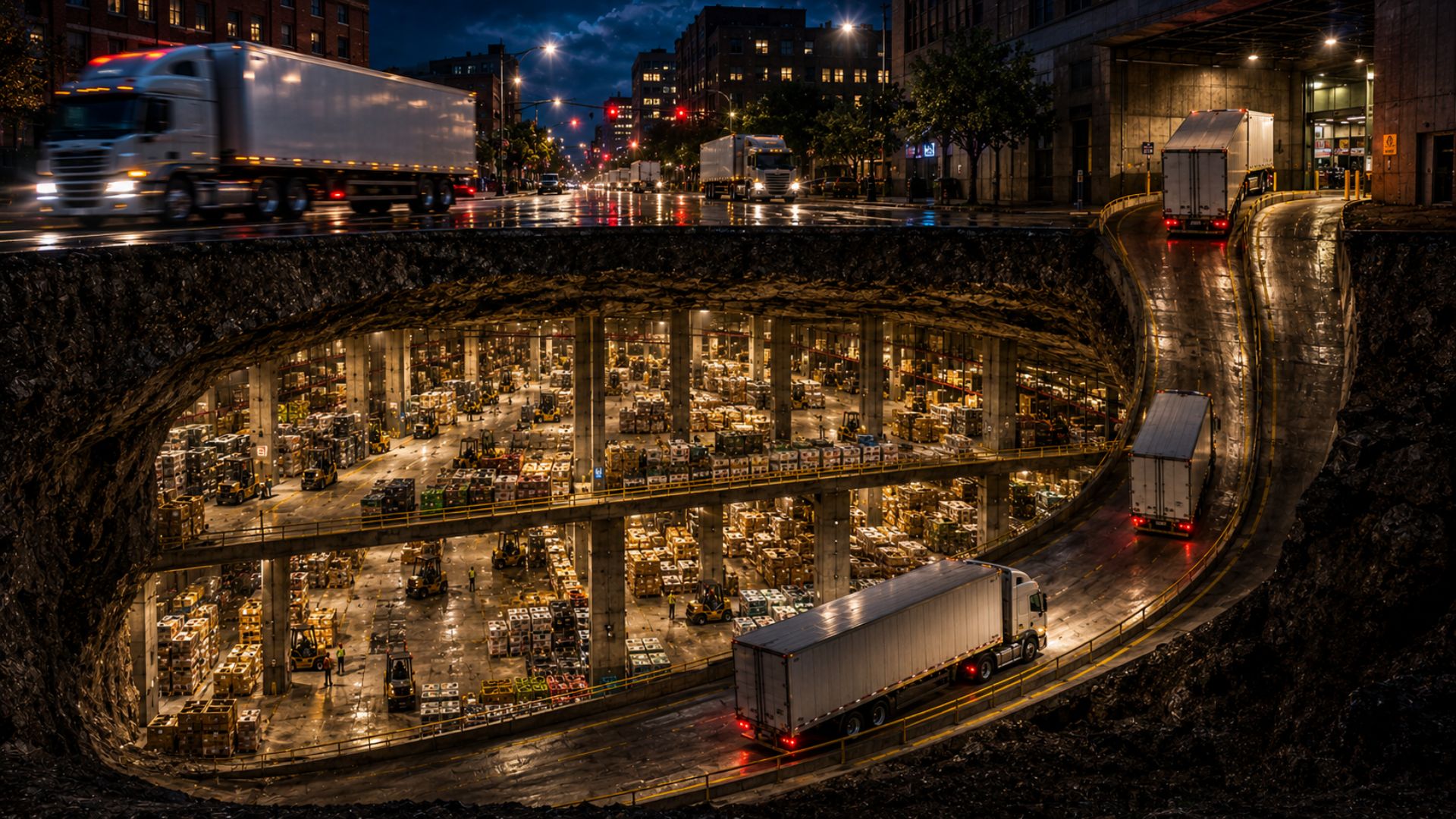

Beneath the streets of Springfield, Missouri, there is a hidden city: an underground warehouse complex carved into an old limestone mine. Hundreds of trucks enter the earth every day, and thousands of tons of food are stored at about 17 degrees naturally, with enormous savings in refrigeration energy.
Beneath the streets of Springfield, in the American state of Missouri, there is a true hidden city underground: the Springfield Underground, a gigantic complex of underground warehouses with about 3.2 million square feet of leasable area, equivalent to approximately 300,000 square meters, carved inside an old limestone mine. Every day, hundreds of trucks, reaching about 700 in the highest reports, descend into the earth to load and unload goods, in one of the most unique and efficient distribution centers in the United States, operated by the family-owned Erlen Group.
The great advantage of this hidden city is the temperature. The surrounding limestone rock keeps the environment at a constant 62 degrees Fahrenheit, about 17 degrees Celsius, throughout the year, without the need for any air conditioning system in the common areas. This makes the location the ideal place to store food: about 75% of the space is dedicated to food products and approximately 60% is refrigerated, with enormous energy savings compared to a conventional warehouse on the surface, exposed to the sun and climate variations.
How a limestone mine became a hidden city

Around the mid-1950s, the operation was converted into an underground mine, and in 1960 the construction of the first warehouse began, utilizing the empty space left by the rock extraction. The original mine, known as Griesemer, remained active until 2015, with mining and warehouse construction happening in parallel for over five decades.
-
400 km² of Greenhouses in Almería, Spain, Astonish American Visitor by Producing Millions of Tons of Produce for Cold-Weather Markets

-
Antarctic Volcano Emits Microscopic Gold Particles That Travel Up to 1,000 Kilometers Across the Continent
-
Little-known Japanese factory is the world’s largest zipper manufacturer, producing 7 billion pieces annually and closing half the world’s pants.

-
Brazilian Factory Recycles One-Third of the Country’s Styrofoam Waste, Matching European Levels with 51,000 Tons Reused Since 2007


Over this period, more than 31 million tons of limestone have been removed, a material used in the production of concrete for roads and bridges. About 600 acres of rock have been mined in approximately 70 years, creating the enormous void that now houses the hidden city. In 1994, the merger of three companies, Griesemer Stone Company, Security Terminal, and General Warehouse Corporation, united everything under a single name, giving rise to Springfield Underground as it is known today.
The natural 17-degree temperature that saves energy

In depth, the rock acts as a gigantic thermal mass that stabilizes the temperature, keeping the environment around 17 degrees Celsius all year round, regardless of scorching heat or freezing cold on the surface. This natural stability eliminates much of the climate control costs that a regular warehouse would have, especially in a region with hot summers and harsh winters like the American Midwest.
For products that require even lower temperatures, the complex has its own refrigeration maintenance team, which controls refrigerated buildings in ranges from minus 29 degrees Celsius to 13 degrees Celsius positive. The combination of the rock’s thermal mass and the efficient construction of the buildings means that the system uses much less energy to maintain these temperatures than it would on the surface. This is why the hidden city attracts so many companies in the food sector, including storage of cheeses, meats, and other perishables.
Hundreds of trucks that disappear underground
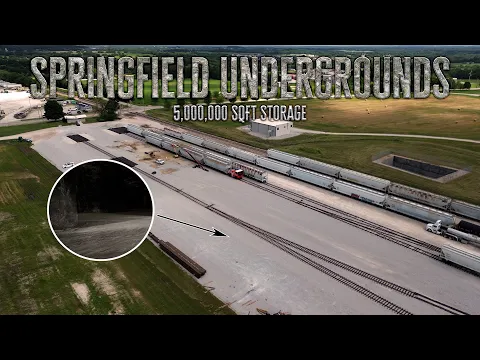

The logistical movement of this hidden city is impressive. Estimates vary according to the source and period, ranging from about 400 to 600 trucks per day in more conservative surveys, reaching reports of more than 700 vehicles daily in the highest counts. To organize this intense flow, the complex has 224 dock doors, two maneuvering yards on the surface, and more than 4.8 kilometers of illuminated internal roads, where trucks circulate as if on the streets of a regular city.
The location is also strategic. The Springfield Underground has immediate access to Interstate 44 and US-65 highways, as well as the main line of the BNSF railway, one of the largest in the United States. This connection allows for direct transshipment from trains to trucks underground, with more than a dozen buildings served by tracks. This transshipment model is one of the major commercial attractions of the hidden city, as it can save tens of thousands of dollars per load for companies that move large volumes.
Why carriers and shippers love the underground

During a visit to the facilities, presenter Jared Flinn toured the complex alongside Christina Angle from the Erlen Group, showing how this hidden world operates. Among the advantages cited by drivers and companies are total protection against sun, rain, snow, and temperature variations, which improves working conditions and better preserves the load during loading.
There are also disadvantages reported by some drivers, which help to balance the picture of this hidden city. Trucks with very long wheelbases may have difficulty making the tighter turns of the internal roads, and the absence of cell signal underground is pointed out as an inconvenience by some professionals. Even so, the balance is usually positive, and the complex continues to grow, excavating new areas each year to offer more leasable space protected from the external elements.
The future of underground warehouses and cargo security
The Springfield Underground model has attracted the attention of companies and logistics researchers worldwide. Besides energy savings, the hidden city offers security advantages: the closed and controlled environment makes it difficult to steal valuable materials, such as pipes and copper fittings, and protects sensitive stocks from extreme climate variations. Spaces with a ceiling height of about 9 meters and sprinkler protection against fire complete the industrial infrastructure.
The concept also sparks interest outside the United States. Refrigerated storage companies from other countries, such as the Faroe Islands, have already visited the complex seeking inspiration for their own projects. In a world pressured to reduce energy consumption and carbon emissions, taking advantage of the natural and stable underground temperature appears as an elegant and low-cost operational solution, capable of uniting logistical efficiency, food conservation, and sustainability in the same hidden city beneath the earth.
Springfield Underground proves that some of the smartest engineering solutions can be literally beneath our feet. An old limestone mine that could have turned into an abandoned hole has transformed into a logistics hub of hundreds of thousands of square meters, powered by the simple physics of the earth’s stable temperature. For the food, transportation, and storage sectors, this hidden city is an example of how repurposing spaces and natural resources can generate efficiency and economy at the same time.
Have you ever heard of this hidden city beneath the streets of Springfield, Missouri? Do you think Brazil, with so many mines and caves, could take advantage of underground spaces like this to store food and reduce energy costs? Leave your comment, tell us what you think of this idea, and share the article with those interested in logistics, engineering, food, and sustainable solutions.