Portuguese
  Spanish



This operation made the restroom seem safe and technological at the same time. The person saw the space before using it and then received privacy upon locking the door.
The automatic change was the basis of trust. Without it, the project lost its main function: to protect privacy during use.
Technological failure on cold days turned safety into fear of being exposed
The problem arose when subsequent reports pointed to failures on cold days. At these times, the glass could be slow to become opaque after the door was closed.
-
How to Prevent Brown Recluse Spider Bites: Common Hiding Spots and Free Tips to Reduce Risks

-
Natto: The Unusual Japanese Superfood Gaining Popularity on Social Media and Driving Record Exports
-
Brazilian Mayor Goes Undercover as Homeless for 24 Hours to Assess Public Services

-
15-Year-Old Entrepreneur Malu Lira Publishes 20 Children’s Books on Financial Education, Earns $500,000, and Expands Her Project to the Amazon Rainforest




This delay was enough to change the user’s entire perception. The restroom was created to reduce fear, but it ended up creating an even greater concern.
Privacy, in this case, depended on a quick response from technology. When that response failed, the person began to feel vulnerable in the middle of the city.
The result was a curious and uncomfortable situation: a restroom designed to increase confidence began to generate fear of being exposed.
Associated Press reported on the case that became an alert about urban privacy
The Associated Press, an international news agency with daily global coverage, detailed the case of public restrooms with transparent walls and glass that turns opaque when the door is locked.
The repercussion shows how an urban solution can take on another meaning when it depends on sensitive technology. The problem was not just in the design of the restroom, but in the trust required to use it.
Public restrooms deal with a very private need. Therefore, any doubt about exposure becomes an immediate discomfort.
The case also shows that innovation needs to work well outside ideal conditions. In public spaces, cold, constant use, and maintenance can change the real experience of users.
Project became an example of urban infrastructure dependent on invisible technology
The transparent restroom became a symbol of a city that relies on intelligent design to solve everyday problems. However, it also showed the risk of depending on technology that the user does not control.
People cannot see the system working internally. They simply expect the glass to become opaque at the right moment.
When that expectation is broken, trust quickly disappears. The problem ceases to be merely technical and becomes social.

For this reason, the administration had to review operation and maintenance. In a public restroom, an apparently small failure can have a great impact on the feeling of security.
Futuristic public restroom became a showcase of social anxiety
The case draws attention because it mixes architecture, public hygiene, and fear of exposure. The transparent restroom seemed like an elegant solution, but it also placed privacy in the hands of an automatic system.
The idea of seeing everything before entering was useful. Still, the possibility of someone seeing who is inside changed how the project came to be perceived.
This contrast explains why the case spread so widely. It shows a situation that is easy to imagine and difficult to ignore.
In the end, the public restroom became a showcase of a modern anxiety: trusting that technology will protect something that cannot fail.
The case of the transparent walls in Tokyo shows that not all urban innovation depends solely on a futuristic appearance. To truly work, it needs to be simple, reliable, and safe in common daily situations.
The idea of showing cleanliness and safety made sense. However, the failure on cold days transformed a creative solution into a warning about privacy, maintenance, and public trust. Would you use a transparent restroom if your privacy depended on smart glass working at the right moment?
Tokyo’s transparent toilet was created to show cleanliness, prevent surprises, and increase confidence in public restrooms, but reports of smart glass failure on cold days placed privacy at the center of urban controversy
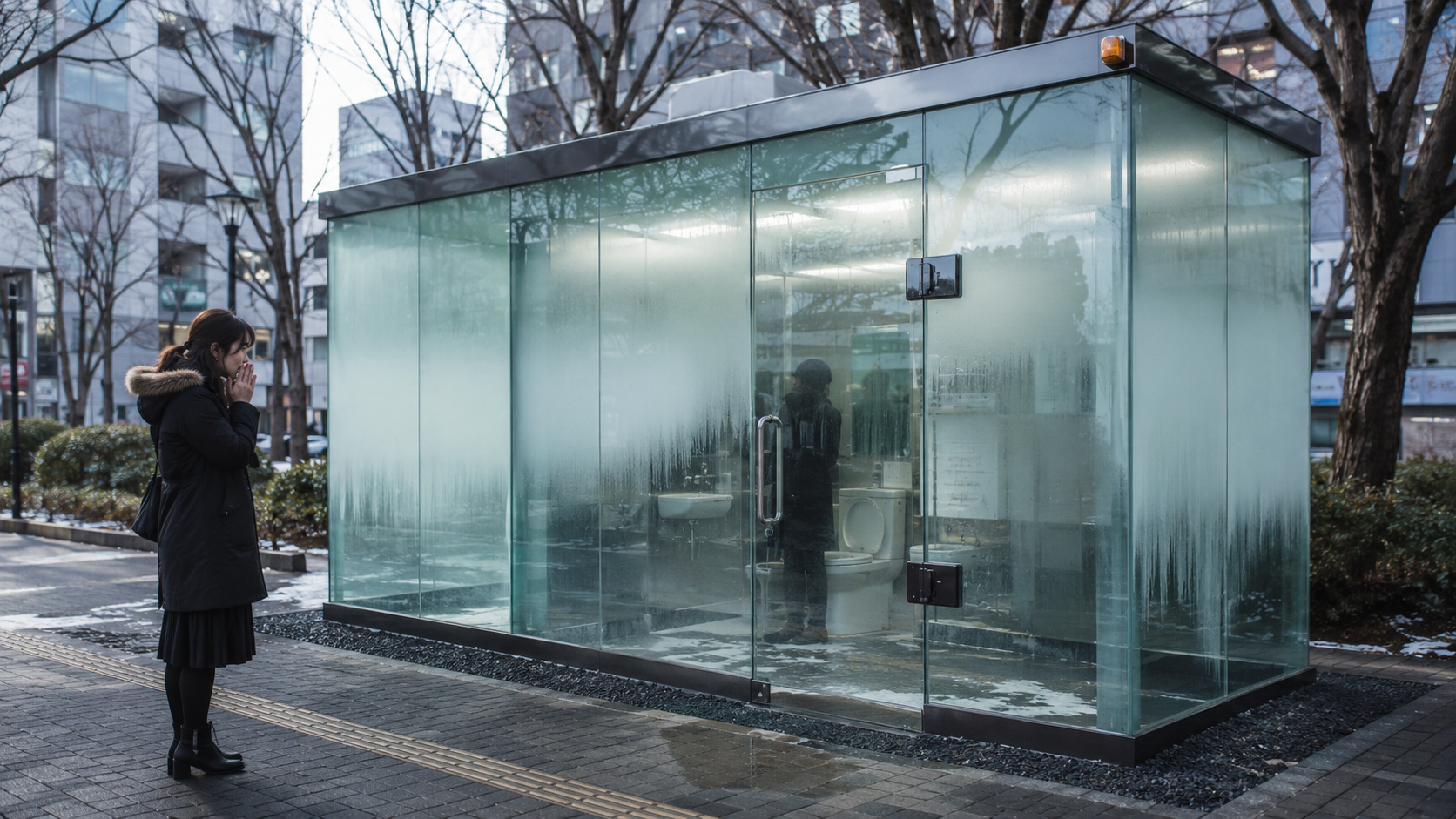
The transparent walls of a toilet in Tokyo drew attention with an unusual promise: to make the space visible when empty and turn opaque when the door was closed.
The idea seemed to solve two very common fears in public restrooms. Before entering, anyone could see if the place was clean and if there was no one hidden inside. The investigation was published by Associated Press, an international news agency with daily global coverage.
However, the same solution that promised safety became a cause for concern. Subsequent reports pointed to failures during cold periods, when the smart glass was slow to darken, creating the fear of public exposure.
Tokyo’s transparent toilet was created to show cleanliness and prevent scares
The transparent toilet in Tokyo was conceived as a simple answer to an old problem in big cities. Many people avoid public restrooms for fear of dirt, insecurity, or surprise when opening the door.


With transparent walls while the space is empty, the user can check the interior before entering. This makes the choice less uncertain and provides a sense of control.
The proposal also aimed to improve confidence in public services. Instead of hiding the condition of the restroom, the project made everything visible before use.
This aspect made the restroom seem modern and practical. Transparency functioned as a visual promise of cleanliness, safety, and natural surveillance.
Smart glass turns opaque when the door is locked
The central point of the project lies in the smart glass. When the restroom is empty, the walls are transparent. When a person enters and closes the door, the glass changes appearance and becomes opaque.
In simple terms, opaque glass is one that prevents a clear view of whoever is on the other side. It lets light pass through but protects the image of the person inside.
This operation made the restroom seem safe and technological at the same time. The person saw the space before using it and then received privacy upon locking the door.
The automatic change was the basis of trust. Without it, the project lost its main function: to protect privacy during use.
Technological failure on cold days turned safety into fear of being exposed
The problem arose when subsequent reports pointed to failures on cold days. At these times, the glass could be slow to become opaque after the door was closed.
This delay was enough to change the user’s entire perception. The restroom was created to reduce fear, but it ended up creating an even greater concern.
Privacy, in this case, depended on a quick response from technology. When that response failed, the person began to feel vulnerable in the middle of the city.
The result was a curious and uncomfortable situation: a restroom designed to increase confidence began to generate fear of being exposed.
Associated Press reported on the case that became an alert about urban privacy
The Associated Press, an international news agency with daily global coverage, detailed the case of public restrooms with transparent walls and glass that turns opaque when the door is locked.
The repercussion shows how an urban solution can take on another meaning when it depends on sensitive technology. The problem was not just in the design of the restroom, but in the trust required to use it.
Public restrooms deal with a very private need. Therefore, any doubt about exposure becomes an immediate discomfort.
The case also shows that innovation needs to work well outside ideal conditions. In public spaces, cold, constant use, and maintenance can change the real experience of users.
Project became an example of urban infrastructure dependent on invisible technology
The transparent restroom became a symbol of a city that relies on intelligent design to solve everyday problems. However, it also showed the risk of depending on technology that the user does not control.
People cannot see the system working internally. They simply expect the glass to become opaque at the right moment.
When that expectation is broken, trust quickly disappears. The problem ceases to be merely technical and becomes social.
For this reason, the administration had to review operation and maintenance. In a public restroom, an apparently small failure can have a great impact on the feeling of security.
Futuristic public restroom became a showcase of social anxiety
The case draws attention because it mixes architecture, public hygiene, and fear of exposure. The transparent restroom seemed like an elegant solution, but it also placed privacy in the hands of an automatic system.
The idea of seeing everything before entering was useful. Still, the possibility of someone seeing who is inside changed how the project came to be perceived.
This contrast explains why the case spread so widely. It shows a situation that is easy to imagine and difficult to ignore.
In the end, the public restroom became a showcase of a modern anxiety: trusting that technology will protect something that cannot fail.
The case of the transparent walls in Tokyo shows that not all urban innovation depends solely on a futuristic appearance. To truly work, it needs to be simple, reliable, and safe in common daily situations.
The idea of showing cleanliness and safety made sense. However, the failure on cold days transformed a creative solution into a warning about privacy, maintenance, and public trust. Would you use a transparent restroom if your privacy depended on smart glass working at the right moment?