






 Portuguese
  Spanish
  6 min of reading
  0 comments


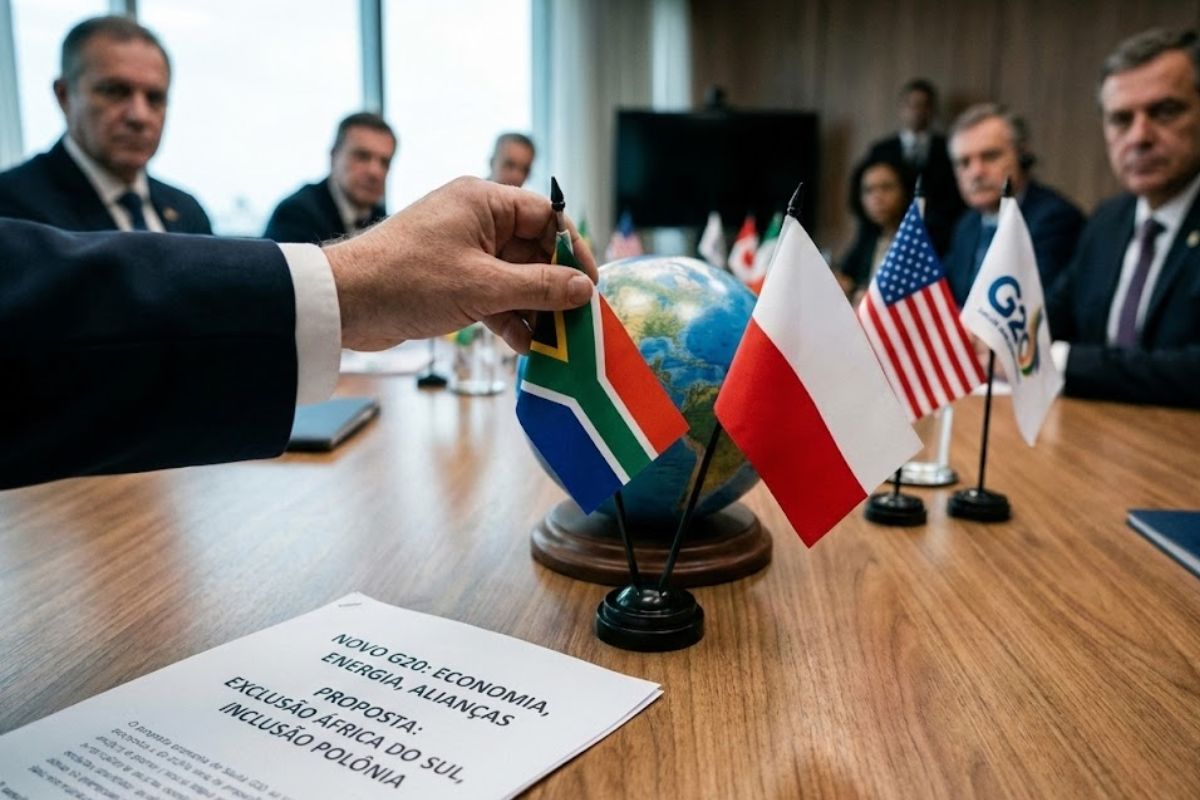
Trump’s Decision to Veto South Africa from G20 Meetings and Open Space for Poland Deepens Boycott of Johannesburg, Redefines Group Agenda for Economy and Energy, and Creates Diplomatic Tension with African Countries and Traditional Allies During American G20 Presidency 2025.
Donald Trump’s government has unveiled its strategy for commanding the G20 by confirming that South Africa will not be invited to the group’s upcoming meetings, while Poland is treated as a new member of the circle of the world’s largest economies. The message is clear: Trump wants to reshape the G20 in the image of U.S. interests, selecting allies and priorities.
The decision is the latest point in a crisis that began at the G20 summit held in Johannesburg at the end of November 2025, boycotted by Washington. Since taking over the rotating presidency of the bloc in early December, the Trump administration has openly spoken about a “new G20” focused on economy, energy, and alliances more aligned with the American agenda, sidelining environmental and social issues.
Trump’s Boycott of South Africa Reaches G20
According to the White House, the veto against South Africa is part of a broader strategy of diplomatic pressure. Trump accuses the South African government, without providing evidence, of persecuting the white minority and promoting land confiscation without compensation.
-
Central Bank changes rule that lasted decades and allows dollar and euro accounts in Brazil for exporters and companies with foreign capital, eliminating the need for currency exchange in some transfers starting in October 2026.

-
The Central Bank ends the R$ 500 limit on Pix by approximation, and account holders will be able to use the general Pix limit to pay any amount by tapping their phone on the terminal starting in October 2026.
-
A collective political will that allows for the creation of a cross-party and state agenda, focusing on concrete actions such as reducing the Custo Brasil; commitment to fiscal balance; feasible goals that enhance professional qualification and the adoption of a myriad of incentives aimed at innovation.

-
PIX from BRICS becomes reality: BRICS Pay advances to enable international payments without the dollar; system inspired by Pix and based on blockchain could move up to 20% of global trade by 2030, while bloc countries already account for 40% of the world economy.




This narrative has already been used to justify the U.S. boycott of the G20 summit in Johannesburg at the end of November and to support retaliations announced since Trump took the presidency of the group in early December.
The offensive ceased to be just a threat last week, when Secretary of State Marco Rubio formalized the veto.
Rubio stated that “President Trump and the United States will not extend an invitation to the South African government to participate in the G20 during our presidency.”
At the same time, he confirmed that Poland was invited to fill the space opened by the South African exclusion, consolidating the idea of a political rearrangement within the bloc.
The clash with Pretoria had already been intensifying. During South Africa’s presidency of the G20, Washington acted to block issues, halt negotiations, and even attempt to prevent the final communiqué of the summit from being approved, deepening the isolation between the two governments.
Poland Becomes Showcase of Trump’s “New G20”
In the same statement, Rubio described Poland as a “natural partner” of the United States. He emphasized that the country, once trapped behind the Iron Curtain, now ranks among the 20 largest economies in the world and that its trajectory symbolizes the type of ally Trump wants to promote within the G20.
According to the Secretary of State, “Poland’s success proves that it’s better to focus on the future than to cling to resentments”, reinforcing the argument that the approach with Washington and American companies would be responsible for boosting Polish prosperity.
From the perspective of the Trump administration, Warsaw exemplifies a reliable ally, aligned in both political values and economic strategy.
Poland is currently one of the European governments closest to the United States and this year elected the right-wing nationalist Karol Nawrocki as president.
For American diplomacy, this political profile reinforces the harmony with Trump’s approach, including on issues of security, energy, and border policies.
Criticisms of the South African Government and the Johannesburg Agenda
Washington’s rhetoric against Pretoria gained new contours in Rubio’s recent statements. He claimed that “the South African government’s appetite for racism and tolerance of violence against its Afrikaner citizens has become central policies”, in addition to accusing South Africa of land confiscation and poor economic management.
Rubio also directly attacked the agenda led by the South African presidency at the G20. According to him, the summit in Johannesburg “was an exercise in bitterness, division, and radical agendas”, prioritizing discussions on climate change, diversity, inclusion, and dependence on foreign aid.
However, these issues are recognized as pillars of global cooperation and multilateralism in international forums.
For the Trump administration, however, they distract from what should be the focus of the G20: economic growth, competitiveness, and trade agreements favorable to the United States.
Rubio even conditioned South Africa’s potential return to the G20 on a change of government in Pretoria. In his formulation, the United States “supports the South African people, but not their radical government led by the ANC”.
He stated that, when the country makes “the difficult choices necessary to fix its failed system” and is ready to reintegrate into the “family of free and prosperous nations,” a place will be reserved. Until then, Washington says it will proceed with a “new G20” without Pretoria at the table.
Trump Wants a G20 Focused on Economy, Energy, and Technology
In practice, Trump’s proposal for the “new G20” is to narrow the group’s scope to three main axes. The first is reducing regulatory burdens, focusing on streamlining investments and facilitating capital flow and business considered strategic for the United States.
The second axis is strengthening energy supply chains, at a time of global competition for sources of gas, oil, and new energy solutions.
The idea is to reinforce partnerships with countries that can ensure stability and predictability, decreasing dependence on regions viewed as unstable or politically divergent from Washington.
The third point is to encourage new technologies and innovation, putting topics such as digitalization of the economy, technological infrastructure, and investments in research and development on the agenda.
For the Trump administration, the G20 should function as a platform to consolidate a bloc of countries willing to adopt rules and standards close to the models defended by the United States and its closest allies.
By prioritizing these three pillars, the White House signals that, under Trump, the G20 is likely to leave discussions on the environment, social inclusion, and reducing inequalities that marked recent summits of the group in the background.
Next Steps for the “New American G20”
The first negotiators’ meetings of the G20 under American presidency, with participation from countries like Brazil, are scheduled to occur in Washington on December 15 and 16, 2025. From these dates, there will be a series of thematic and technical meetings throughout 2026, in which Trump intends to consolidate his vision for the “new G20”.
The White House’s plan is to conclude the presidency with a summit of heads of state hosted at Mar-a-Lago, Trump’s property in Florida. The gesture is seen as a symbol of the effort to personalize American leadership in the bloc and reinforce the political brand of the president in one of the main global forums.
So far, the other members of the G20 have not officially commented on the veto against South Africa and the invitation to Poland.
As decisions of the group are typically made by consensus, diplomats assess that Washington’s movement is likely to provoke intense debates on participation rules and the limits of the rotating presidency’s influence.
On the Polish side, Foreign Minister Radosław Sikorski confirmed he has been negotiating with Washington for the country’s entry into the G20.
He argues that Poland has a right to the vacancy “not only as one of the 20 largest economies in the world but also as a country that presents political and intellectual arguments”, highlighting the transition from a planned economy to a market economy as credentials for the new role.
Even with the veto against Pretoria, the G20 remains formally composed of 19 countries, plus the European Union and the African Union, a structure that will now coexist with the American invitation to Poland and Trump’s pressure for a redesign of priorities and alliances within the bloc.
And you, do you think Trump’s strategy to create a “new G20” will strengthen the group or open an even greater crisis among the major global partners?




-

1 person reacted to this.