






 Portuguese
  Spanish


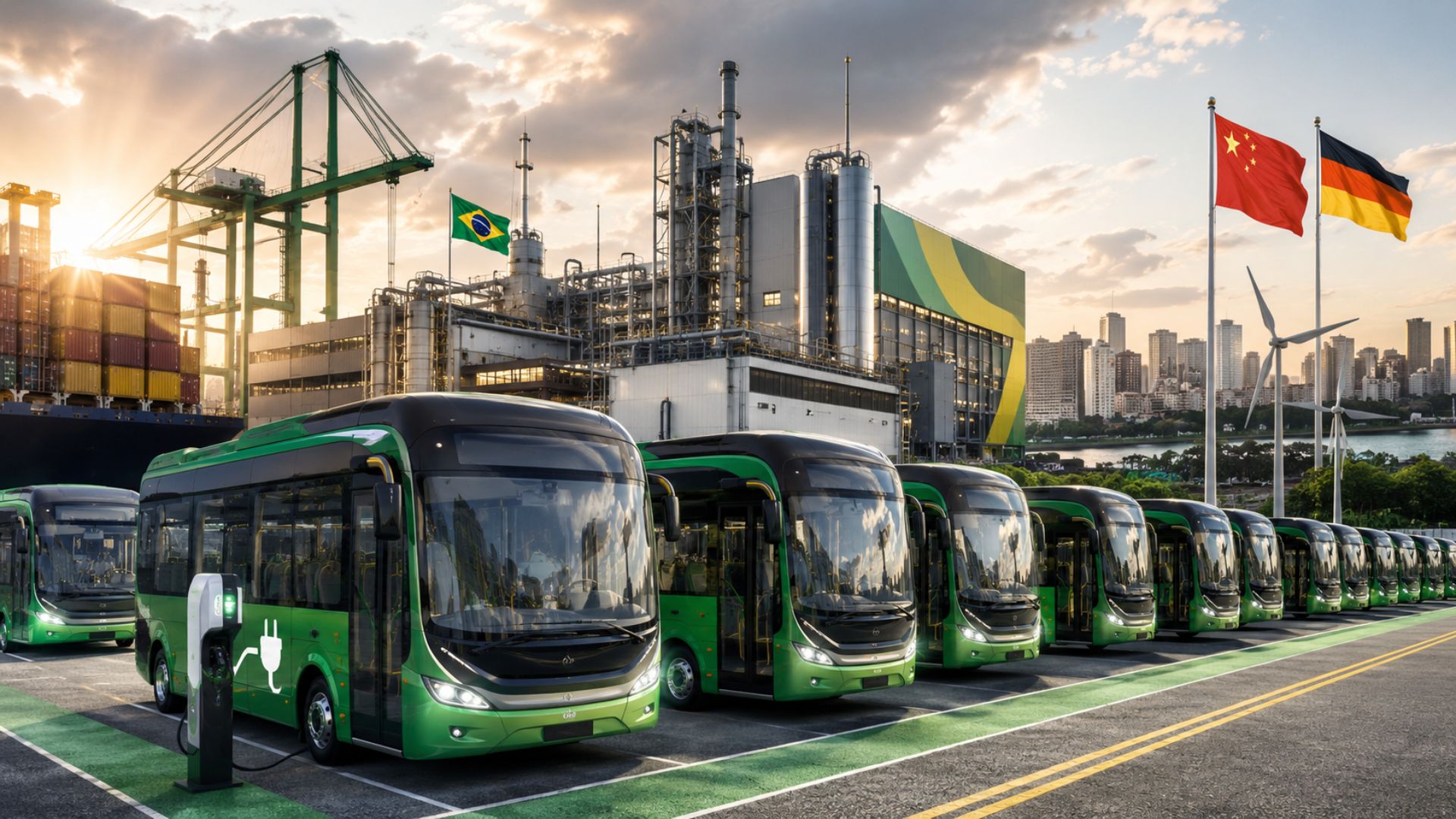

The BNDES and the Ministry of Cities sent representatives to Frankfurt and Beijing between May 17 and 29 to negotiate with manufacturers the establishment of electric bus factories in Brazil. According to NSC, the main advantage presented is the demand guaranteed by the New PAC, which reserved R$ 3.73 billion for the replacement of diesel buses, in addition to R$ 6.5 billion in credit lines for clean mobility and recharging infrastructure.
The federal government turned the need to renew fleets into an argument to industrialize the country. Representatives from the BNDES and the Ministry of Cities have been traveling since May 17 to Frankfurt, Germany, and Beijing, China, with a clear mission: to convince foreign manufacturers to set up electric bus factories in Brazil. The advantage presented to the companies is the demand predictability created by the New PAC Selections, which reserved R$ 3.73 billion exclusively for the gradual replacement of diesel-powered buses with low or zero-emission vehicles.
The trip was authorized by the president of BNDES, Aloizio Mercadante, and includes the institution’s manager Márcio Fróes Miguez as a technical representative. The strategy is not just to buy ready-made electric buses, but to condition the release of federal funds to local production of vehicles and components. The Ministry of Development, Industry, Commerce, and Services wants to link each real of the PAC to the installation of industrial units in Brazilian territory, especially for the manufacture of lithium-ion batteries, the most expensive component of these vehicles.
The R$ 3.73 billion of the New PAC and how they will be distributed

image: Ministry of Cities
The financial package that the government brings to the negotiation table is divided into two fronts. Of the total R$ 3.73 billion reserved by the New PAC for fleet renewal, R$ 1.27 billion will be directly allocated to states and municipalities for the acquisition of low or zero-emission electric buses. The other R$ 2.46 billion will be available for private public transport concessionaires who wish to replace their diesel vehicles.
-
China Tightens Control on Antimony, Driving Prices from $22,000 to Nearly $40,000 per Ton as U.S. Rushes to Bolster Strategic Reserves

-
BlackRock Freezes $1 Billion in Brazilian Renewable Energy, Impacting 1.5 GW of Planned Projects and Highlighting Investor Concerns Over Infrastructure Bottlenecks Cutting Up to 25% of Solar and Wind Generation
-
Labor Shortage: Despite Record Average Salary, 90% of Brazilian Bar and Restaurant Owners Struggle to Hire Key Roles Like Sushi Chefs and Head Cooks

-
Supermarket Deli Counter Attendants in Brazil Could Earn Over $2,100 Monthly by 2026, Plus Benefits Package


In addition to this specific funding for vehicle purchases, BNDES estimates to release around R$ 6.5 billion in credit lines aimed at clean mobility, including recharging infrastructure and garage adaptation. For foreign manufacturers, this volume of resources represents a guaranteed market through public purchase, something rare in emerging countries and which significantly reduces the risk of investing in a new factory.
Why China and Germany are the mission’s destinations
In China, the Brazilian delegation focuses its agendas in Shenzhen, a city that operates the largest electrified urban fleet in the world, with about 16,000 electric buses. The mission aims to closely understand BYD’s industrial model and evaluate partnerships to expand production in Brazil. Shenzhen is considered the global reference for a complete transition to electric buses in public transport and serves as a showcase for what the Brazilian government wants to achieve.
In Germany, BNDES technicians are visiting Frankfurt to detail the available credit lines and present the Brazilian regulatory scenario. The choice of Germany is not accidental: the country is home to brands like Mercedes-Benz, Daimler, and MAN, which already have operations in Brazil and know the local market. The idea is for these companies to consider producing electric versions of their buses in Brazilian territory, taking advantage of the industrial infrastructure they already have.
The price that still hinders electrification
Despite the progress in negotiations, cost remains the main obstacle to the massive adoption of electric buses in Brazil. An imported electric bus can cost up to three times more than an equivalent diesel model, a difference that weighs on the budgets of municipalities and concessionaires. This is precisely why the government is betting on local production as a way to reduce prices: factories in Brazil eliminate import costs and can use national inputs.
The Ministry of Cities argues that the replacement pays off in the long run. According to official estimates, each electric bus avoids the emission of about 110 tons of carbon dioxide per year. Besides reducing pollutants, maintenance and fuel costs are significantly lower in electric vehicles. The challenge is to convince public managers to pay more now to save later, in a country where mandates last four years and the planning horizon is usually short.
What São Paulo and Brasília already show about electric buses

image: Prefeitura de São Paulo
The largest urban centers in the country have already taken the first steps in electrifying public transportation. São Paulo currently concentrates the largest electric bus operation in Brazil, with more than 1,200 electric or low-emission vehicles integrated into the system. The São Paulo capital combines national and imported models financed by public banks and serves as a laboratory to evaluate performance, operational costs, and passenger acceptance.
In Brasília, the process follows a different path. The Federal District recently incorporated 45 electric buses manufactured by the Chinese company CRRC to test battery performance in dry climates and high temperatures. The results of these operations are considered decisive to gauge the interest of manufacturers in setting up permanent factories. If the data from São Paulo and Brasília confirm operational viability, the government’s argument gains even more strength in ongoing negotiations in China and Germany.
What’s at stake for the future of the Brazilian industry
The international mission of BNDES and the Ministry of Cities takes place at a time when the Chinese presence in the Brazilian automotive industry is growing rapidly. At Fenatran 2026, the main road transport fair in Latin America, seven of the 14 confirmed manufacturers are of Chinese origin. CRRC has already announced the opening of a factory in Araraquara, São Paulo, for train production.
The federal government is trying to use the R$ 3.73 billion from the New PAC as leverage to ensure that the transition to electric buses brings with it jobs and industrial capacity, not just imported vehicles. The concern of the national sector is legitimate: without local content requirements, public money may simply finance imports. The outcome of the negotiations in Frankfurt and Beijing will determine whether Brazil will be a consumer or producer in the era of electromobility.
Do you think Brazil will be able to attract electric bus factories with the purchase guarantee of the New PAC, or will manufacturers prefer to continue exporting ready-made vehicles? What worries you the most: the price of electric vehicles, the dependence on imports, or the timeframe to set up this industry? Tell us in the comments.


