






 Portuguese
  Spanish


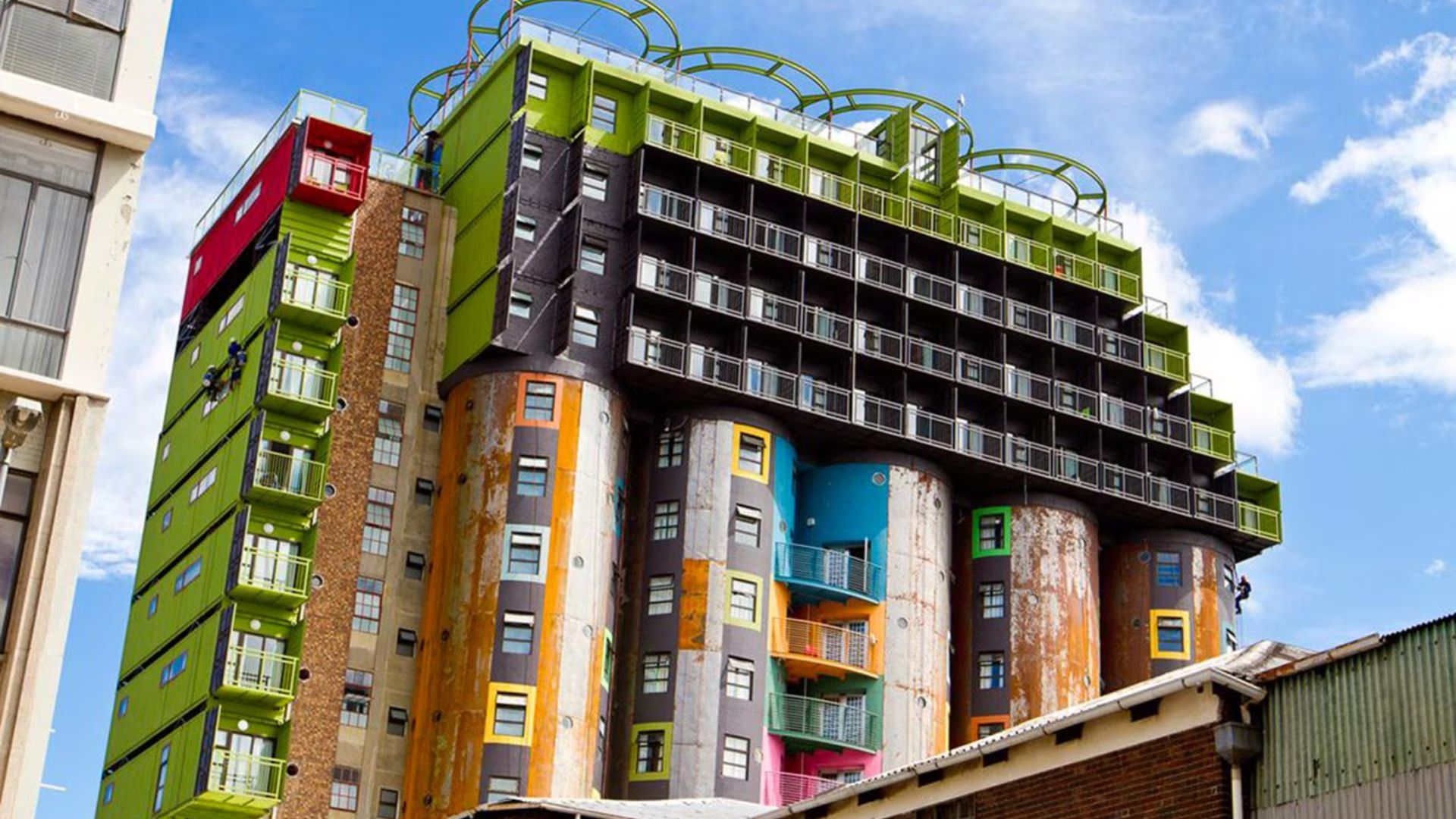


The Mill Junction in Johannesburg, South Africa, occupies a former grain silo that remained idle for years. The South African developer Citiq completed the work in January 2014 and opened the building to the first students in February 2015, offering 375 individual apartments at an affordable price.
An abandoned grain silo in downtown Johannesburg, South Africa, was transformed into one of the most creative student housing solutions on the African continent. The project, named Mill Junction, consists of 375 individual apartments for university students, distributed among the original ten concrete floors of the old industrial structure and four additional floors of colorful shipping containers stacked on top of the building. The work was conducted by the South African developer Citiq and addressed a chronic shortage of affordable student housing in the country’s largest city.
The construction was completed in January 2014 and opened to the first students in February 2015. The main reason for the project was to repurpose an idle industrial structure instead of demolishing it and erecting a new building from scratch. The result is almost forty meters high and stands out among neighboring buildings, offering panoramic views of the city and a model of urban adaptation that is being studied by architects worldwide.
From grain silo to university residence

The original structure of Mill Junction is a grain storage silo with eleven concrete floors. This type of construction is common in old industrial areas but loses its function when agricultural or processing activities are moved to more remote regions of the city. In Johannesburg, the complex had remained idle for years before Citiq’s intervention.
-
How to Prevent Brown Recluse Spider Bites: Common Hiding Spots and Free Tips to Reduce Risks

-
Natto: The Unusual Japanese Superfood Gaining Popularity on Social Media and Driving Record Exports
-
Brazilian Mayor Goes Undercover as Homeless for 24 Hours to Assess Public Services

-
15-Year-Old Entrepreneur Malu Lira Publishes 20 Children’s Books on Financial Education, Earns $500,000, and Expands Her Project to the Amazon Rainforest




To transform the silo into housing, the architectural team had to open windows in the thick concrete facades and adapt the interior to accommodate individual apartments. The operation kept the original structure visible, giving the building an industrial aesthetic that became the project’s trademark.
Four extra floors made of shipping containers

To expand the available space, Citiq opted to stack shipping containers on top of the silo. There are four extra levels formed by modular units painted in vibrant colors, which wrap around the top of the building and give Mill Junction its most striking visual identity. This feature allowed for an increase in the number of apartments without altering the building’s base, utilizing the original concrete structure for support.
Construction workers hoisted the containers with cranes and fixed them in a permanent position on the silo. Many of the upper units have their own balconies, with a direct view of the Johannesburg skyline. The ensemble creates a strong contrast between the gray of the original industrial concrete and the colorful modular levels at the top.
What Mill Junction offers to students


The development features 375 individual apartments, placing Mill Junction among the largest recycled silo student housing complexes ever built worldwide. In addition to private rooms, the building offers study rooms, libraries, lounges, and computer rooms for common use by residents.
Citiq’s proposal was to offer an affordable housing model in a city where traditional rents are often out of reach for most South African university students. The combination of adapted structure, recycled containers, and functional common areas resulted in a lower final cost than new residential buildings in the same central area of Johannesburg.
A model of urban reuse
Mill Junction has become an international reference in repurposing industrial structures for residential purposes. The combination of the concrete silo and stacked shipping containers is a formula that can be replicated in other cities facing similar issues with student housing and abandoned industrial structures. The adaptation cost tends to be lower than that of conventional construction from scratch, and the environmental gain is also considerable by avoiding the demolition of existing structures.
For Brazil, which has in several cities unused silos and industrial warehouses in central areas, the model serves as direct inspiration. Public and private universities in urban centers face a growing demand for affordable student housing, and similar adaptations could transform old structures into university residences at a reduced cost compared to new developments.
Mill Junction proves that abandoned industrial structures can gain new life when combined with creative modular architecture solutions. The mix of old concrete and colorful containers in Johannesburg has become a world reference in affordable student housing.
And you, what do you think about this model? Would you live in an apartment inside a converted silo? Do you believe Brazilian cities could adapt their idle industrial structures for student housing? Leave your comment, share your opinion, and tag someone who loves architecture.








Excellent, creative and giving worth