Portuguese
  Spanish


President Demands Immediate Action and Authorizes Marco Rubio to Initiate Negotiations to Ensure Free Passage of Commercial and Military Vessels Through Both Canals.
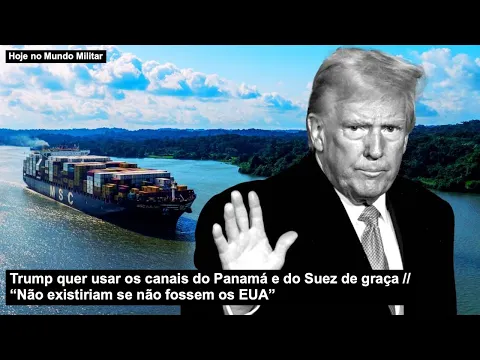
The President of the United States, Donald Trump, requested on Saturday (26) that all American commercial and military ships have free passage through the Panama and Suez canals. The order was given to Secretary of State Marco Rubio, with the aim of starting negotiations “immediately” on the matter.
The statement was made by Trump via the Truth Social platform. According to the president, the two maritime routes are vital for international trade and, in his view, “would not exist without the United States.” He emphasized that American commercial and military vessels should transit “without costs” through the two strategic canals.
Trump Reinforces Longstanding Interest in Controlling the Panama Canal
The demand regarding the Panama Canal is not new. Even before resuming the presidency, Donald Trump had already expressed the desire to reassess control of the interoceanic passage, built by the U.S. in the early 20th century. The construction was inaugurated in 1914 and remained under American administration until 1999.
-
Nuclear Submarine USS Alexandria Retired After 35 Years, Having Completed Over 1 Million Miles in Missions

-
MODEC Introduces New Hull Design for FPSO Gato do Mato to Produce Up to 120,000 Barrels of Oil Per Day in Brazil’s Pre-Salt Region
-
This Massive 12-Meter, 21-Ton Underwater Drone Can Operate Autonomously for Up to Five Days

-
Global Shipping Faces Shortage of Certified Maritime Officers, Salaries in the U.S. Can Exceed $100,000 Annually



Control was transferred to the Panamanian government after an agreement signed in 1977 by then U.S. President Jimmy Carter. Since then, the canal has solidified its position as one of the world’s main maritime corridors, responsible for about 5% of global trade.
In recent weeks, the U.S. has intensified its military presence in the Panama Canal region after accusing China of trying to expand its influence over the passage. In April, the Panamanian government authorized the movement of American troops in areas close to the route, amid security alerts.
Suez Canal Also Comes Into the Crosshairs of the United States
Besides the Panama Canal, Donald Trump has turned his attention to the Suez Canal in Egypt. The passage, which concentrates approximately 10% of global maritime transport, has gained prominence after recent conflicts in the Red Sea region.
Since late 2023, attacks by Houthi rebels from Yemen on commercial and military vessels near the Suez Canal have affected maritime traffic. The actions were justified by the groups as support for the Palestinian cause in the war between Israel and Hamas.
With the increase in insecurity, many vessels have begun to avoid the Red Sea, opting for alternative routes around the African continent. This has resulted in logistical delays and increased costs in international trade.
To try to restore security in the region, the U.S. and allies conducted military operations in the Red Sea and the Gulf of Aden, targeting Houthi positions. Nevertheless, instability persists, directly affecting passage through the Suez Canal.
Free Passage is Strategic for the U.S. in Global Trade
Donald Trump’s initiative to ensure free access to the Panama and Suez canals seeks to secure essential trade routes for the U.S. Both waterways play a central role in the movement of goods between America, Asia, Europe, and the Middle East.
In the case of the Panama Canal, the United States competes with China, the main competitor in terms of cargo volume. Meanwhile, in the Suez Canal, concerns have intensified in light of the threat posed by attacks in the Red Sea.
By ordering direct action from Secretary of State Marco Rubio, Trump signals the intention to negotiate formal guarantees of free passage for American commercial and military ships, both in the Panama Canal and the Suez Canal.
Context Reinforces Competition for Global Influence
The U.S. actions regarding the Panama and Suez canals reflect the current geopolitical landscape, marked by competition for strategic trade routes. Control or influence over these maritime corridors can significantly impact international trade and global supply chains.
Donald Trump’s positioning suggests that the country will seek to strengthen its presence in these regions in the coming months, both through diplomatic negotiations and, if necessary, through additional security measures.
Source: CartaCapital