Portuguese
  Spanish


Discovery in Tonga Reveals 1,300-Ton Rock That Was Launched by a Tsunami About 7,000 Years Ago, Reinforcing Alerts About Coastal Risks.
A colossal rock weighing nearly 1,300 tons has been discovered in Tonga, in the South Pacific, and it may be the largest ever transported by waves on the planet.
The discovery is impressive not only for the size of the rock but also for the information it brings about past extreme events.
Unexpected Discovery in the Interior of the Island
The finding was made by Martin Köhler from the University of Queensland while examining the southern side of Tongatapu Island.
-
16-Year-Old from Brazil’s Sertão Wins Young Scientist Award for AI Predicting Rainfall with 94.5% Accuracy to Aid Farmers

-
Netherlands Reports First Child Euthanasia Case Since Rule Expansion for Minors

-
Brazilian Innovator Survives Homemade Submarine Dive in Paraty Despite Hatch Leak and False Oxygen Alarm
-
China Develops Custom 140-Ton Electric Mining Truck with 770 kWh Swappable Battery, Deploys 290 Units in Xinjiang’s Largest Zinc Mine



He and his team were looking for signs of ancient tsunamis in the coastal cliffs when they received a tip from local residents.
“It was already late, and we were talking to some farmers when they pointed out this rock to us,” Köhler said. “I was very surprised; it is located deep inland, outside our field work area, and must have been carried by a large tsunami.”
The rock, named Maka Lahi, is situated more than 200 meters from the coast and has impressive dimensions: 14 meters long, 12 meters wide, and 6.7 meters high. A 3D model was created to analyze its path.
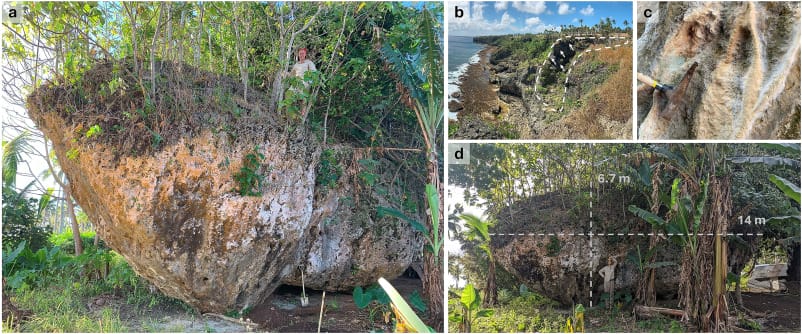
Giant Tsunami Likely Carried the Rock
According to simulations conducted by the team, the Maka Lahi was ripped from a cliff more than 30 meters above sea level.
To achieve this, a tsunami with waves of up to 50 meters high and lasting about 90 seconds would be necessary.
This extreme event occurred approximately 7,000 years ago during the Holocene.
Researchers believe that the force of the tsunami was the result of an underwater earthquake or volcanic eruption—common events in the tectonically active Tonga region.
The Maka Lahi is now considered the largest known rock on top of a cliff moved by wave action, according to researchers.
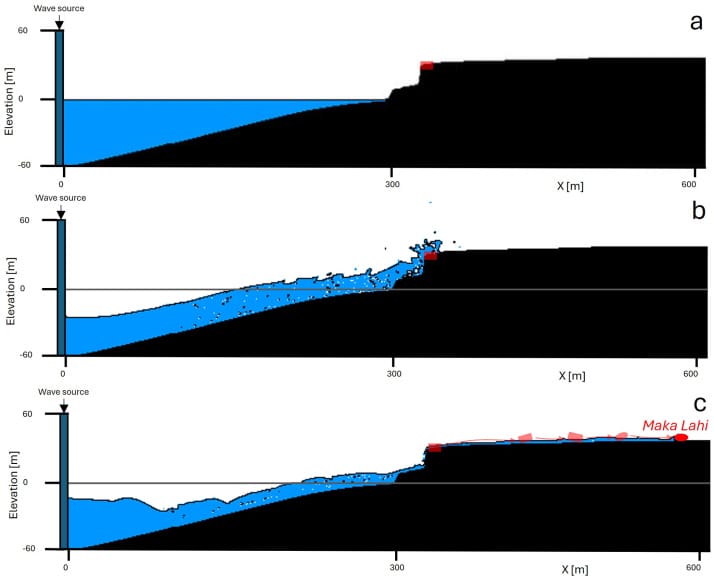
schematic cross-section of the bathymetry and topography used in numerical modeling in CADMAS-SURF. (a) Pre-event scenario illustrating the coastal morphology of the southern coast of Tongatapu. (b) Tsunami impacting the cliff. (c) Resulting flow and inland transport of
Maka Lahi. Pebble not to scale.
Importance for the Present and the Future
Beyond its historical significance, the discovery holds current value. The region has already been hit by other tsunamis, including one in 2022 that caused six deaths and destruction in various areas.
For Dr. Annie Lau, co-author of the study, understanding ancient events is essential. “Understanding past extreme events is crucial for preparedness and risk assessment, both now and in the future,” she stated.
Global Coastal Risk Assessment
The research findings extend beyond Tonga. According to Lau, understanding how such large rocks were transported by waves helps refine risk models in coastal areas.
“The findings we reported regarding the Maka Lahi rock provide evidence of a tsunami in the Pacific region during the Holocene,” Lau explained. “The analysis strengthens our understanding of rock transport by waves to improve coastal risk assessments in tsunami-prone regions worldwide.”
The study was published in Marine Geology.