






 Portuguese
  Spanish
  4 min of reading
  15 comments


A Grandiose Work That Impresses by Its Extent and Importance to the Economy, Connecting Bom Jardim de Minas to Santa Rita de Jacutinga. Discover the Details of the Tunelão: The Largest Railway Tunnel in Brazil!
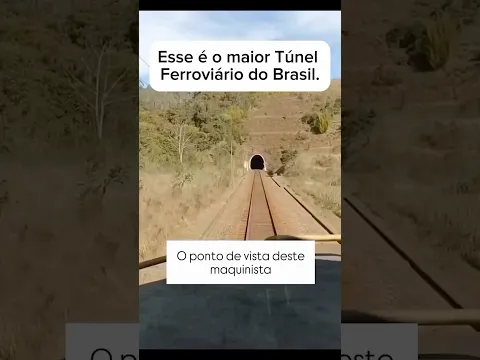
When we think of grand works in Brazil, highways and bridges often steal the spotlight. But did you know that in Minas Gerais lies the largest railway tunnel in the country? The famous Tunelão, which connects Bom Jardim de Minas to Santa Rita de Jacutinga, impresses not only with its size but also with the complexity of its construction and its importance to the economy. If you are a fan of curiosities about infrastructure and transportation, get ready to learn about the details of this giant that spans 8.6 kilometers in length!
How the Tunelão Changed Transportation in Brazil
The Tunelão is an essential part of the Steel Railway, a railway line designed to facilitate the transport of industrial products between Itabirito, in Minas Gerais, and Barra Mansa, in Rio de Janeiro. The crossing of the tunnel takes about 12 minutes, with trains maintaining an average speed of 50 km/h along its more than 8.6 kilometers. That’s a lot of ground (or rather, rock) to cover!
In addition to being a landmark in size, the largest railway tunnel in the country plays a strategic role: it connects key points for the flow of goods and boosts the transport of heavy cargo, such as iron ore. The Steel Railway, also nicknamed the 1,000-Day Railway by railway workers, is an essential corridor for industries that depend on efficient logistics.
-
Survivor of 1966 SS Daniel J. Morrell Shipwreck in Lake Huron Recounts 38-Hour Ordeal in Extreme Cold

-
The Greatest Hoax in World Cup History? The Film That Denied Brazil’s 1958 Victory and Exposed How Fake Evidence Can Seem Convincing on TV
-
Fake South Korean Online Stores Offer Shopping Thrill Without Spending Money or Receiving Products
-
The War of Jenkins’ Ear: How a Severed Ear Sparked One of the 18th Century’s Most Unusual Conflicts



A Giant Overcoming Natural Barriers
The construction of the Tunelão was no easy feat. The challenging terrain, with solid rock and natural barriers, required the use of advanced technologies for drilling and installing ventilation systems. Additionally, safety was a constant concern throughout the entire process.
The tunnel is a true masterpiece of engineering. Designed to support the continuous transport of heavy locomotives, it features modern systems that ensure proper ventilation and constant monitoring. This makes it possible to safely transport tons of cargo every day, even in such a complex environment.
The Tunelão and Its “Brothers” in the Steel Railway
If you think the Tunelão is the only highlight of this railway, you are mistaken. It is part of a gigantic system that includes another 81 tunnels distributed along the Steel Railway. Together, they form a true railway labyrinth, connecting important regions such as Belo Horizonte, Juiz de Fora, and Vitória.
These connections are not just a engineering landmark, but also an economic development one. The railway allows cargo to reach the port of Vitória, in Espírito Santo, efficiently facilitating exports and boosting the local economy.
Benefits of the Largest Railway Tunnel in the Country
The presence of the Tunelão and the entire Steel Railway goes far beyond impressing with its grandeur. Nearby cities such as Ouro Preto, Juiz de Fora, and Vitória reap direct benefits from cargo transport. This flow of goods not only strengthens local economies but also contributes to job creation and improves regional infrastructure.
Another positive aspect is the environmental impact. Rail transport is more sustainable than road alternatives, as it consumes less fuel and reduces the emission of polluting gases. This makes the largest railway tunnel in the country a friend not only of the economy but also of the environment.
A Historic and Technological Milestone with the Arrival of the Railway Tunnel
The Tunelão is much more than a tunnel: it represents the overcoming of challenges and the advancement of engineering in Brazil. Built in a setting of natural barriers, it is proof that with planning and technology, it is possible to turn difficulties into opportunities.
Moreover, the Tunelão is a symbol of regional integration. It connects states, fosters the transport of goods, and highlights the importance of railways in the country’s development. Its grandeur is a reminder of what Brazil is capable of achieving when investing in infrastructure.
The Future of Rail Transport in Brazil
The success of the Tunelão raises an important discussion: how can Brazil make better use of rail transport? In a country with continental dimensions, railways are a practical and sustainable solution for the flow of products. The Steel Railway, with its system of tunnels, shows that investments in this sector can bring long-term benefits.
Whether for its grandeur, functionality, or impact on the economy, the largest railway tunnel in the country continues to be an example of innovation and efficiency. And who knows, it may inspire new projects that can further boost rail transport in Brazil.
Now that you know the details of the Tunelão, it is impossible not to admire this monumental work that connects regions and propels Brazil towards the future. Who knows, the next giant tunnel may be on its way!





Parabéns para este projeto ,espero que a ferrovia 158 ou 118 que liga Rio de Janeiro ao porto do açú a vitória , eu espero que saia do papel
Os governos militares destruíram as nossas milhas ferroviárias por burrice e incompetência. Se ficarem **** é pior.
Tá revoltado? Você nunca foi trabalhador.