






 Portuguese
  Spanish


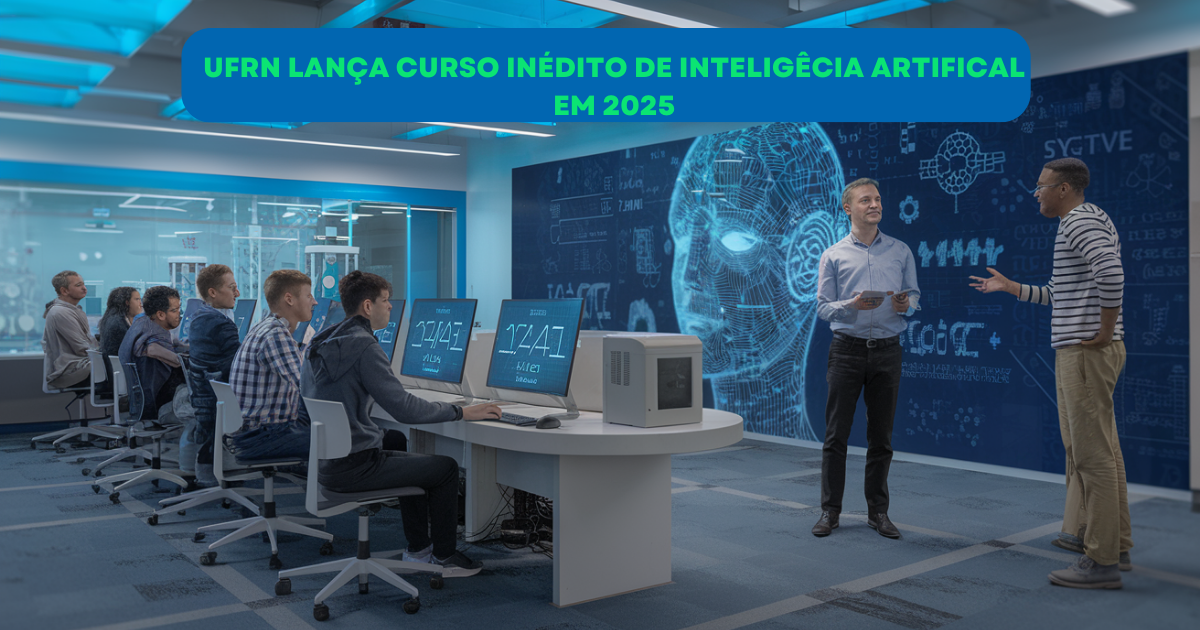


In 2025, UFRN Launches the Bachelor’s Degree in Artificial Intelligence, Preparing Professionals to Face Global Technological Challenges. The Initiative, Along with New Degree Programs in Computer Engineering and Energy, Establishes the University as a Reference in Innovation in Brazil.
The universe of technology and education in Brazil has just received an extraordinary boost. The Federal University of Rio Grande do Norte (UFRN) has revealed an ambitious plan that promises to transform academic training in the technological field.
In a historic decision, the institution approved the creation of the Bachelor’s Degree in Artificial Intelligence, marking a new chapter in higher education in the country.
This measure, however, goes beyond just another degree. UFRN aims to train highly qualified professionals to tackle one of today’s most promising and complex fields.
-
Surprising opportunity in the railway sector: MRS offers a free course for assistant train driver and shunter in Juiz de Fora with a R$ 1,600 scholarship, specialized training, and the chance to join one of the largest railway operators in Brazil.

-
It’s official: IFMS opens spots in free courses on artificial intelligence, drones, and app creation, expanding technological education in 2026 and preparing students for areas with high professional demand and accelerated digital transformation.
-
Senai launches an unprecedented program with Petrobras and opens 2,000 spots in free courses with recognized certification, a monthly allowance of R$ 600, and training for industrial professions that continue hiring across the country.

-
Petrobras and SENAI open 480 spots in free technical courses with a scholarship of up to R$ 858, meal allowance, and training in Mechanics, Welding, Metallurgy, and Industrial Automation to meet the growing demand of the industry and the oil and gas sector.


UFRN Opens the Doors to Artificial Intelligence
In September 2024, UFRN’s Council of Teaching, Research and Extension (Consepe) approved the implementation of the Bachelor’s Degree in Artificial Intelligence, which will be offered at the Natal campus, linked to the Digital Metropolis Institute (IMD). Set to begin in 2025, the course will initially offer 40 spots.
The degree aims to equip students to develop technological solutions for complex challenges, using the most advanced tools in artificial intelligence.
According to Consepe, the focus is on training professionals capable of innovating in areas such as machine learning, data science, and generative AI, technologies that have transformed industries worldwide.
In addition, UFRN announced two more degree programs: Computer Engineering at the Caicó campus and Energy Engineering at the Natal campus.
These initiatives further strengthen the university’s commitment to expanding academic options and meeting market demands for specialized professionals in technology and renewable energy.
Number of Spots and Changes for 2025
With the creation of the new courses, the total number of spots for 2025 will increase to 7,886, an increase of 55 compared to 2024. Of these, 7,241 spots will be available through the Unified Selection System (Sisu), divided into 4,952 for the first semester and 2,289 for the second.
According to UFRN, the other 645 spots will be filled through specific selection processes and readmission. The Bachelor’s Degree in Artificial Intelligence is part of this last modality, solidifying itself as a strategic option for those wishing to specialize in this emerging field.
In terms of selection criteria, UFRN has updated the weights and minimum scores for admission to its courses. However, the regional bonus applied in previous years will be discontinued, following a decision by the Supreme Federal Court.
Focus on Technology: UFRN and Strategic Partnerships
The creation of the Artificial Intelligence course is not UFRN’s only action in the technology field. Recently, the IMD began construction of the Artificial Intelligence and Data Science Center (NIACID), a research center with a budget of R$ 3.3 million.
According to UFRN’s advisory board, NIACID will bring together scientific projects from companies and researchers, establishing the Natal campus as an innovation hub in northeastern Brazil.
Furthermore, partnerships with giants like Dell Technologies are strengthening educational offerings. In 2024, the university launched the Dell Technologies AI Delivery Academy, a free eight-month course in Artificial Intelligence with R$ 1,200 scholarships for participants. This initiative complements UFRN’s efforts to prepare the next generation of leaders in technology.
Impacts on the Market and Society
The advancement of Artificial Intelligence is already transforming the global job market. In Brazil, the demand for specialized professionals exceeds supply, especially in areas such as data analysis, automation, and software development.
According to the World Economic Forum, around 97 million new roles will emerge by 2025 due to the adoption of advanced technologies.
With the implementation of the AI course, UFRN not only responds to this growing demand but also positions itself as a pioneer in developing regional talents.
Additionally, the focus on renewable energy in the Energy Engineering program reflects a commitment to sustainability, aligning with global carbon emission reduction targets.
What to Expect for the Future?
The creation of the Bachelor’s Degree in Artificial Intelligence and other courses marks a new era for UFRN, placing the institution among the most innovative in Brazil.
But the success of these initiatives will depend on effective execution and continued investment in infrastructure and training.
Do you believe these changes will help solidify Brazil as a leader in technological innovation?








Só não acredito na gratuidade q vcs expõem no anuncio😅