Portuguese
  Spanish


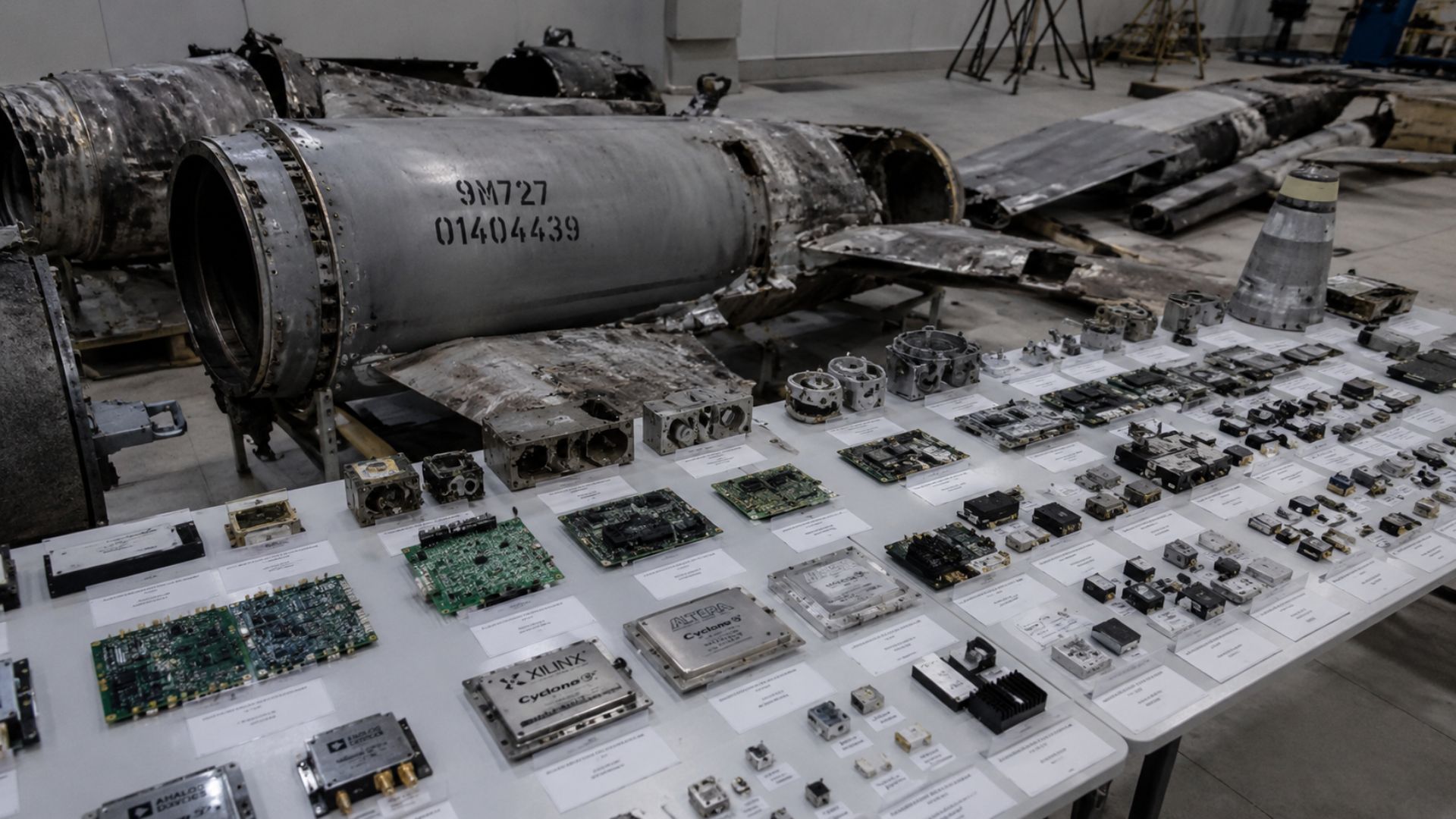

According to the portal Xataka, Ukraine dismantled debris from Kh-101 missiles that hit residential buildings in Kyiv and found more than a hundred components manufactured by American and European companies inside each missile, including chips and microelectronics systems produced in 2024, 2025, and even 2026, years after the sanctions packages that were supposed to have cut off Russia’s access to this technology.
The discovery exposes one of the biggest failures of modern technological warfare: imposing sanctions does not necessarily mean stopping the supply. Russia continues accessing Western microelectronics through re-exports, intermediaries, obscure distributors, and hard-to-track commercial networks, and some components also come from China as compatible copies of Western designs. For Ukraine, the discovery is particularly bitter: the missiles that devastate Ukrainian cities rely, in part, on technology designed and manufactured by the same countries that provide anti-aircraft systems and military aid to Kyiv. The paradox reveals that, in the 21st-century war, dismantling an enemy missile means not only studying its military technology but discovering to what extent the global market continues indirectly fueling the war it claims to want to prevent.
More than a hundred Western components in each missile

The Ukrainian teams that analyzed the Kh-101 debris in Kyiv expected to find Russian technology, perhaps Chinese parts or improvised systems to circumvent sanctions. What they discovered was more disturbing: each missile contained more than a hundred components manufactured by companies from the United States and Europe, including chips, microcontrollers, and essential electronic systems for navigation, guidance, and flight control. Without these components, the missile does not function as designed.
Some of these chips were manufactured in 2024 and 2025, and there are records of components dated 2026, demonstrating that the flow of Western technology to the Russian military industry has not decreased with the sanctions. The presence of recent parts indicates that the supply chain feeding Russia is active and operational, with supply routes that adapt faster than Western governments can track and block. For Ukrainian investigators, opening a Russian missile has become an exercise in auditing their allies’ own supply chain.
-
Largest Known Single-Piece Meteorite, Weighing 60 Tons, Puzzles Scientists with Its Intact Fall and Lack of Visible Crater

-
Oceanographer Turns Abandoned Fishing Nets from Brazilian Waters into Bags, Creating Jobs and Earning Over $7,000 Monthly

-
Australia deploys poisoned sausages and uses traps, shooting, and fences in a battle against invasive cats that kill over 1.5 billion native animals annually, threatening more than 200 species.

-
NASA Rover Captures “Tired Face” on Mars, Highlighting Human Brain’s Tendency to See Faces in Rock Formations





The Kh-101: the missile that Russia keeps perfecting

image: missilethreat
The Kh-101 has become one of the central pieces of the Russian air campaign against Ukraine. Launched from strategic bombers and designed for long-range flights at low altitude, the missile is difficult to detect by conventional radars and requires sophisticated anti-aircraft systems to be intercepted. Since 2022, Russia has multiplied the production of the Kh-101 to levels much higher than before the invasion, demonstrating industrial capacity that sanctions should have compromised.
Russia also continuously modifies the missile to make interception more difficult. The latest versions incorporate improvements in anti-jamming systems, more sophisticated navigation, dual warheads that reduce fuel consumption, and fragmentation munitions with zirconium elements to increase destructive power. Ukraine continues to intercept a significant portion of these missiles, but each new evolution requires the expenditure of more defensive resources, and Russia’s ability to iterate the design demonstrates that Moscow maintains sufficient industrial infrastructure to sustain a prolonged technological war.
How Western technology reaches Russia despite sanctions
The path between a chip factory in the United States or Europe and a Russian missile hitting Kiev involves multiple layers of intermediaries. Russia accesses Western microelectronics through re-exports via countries that do not apply sanctions, distributors operating in gray areas of international trade, and complex commercial networks that fragment orders into small quantities to avoid detection. Some parts arrive via China, either as original products resold or as locally manufactured compatible clones based on Western designs.
The result is that Moscow has managed to maintain and expand its missile production despite the declared economic isolation. Sanctions have imposed additional costs and complicated logistics, but have not cut off supply. The difference between announcing restrictions and making them work is at the center of Ukrainian frustration: Kiev watches missiles with American and European technology destroying its cities while the same countries that manufactured the chips fund the defense systems trying to shoot down these missiles.
The paradox that bothers the West
The history of the Kh-101 reflects a contradiction that Western governments would prefer not to face. While the United States and Europe provide Patriot and NASAMS anti-air systems, military intelligence, and billions of dollars in economic aid to Ukraine, part of the global technology industry continues to infiltrate components into the Russian military machine. In practice, Western companies may see their own chips inside missiles that, in turn, force the use of interceptors funded by the West and costing millions of dollars per unit.
This paradoxical cycle fuels a war where the same side pays to attack and to defend. For Ukraine, the problem is no longer just Russia: it is the inability of global supply chains to prevent critical technologies from reaching the Kremlin’s military production. Each missile shot down over Kyiv that reveals American and European chips inside is physical proof that the sanctions system, in its current form, is not fulfilling the promise to strangle Russia’s military capability.
The industrial war that no sanction has managed to stop
The analysis of the debris from the attack on Kyiv is also revealing how modern war works in industrial terms. No current major power manufactures advanced weaponry completely isolated from the global market. Missiles, drones, and guidance systems depend on an international network of microelectronics, software, and components that is extremely difficult to control, even with the political will to do so.
Russia has demonstrated that, even under the broadest sanctions ever imposed on a major economy, it still manages to access a significant portion of the global technological infrastructure. The lesson for governments and regulators is that sanctions on high-tech products require real-time monitoring of supply chains, active cooperation with intermediary countries, and a willingness to punish companies that, directly or indirectly, allow technology to reach the prohibited destination. Without this monitoring capability, sanctions function as declarations of intent that global trade circumvents.
A missile that reveals more than the war wants to show
Ukraine dismantled Russian Kh-101 missiles and found more than a hundred Western components in each, including chips manufactured in 2025 and 2026. The discovery proves that American and European technology continues to reach Russia through intermediaries, that sanctions have not cut off the supply, and that the global supply chain indirectly fuels the war that the West claims to want to prevent. Each missile opened in Kyiv is an involuntary audit of a sanctions system that promises more than it delivers.
What do you think about discovering American and European chips inside Russian missiles attacking Ukraine? Tell us in the comments if you believe sanctions can be effective against global supply chains, how you evaluate the paradox of funding defense and indirectly fueling the attack, and whether responsibility should fall on the chip manufacturers or the intermediaries. We want to hear your opinion.