Portuguese
  Spanish


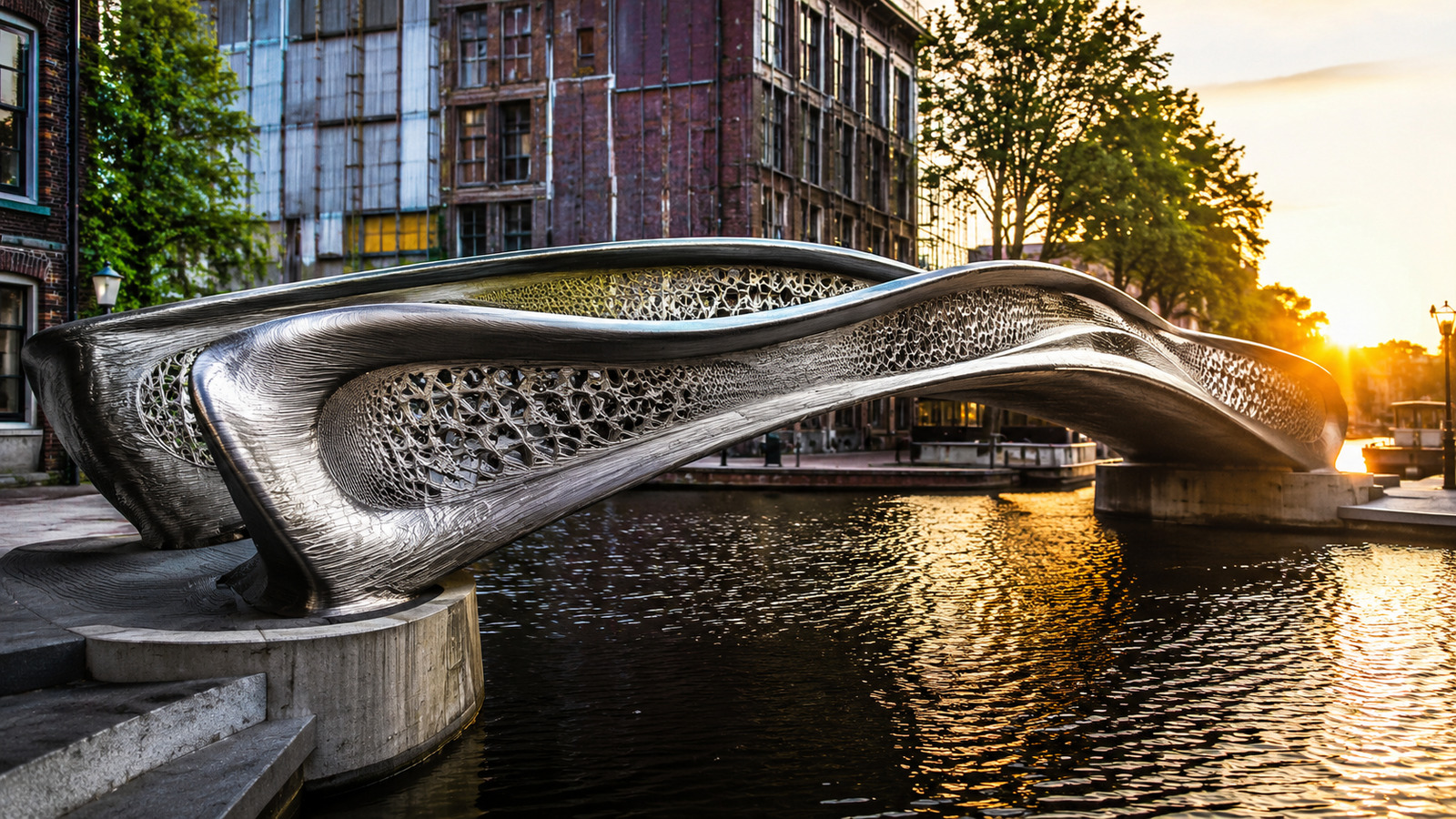


Built by MX3D with WAAM technology, the stainless steel bridge in Amsterdam combines 3D printing, real-time sensors, and digital twin to reduce waste and test new paths for public works
The world’s first 3D printed bridge was built by MX3D over a canal in Amsterdam, using four industrial robotic arms, stainless steel, and sensors to test a new form of public infrastructure.


How the 3D printed bridge was built
The structure was formed by continuous layers of stainless steel deposited by industrial robots. The printing took six months, a shorter time than expected in a conventional site, where there would be more stages and waste.
The process used was Wire Arc Additive Manufacturing, known as WAAM. In it, a six-axis robotic arm holds a welding torch and deposits wire beads, layer by layer, following a digital model.
-
Brazil Constructs First Japanese SABO Barrier in Nova Friburgo to Prevent Landslides, a $3 Million Concrete Trap for Rocks, Logs, and Mud

-
Brazilian Navy’s Technology Plays Strategic Role in Future of Small Modular Reactors, Boosting Nuclear Energy Capacity with Innovative Solutions for Power Generation and Industrial Applications

-
China Surpasses U.S. and Russia Combined in Submarine Production
-
Xiaomi Unveils Smart Glasses in Brazil with 12MP Camera, 4K Video, and AI Features, Challenging Ray-Ban Meta


MX3D created its own software to transform ABB welding robots into metal printers controlled by CAD files. Four robots worked in parallel at the old NDSM shipyard in northern Amsterdam.
WAAM reduced waste and allowed complex shapes
Metal additive construction places steel only where the structure needs it. With computational design and topological optimization, unnecessary material is eliminated millimeter by millimeter, without relying on traditional cuts and welds.
This method gave the 3D printed bridge a design inspired by organic structures, with curves, perforations, and thickness variations. These shapes would be expensive or unfeasible in a common construction.
The structure is 12.2 meters long and weighs 4.9 tons. The printing used over 6,000 kg of stainless steel wire as the total input, with surplus reduced to a minimum.
The S-shape and perforated balustrades were defined by generative design algorithms, such as Grasshopper and Karamba.

Financing and structural validation
The project received funding from the Lloyd’s Register Foundation. The grant was £320,000 for a project that lasted from 2017 to 2025.
Among the industrial partners were ABB Robotics, ArcelorMittal, Autodesk, and the construction company Heijmans. Since there was no normative code for 3D printed steel, structural safety needed to be proven.
The Steel Structures Research Group at Imperial College London, led by Professor Leroy Gardner, characterized the material from scratch. The team conducted destructive and non-destructive tests before opening to the public.
3D Printed Bridge Also Became a Laboratory
In addition to serving pedestrian traffic, the 3D printed bridge functions as a smart infrastructure laboratory.
Sensors monitor deformation, vibration, temperature, displacement, and air quality in real-time.
This data feeds a digital twin managed by The Alan Turing Institute, in partnership with Autodesk and the University of Cambridge. The computational model accurately mimics the physical bridge with increasing precision.
With this system, engineers can anticipate wear, test load hypotheses, and monitor structural health without interrupting use. The sensors also analyze user movement and the dynamic loads generated.
Monitoring includes internal forces, fatigue-related oscillations, environmental conditions over the canal, and temperature and corrosion effects throughout the seasons. The system gathers structural and environmental information.

Recognition and Future of the Technology
The bridge received the Outstanding Development in Welded Fabrication award from the American Welding Society. With this, it entered a historic list that includes the Panama Canal and the Curiosity rover.
The recognition indicates that metal additive manufacturing is no longer a prototype. MX3D has already taken WAAM technology to the maritime, nuclear, aerospace, and energy sectors.
The next step is commercial scale. The goal is to make the process cost-competitive against conventional rolled steel, so that complex, fast, and minimally wasteful constructions become the norm rather than the exception.
With information from Monitor do Mercado.