Portuguese
  Spanish


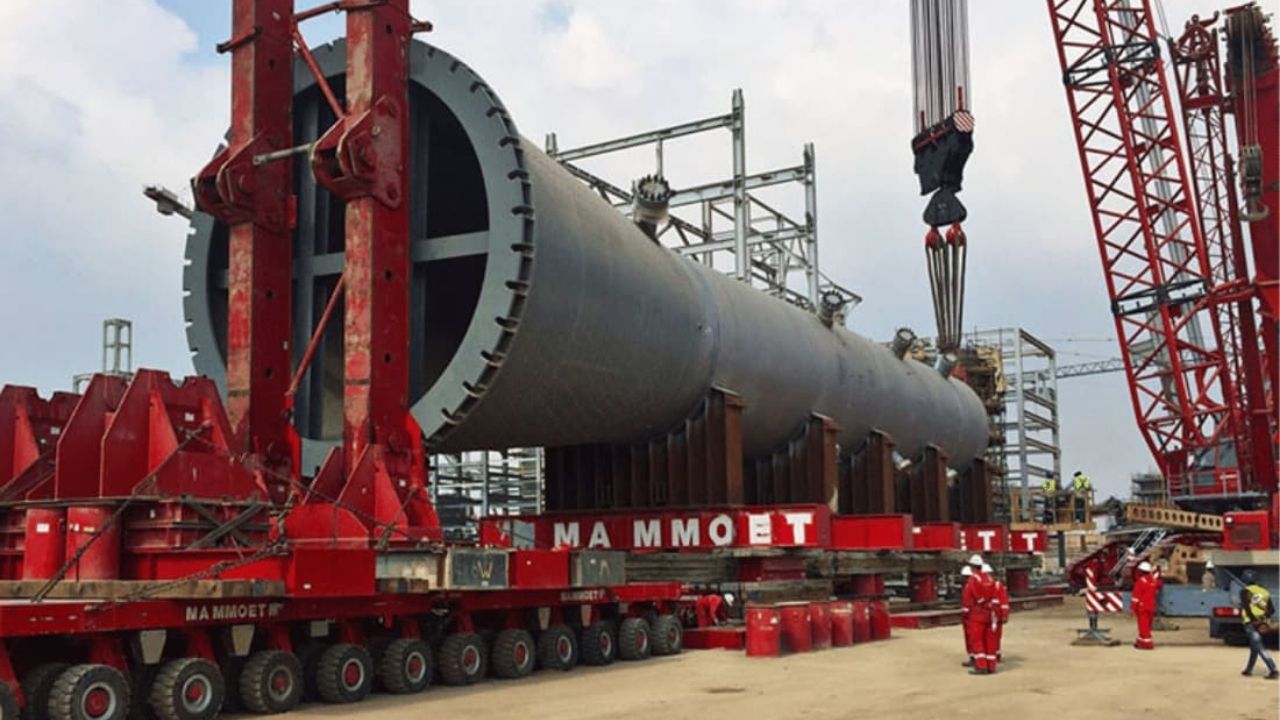


The giant load transported by Mammoet in Egypt carried a 1,220-ton hydrorefinery reactor over 247 km between Suez and Mostorod, using 102-axle SPMTs, tunnel reinforcement, road compaction, and obstacle removal to meet the Egyptian Refining Company’s project for local refining modernization.
The giant 1,220-ton load was transported by Mammoet in Egypt, in a 247 km land operation between Suez and Mostorod, in the Cairo region. The movement took place within the Egyptian Refining Company project, created to modernize diesel and LPG production in the country.
According to Mammoet, the operation involved 16 heavy items received between August and December 2014, with the last component arriving in July 2015. The land transport began on October 1, while the largest reactor arrived at the site on December 5 and was lifted on December 11.
Largest load ever received by Egypt required a prepared route

The transport of the giant load marked a historic achievement for Mammoet and heavy logistics in Egypt. The company needed to carry the hydrorefinery reactor through deserts, mountain roads, highways, and urban sections to the ERC complex in Mostorod, Qalubiya.
-
Cost of Installing Electric Fences in 2026: Price Per Meter and Factors Affecting Installation

-
Retired Builder Constructs House Using Over 4,000 Milk Cartons in Brazil, Engineer Estimates Structure Could Last 100 Years

-
Concrete-filled PVC homes could be cheaper than traditional masonry, UPF research finds; with ready modular panels, less waste, and faster construction, the Concrete-PVC system aims to cut costs and transform affordable housing in Brazil.
-
Brazilian House Built with 32.8 Tons of Construction Debris Offers Affordable Housing Solution



The 247 km distance became the longest route ever traveled by SPMTs in Mammoet’s history up to that moment. The route connected the Suez region to the outskirts of Cairo, crossing areas with different levels of difficulty.
Even before the operation began, civil works were necessary. More than 30 km of roads were compacted and reinforced to support the load’s weight and the passage of self-propelled modular transporters.
Five road tunnels also needed reinforcement with steel beams and hydraulic jacks. Without this preparation, the road structure would not have been safely able to accommodate a 1,220-ton moving piece.
102-axle SPMTs took the reactor to Mostorod
The largest piece transported was a hydrorefining reactor weighing 1,220 tons. To move this giant load, Mammoet used three SPMT trains with 34 axle lines each, forming a total configuration of 102 axles.
These self-propelled transporters are used in operations where conventional trucks cannot operate. They distribute the weight at several points, allow precise maneuvers, and can move industrial structures of extreme dimensions.
The transport of the reactor took 45 days until its safe arrival at the construction site on December 5th. A few days later, on December 11th, the piece was hoisted and installed on the foundation prepared to receive it.
On site, Mammoet cranes of 1,600 and 750 tons were positioned to receive and install the heavy items. The operation required synchronization between transport, civil engineering, hoisting, and industrial assembly.
Urban obstacles had to be removed

In addition to the resistance of roads and tunnels, the route also faced urban obstacles. To clear the way, it was necessary to cut down 80 city trees, remove 250 light poles, and take down more than 200 traffic barriers.
The load did not just travel a route: the route itself had to be temporarily redesigned for it to pass. This is one of the points that make operations of this type so complex and expensive.
The route also included inclines of up to 4%, an additional challenge for a composition with extreme weight. In heavy loads, any ramp requires careful control of traction, stability, and braking.
The passage through Cairo increased the difficulty. The Egyptian capital is among the busiest cities in the world, and crossing its area of influence with a giant load required planning to reduce risks, delays, and impacts on traffic.
Project involved 16 heavy items for refinery
The 1,220-ton reactor was the most impressive component, but not the only one. In total, Mammoet transported 16 heavy items for the Egyptian Refining Company, in an industrial package linked to the expansion and modernization of the refinery.
The total load of the project reached 1,700 tons. For the first time in Egypt, items of this size were moved with high-tech self-propelled modular vehicles in an operation of this type.
Two smaller reactors, weighing 79 and 140 tons, were safely transported and installed back in mid-October. These previous movements helped prepare the sequence for the heaviest stage of the project.
The entire operation was expected to last at least five months. This shows that transporting giant cargo is not just a slow journey, but a chain of interdependent steps, including route preparation, movement, receipt, and installation.
Refinery targets diesel and LPG for the Egyptian market
The Egyptian Refining Company was established in July 2007 with the aim of modernizing an existing refinery and directing production towards lighter derivatives, such as diesel and LPG. This point helps explain the industrial importance of the operation.
Many Egyptian refineries were prepared to produce large volumes of fuel oil, while demand was growing precisely for lighter products. The giant cargo was part of a structural response to this energy challenge.
The ERC project was described as one of the largest semi-governmental undertakings underway in Egypt at that time. The heavy logistics, therefore, was not just a technical step: it supported a transformation in the country’s refining capacity.
By installing new equipment, the refinery sought to expand production, better meet the domestic market, and reduce dependencies in a strategic sector for transportation, industry, and supply.
Operation also tested the country’s infrastructure


The transport of the giant cargo served as a proof of capacity for Egyptian infrastructure. The operation showed that, with reinforcements, planning, and specialized equipment, the country could receive and move industrial components of extremely high weight.
This type of operation increases investor confidence because it demonstrates real logistical capability. Energy, oil, gas, and heavy industry projects depend on routes capable of receiving huge equipment.
The presence of international professionals in cooperation with Egyptian specialists also reinforced the complexity of the work. The operation required technical knowledge in heavy transport, civil works, safety, engineering, and urban coordination.
In the end, the 247 km route became more than just a displacement. It functioned as a stress test for roads, tunnels, public planning, and operational capacity.
When logistics becomes part of the work
The journey of the 1,220-ton reactor shows that large industrial projects do not rely solely on construction at the final destination. Often, the hardest part begins beforehand, when each piece needs to overcome ports, roads, tunnels, and cities.
Mammoet’s giant cargo in Egypt turned transportation into precision engineering. It involved 102 axles, 45 days of movement, tunnel reinforcement, obstacle removal, and a route prepared to cross even busy areas near Cairo.
The case also shows how heavy logistics can influence the future of a national industry. Without transporting the reactor, there would be no installation. Without installation, the refinery’s modernization would not advance at the same pace.
Do you find the weight of 1,220 tons more impressive or the fact that a 247 km route was adapted for a single load to pass? Leave your opinion in the comments.