






 Portuguese
  Spanish


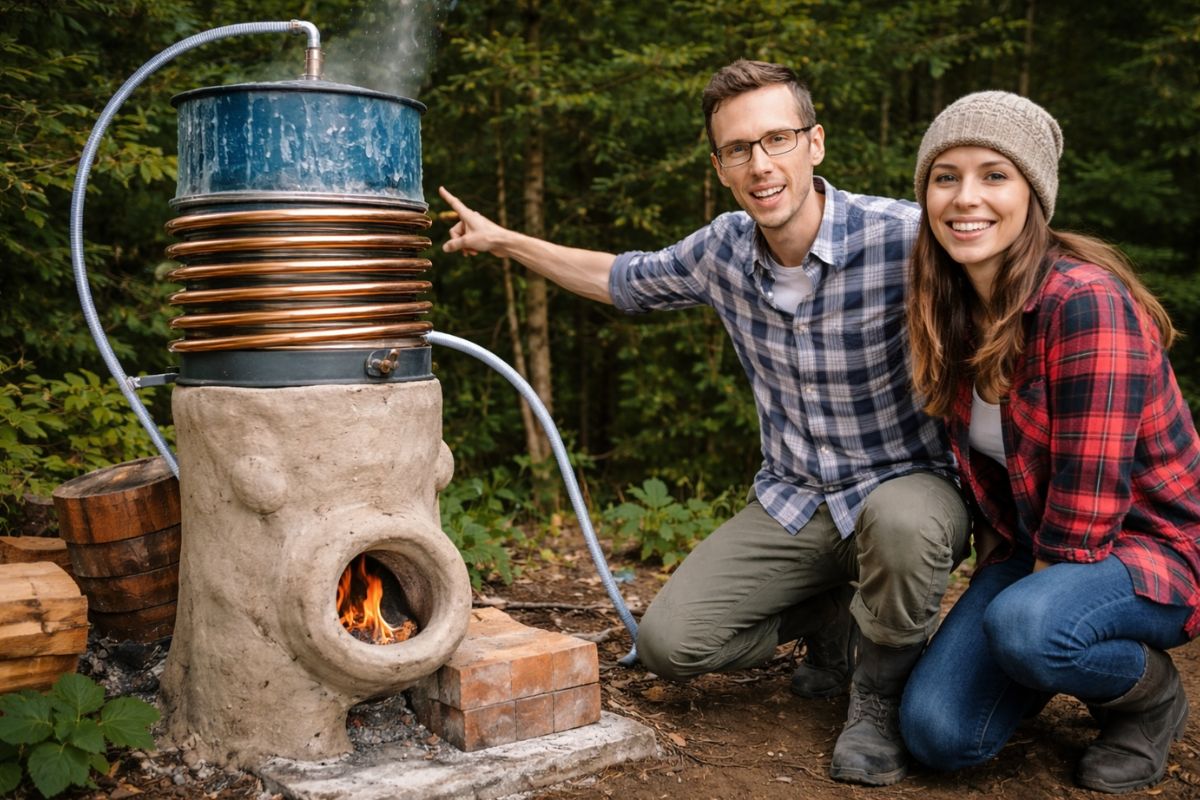


Sébastien and Isabelle, in Harrington, built a water heater that cooks and heats at the same time, using a barrel above the fire and a coil of copper pipes in the clay chimney, guided by thermosiphon, with efficient heat and minimal wood without any pump
The water heater appears as a direct response to a simple and recurring problem for those living far from infrastructure: heating water for bathing without relying on propane, a pump, or an outlet. In rural Quebec, the choice was to transform a handmade rocket stove into a continuous and predictable heat source.
The experiment was conducted by Sébastien and Isabelle, who live in Harrington, in an area known as La Natsu. Instead of buying a ready-made system, they decided to test the limits of what the heat from fire can do when channeled with discipline.
A Water Heater That Arises from a Routine

The logic of the project starts from the basics: if the water is above the heating point, it can circulate due to density difference, without a motor.
-
Award-Winning Japanese Restaurant Reveals It Has Preserved Part of the Same Frying Oil for 66 Years

-
American Youth Transforms from Severe Obesity to U.S. Air Force Enlistment, Losing 90 Kilograms in Two Years
-
11-Year-Old Entrepreneur Sells 60 Homemade Sweets Daily, Mastering Cost Calculation, Social Media Promotion, and Client Negotiation Since Age 7

-
Peruvian Mountain’s 5,200 Aligned Holes May Unveil Ancient Indigenous Market for Corn and Cotton


This shifts the conversation for those with firewood but no constant electricity.
The couple’s water heater was designed to function even when everything else fails.
The setting is rural, with life close to nature and manual labor.
The decision to build the water heater also aligns with this context: fewer parts, less maintenance, less dependence on industrialized fuel.
The bet is on structural simplicity, not on electronic complexity.
How the Rocket Stove Becomes a Home Thermal Machine

The rocket stove used by Sébastien and Isabelle follows a design known for its efficiency: three openings with distinct functions.
There is a lower entrance to ignite the fire and pull in air, an intermediate opening to feed the firewood, and an upper exit that serves as a chimney.
The goal is to concentrate heat and keep combustion alive with little wood.
When the rocket stove works well, it produces a stable column of hot air, and this is where the water enters the story.
The chimney was crafted with clay, forming thermal mass that retains heat for some time, even after the fire diminishes.
The hot mass extends heating and smooths temperature spikes.
Elevated Barrel, Copper Pipes, and the Role of the Thermosiphon

The heart of the system is a barrel positioned above the fire level, with two water connections.
The cold water descends from the bottom, travels through the circuit, receives heat and returns through an upper pipe to the same barrel.
The barrel is not a decorative detail: it defines the direction of the flow.
The critical section of the circuit passes through spiral copper pipes within the walls of the chimney, where the temperature is highest and most stable.
As it heats, water becomes less dense and rises, while cooler water descends to take its place, creating natural circulation.
This movement is the thermosiphon, a type of passive heat exchange based on natural convection. Without a thermosiphon, the system becomes just hot metal without useful circulation.
Heating Time, Efficiency, and What the Numbers Suggest
In the presented configuration, heating about half of the barrel required approximately two hours of fire.
The couple’s practical calculation is straightforward: with this heated fraction, it would be possible to take around ten baths, depending on mixing with cold water and usage.
The water heater here does not promise instantaneous results; it promises consistency.
The efficiency of the rocket stove helps explain why the result appears with little firewood, but the prototype still has limitations.
The barrel was not thermally insulated, which accelerates heat loss to the environment, and the declared intention is to migrate to an insulated hot water reservoir, including avoiding the use of a plastic barrel for heating.
Insulation, in this type of project, is almost as valuable as the fire.
Cooking and Heating at the Same Time Changes the Use of Space
There is a practical consequence that is often overlooked when talking about water heaters: the same heat can be used to prepare food.
At the top of the rocket stove, the couple uses the hot spot for cooking while the circuit operates in the chimney.
It’s an economy of tasks, not just energy.
This detail also relates to the organization of space. Instead of two appliances, one set serves as a heat source and as a stove.
The water heater ceases to be a piece of equipment and becomes part of the domestic routine, especially during planned outdoor use, like the idea of an outdoor shower.
When heat is scarce, wasting it becomes a luxury.
What Needs to Go Right to Not Fail at the Decisive Moment
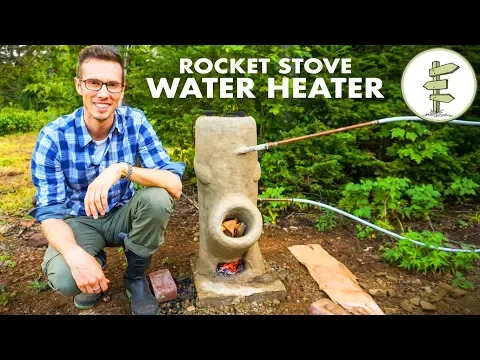

The first requirement is geometric: the barrel needs to be higher than the rocket stove for the thermosiphon to occur.
If this relationship is lost, circulation decreases and the water heater loses performance.
The second is hydraulic: the circuit must allow continuous flow, without constrictions that interrupt convection.
There is also a safety point that comes with any wood-heated water heater: control of temperature and pressure.
Heated water in a circuit requires attention because heat does not negotiate when the system is too closed.
For this reason, even with the allure of simplicity, projects like this require careful evaluation of materials, connections, and usage, especially when the intention is to take it to a real and recurring bath.
Sébastien and Isabelle’s story in Harrington shows how a water heater can arise from a rocket stove, an elevated barrel, copper pipes, and a thermosiphon, without propane, a pump, or electricity.
What stands out is not the improvisation, but the minimal engineering that transforms heat into routine.
If you had to choose a path to heat water for bathing, would you prefer the predictability of propane or the autonomy of a thermosiphon-based water heater? And looking at the rocket stove, which part seems most critical to you: the barrel in the right place, the copper pipes in the chimney, or the safety control for daily use?


