





 Portuguese
  English
  Spanish
  7 min of reading
  0 comments



Student Transforms Agricultural Waste into Panels That Capture UV Light and Generate Energy Even on Cloudy Days with the AuREUS Technology, Awarded Worldwide.
The kitchen of Carvey Ehren Maigue turned into an improvised laboratory during the pandemic. With universities closed and no access to the equipment of Mapúa University, in Manila, the electrical engineering student started crushing spoiled ginger, filtering discarded carrots, and distilling fruit waste on the home stove. The goal was ambitious: to extract luminescent particles from commercially valueless vegetables and convert this material into a panel capable of generating electricity even without direct sunlight. From this routine, the AuREUS (Aurora Renewable Energy and UV Sequestration) was born, a technology awarded the first James Dyson Award Sustainability Award in 2020, chosen among 1,800 entries from 27 countries. At the time, Maigue was 27 years old.
What seemed like a pandemic hack transformed into a serious proposal for solar energy for cloudy days, with potential for use in facades, windows, and vertical surfaces—areas where traditional panels struggle to operate.
AuREUS and the “Blind Spot” of Solar Energy: Why Conventional Panels Lose Efficiency Without Sun
Conventional solar panels have a structural limitation: they were designed to capture mainly visible light with more direct incidence. On cloudy days, the useful irradiance drops, and generation plummets. In practice, in many regions, this dependence on “clean sun” creates a bottleneck that affects predictability and return on investment.
-
The race of humanoid robots in factories has truly begun, Hyundai announced that it will deploy more than 25,000 units of Atlas in its production lines starting in 2028, in a partnership that involves Boston Dynamics and training with Google DeepMind.

-
Russia wants to build new nuclear plants in Brazil and is negotiating an agreement with the Lula government to expand Rosatom’s presence in atomic energy projects, small reactors, and peaceful nuclear technology.

-
Microscopic fossils 1.7 billion years old found in rocks in Australia reveal complex cells living at the bottom of an ancient sea and may change what scientists know about the evolution of life on Earth.
-
Seen from space, an underwater volcano erupts in the Pacific, spewing smoke directly from the sea, spreading floating pumice, and may be creating a new island in a region so poorly mapped that scientists still do not know exactly which structure is erupting.


It is at this point that AuREUS tries to change the game. The idea comes from a detail that many people observe but almost no one transforms into technology. Maigue realized this by looking at his own glasses: photo-sensitive lenses darken even when the sky is overcast. The light that triggers this effect is ultraviolet (UV)—invisible but present.

UV behaves differently: it penetrates dense clouds and spreads across urban surfaces. Some hits on walls, sidewalks, and facades, creating a “bath” of diffuse radiation that exists even when the sun isn’t shining.
The problem is that common solar panels cannot capture this portion efficiently. AuREUS was designed to be a kind of “bridge” between UV and traditional photovoltaic.
The Physics Behind AuREUS: How the Northern Lights Inspired a “Sunless” Solar Panel
The technical inspiration came from a natural phenomenon: the northern lights. The glow of the aurora occurs when particles in the atmosphere absorb high-energy radiation and re-emit that energy in the form of visible light. In other words: nature takes something invisible (or barely visible) and converts it into light that can be perceived.
Maigue sought to replicate this logic with organic materials. He identified that certain vegetables and fruits, especially in colors like red, orange, yellow, and green, have compounds capable of absorbing UV and re-emitting visible light (luminescent effect).
To test this, he experimented with 78 types of crops. Of these, nine showed more consistent potential for prolonged use, according to his own development outlined.
The goal was not to “create a new solar cell,” but to create an intermediate layer that transforms UV into visible light to be captured by common photovoltaic cells.
Agricultural Waste as Raw Material: Spoiled Ginger, Discarded Carrot, and Fruits Lost Due to Storms
AuREUS starts before the laboratory: it starts at disposal. Maigue worked with rejected fruits and vegetables, material that would normally go to waste, composting, or simply rot without economic destination. Part of this volume, in the Filipino context, comes from recurring losses associated with extreme weather events.
He cites a relevant cutting to explain the availability of raw material: between 2006 and 2013, weather events destroyed more than 6 million hectares of crops in the archipelago, with estimated losses of US$ 3.8 billion. This type of loss transforms harvested products into waste. AuREUS attempts to convert this waste into technological input.
The logic is straightforward: what doesn’t sell can be used for extracting luminescent compounds. And this creates an additional argument beyond energy: it creates a route for utilizing a material that, in many cases, has no value.
How the AuREUS “Sunless Solar Panel” is Manufactured: Extraction, Translucent Resin, and “Guided” Light to the Solar Cells
The process described by Maigue involves simple steps in concept but demanding in execution:
- Crushing, filtering, and distilling to extract luminescent compounds from the waste.
- Suspending these particles in a flexible resin, which becomes a translucent substrate.
- Molding into various shapes: flat panels, curves, facade panels, and even “glass” in double windows.
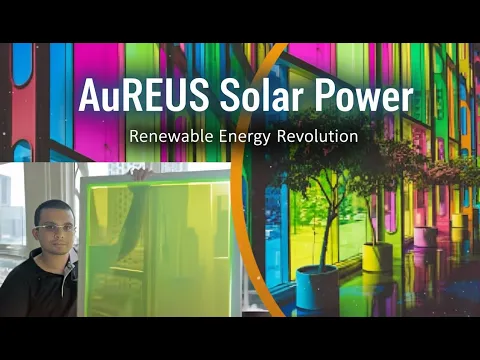
The final material is described as translucent, with a lime green tint, and with enough resistance for outdoor use.
The critical stage is what happens when UV hits the panel. The particles absorb UV radiation and re-emit it as visible light.

Subsequently, by the logic of internal reflection (principle similar to that of optical fibers), this light “travels” inside the substrate to the edges, where a row of conventional photovoltaic cells captures the light and transforms it into electricity.
This is an important point for technical clarity: AuREUS does not “replace” traditional photovoltaics. It functions as a UV concentrator/converter that feeds common PV cells. The difference lies in the substrate and the way the radiation is collected.
Performance and Numbers of AuREUS: “Almost 50% of the Time” and Prototype Charging Two Phones a Day with the “Sunless Solar Panel”
The numbers Maigue reports as usage of the “sunless solar panel” draw attention because they change the reasoning of availability. Preliminary tests indicate that AuREUS could generate energy in almost 50% of the time, compared to 15% to 22% typical of conventional panels in the argument presented.
The difference here is not necessarily “more efficiency per photon,” but more useful hours of generation by capturing diffuse UV spread across surfaces, including UV reflected by sidewalks, walls, and nearby structures.
At the prototype level, Maigue claims that a panel developed in the apartment generated enough electricity to charge two phones a day. He also mentions that the extraction of luminescent particles reaches 80% efficiency, with research aiming to approach 100%.
A practical detail for cities: AuREUS can be installed vertically. Conventional panels prefer tilt and solar orientation. AuREUS, in theory, would work on walls, windows, and facades, without the need for tilting towards the sun.
If validated at scale, this point directly aligns with BIPV (Building-Integrated Photovoltaics): generation integrated into the very envelope of the building.
Solar Energy on Facades and Windows: Why AuREUS Targets the Vertical Space of Cities
The economics of solar energy suffer from a simple limit: it needs well-positioned area. In dense urban regions, roofs compete with equipment, structures, and shadows. Facades, on the other hand, represent a gigantic surface that remains “idle” from an energy perspective.
AuREUS — the “sunless solar panel” — attempts to occupy exactly this idle space: vertical surfaces. In theory, this would allow office buildings, hospitals, stations, and residential buildings to utilize large facade areas to generate energy without changing the footprint of the property.
In this scenario, AuREUS does not enter as a “pure” competitor to the traditional roof panel. It functions as an additional layer, enhancing generation in locations where the common panel isn’t the most efficient or isn’t viable due to architecture.
James Dyson Award 2020, Funding and Commercial Pilot: What Has Happened Beyond the Prototype
The recognition came after persistence. Maigue tried to enter the project in the James Dyson Award in 2018 and did not pass. He continued refining the technology and returned in 2020. In the second attempt, he won the sustainability award, with the final selection attributed to James Dyson himself.
The award included £30,000 (about US$ 40,000 at the time), funds used to advance development and testing. In 2021, Maigue mentioned a pilot partnership with a multinational in the BPO (Business Process Outsourcing) sector for the first commercial installations.
Applications in urban transport surfaces (such as bus and train sides), as well as plates and poles, are also cited—uses consistent with the advantage of AuREUS in harnessing diffuse UV and operating outside the optimal sun angle.
Technical Limitations of AuREUS: What Still Needs to be Done to Become a Scalable Market Solution
Despite the strong narrative, there are still technical points that need to mature for industrial evaluation:
- Output per square meter (W/m²) has not been publicly disclosed in the base text, and this is essential data for economic viability.
- The technology was born in “home laboratory” conditions and still requires robust validation in larger installations and long exposure cycles.
- Among the colored compounds tested, the stable substitute for the blue dye has not yet been found, limiting part of the spectrum captured according to his own description.
- The supply scale is also an open question: how much agricultural waste is needed to produce enough panels for large projects?
These gaps do not negate the concept but define where AuREUS still needs to evolve: standardization, public energy metrics, durability, and raw material logistics.
Why AuREUS Matters: UV, Solar Energy on Cloudy Days, and Vertical Generation in Dense Cities
The strategic value of AuREUS lies in addressing a real bottleneck: the dependence of solar energy on ideal conditions of direct visible light and well-oriented rooftop area.
If the technology proves itself at scale, it opens two fronts that are currently difficult to combine:
- More Distributed Generation Over Time, by capturing diffuse UV present even without a clear sky.
- Distributed Generation in Space, by transforming facades and windows into collecting surfaces.
Additionally, there is the layer of the production chain: converting agricultural waste into technological input. This does not alone solve the economy of energy but creates an interesting cycle where losses become raw material.
In the end, AuREUS does not need to “replace” traditional solar to be relevant. It just needs to function as an urban and vertical complement, capturing a type of radiation that currently goes unnoticed.
It is a bet on a little explored territory: UV as an indirect energy resource, transformed into useful light by luminescent materials and then converted into electricity by common photovoltaics.








-

-

-

-

-

32 people reacted to this.