






 Portuguese
  Spanish


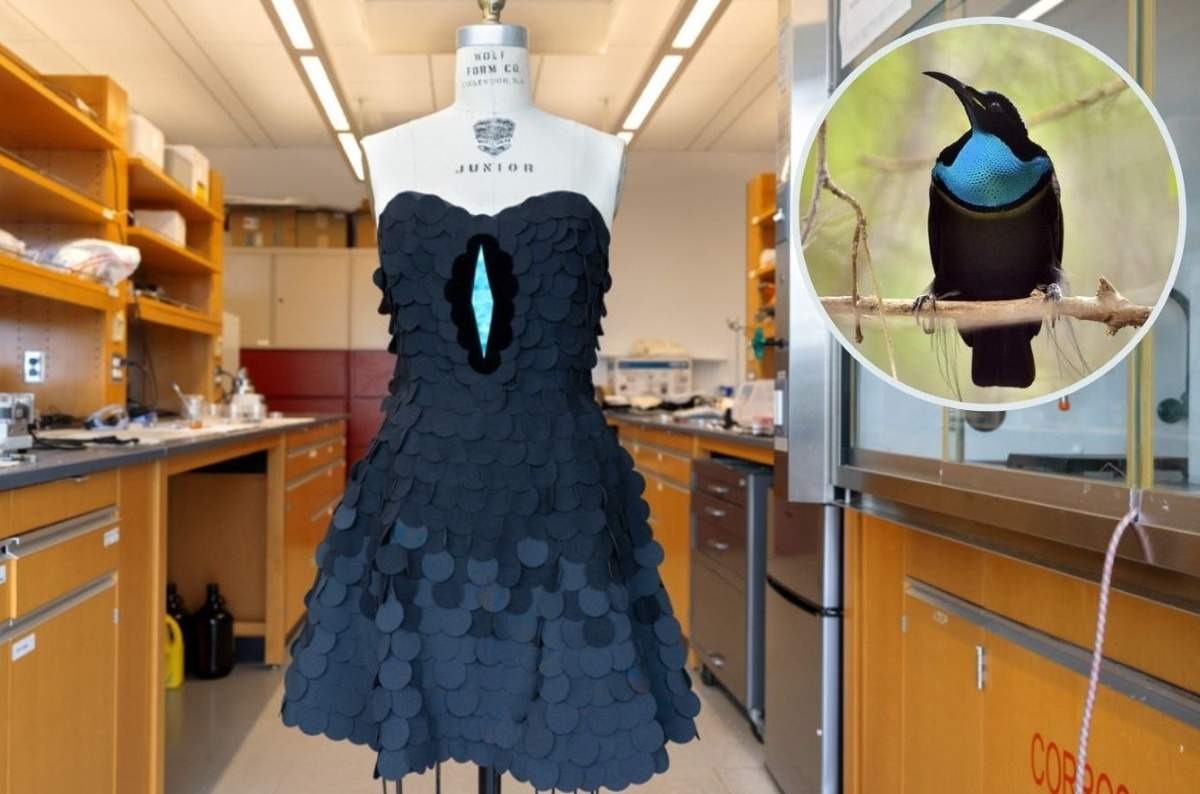

Material With 0.13% Reflectance Created by Cornell Researchers Replicates the Optical Structure of the Riflebird, Uses Natural Fibers Such as Wool, Silk, and Cotton, and Opens Applications in Solar Energy, Advanced Optics, Sensors, Telescopes, and Technological Fashion
The new fabric developed by Cornell researchers features 0.13% reflectance, inspired by the plumage of the New Guinea riflebird, using wool, silk, and cotton treated with polydopamine and plasma, allowing for optical, thermal, and aesthetic applications.
Optical Structure Inspired by Bird of Paradise
The project sought the ultra-black that reflects less than 0.5% of light and is valued in telescopes, sensors, and solar devices. The team studied how specific feathers trap light in successive microcavities.
The riflebird combines melanin and compact barbules that create internal cavities, leading to multiple reflections until the light disappears. The surface appears to be an absolute void, forming an almost complete darkness.
-
Pennsylvania Mine Creates Ice in Summer Heat and Melts in Winter, Turning a Mountain Crevice into a Reverse Natural Refrigerator

-
China Accelerates Global Expansion of Robotics: From Smart Vacuums to Industrial and Humanoid Machines, Millions Exported to Over 150 Markets
-
Polar Air Mass to Hit Brazil: Temperatures to Plummet in Nine States, Near Freezing in the South with Frost Risk Until Monday
-
Chinese “dark factories” produce electric cars 24/7 with minimal human intervention, as Zeekr assembles 800 units daily, raising concerns in Brazil.





The researchers replicated this architecture using white merino wool impregnated with polydopamine down to the core of the fibers. They then applied plasma etching to generate nanofibrils responsible for light trapping.
The result was a flexible and natural fabric that achieved an average reflectance of 0.13%, lower than any other fabric reported. It preserves intensity when tilted, maintaining color over a 120-degree angle.
The angular stability of the material sets it apart from previous versions that lost performance based on angle. The persistence of the tone allows for more precise optical uses in sensitive devices.
Simple and Industry-Compatible Process
The method does not require unusual compositions or synthetic substrates. It works on natural fibers already present in the industry, facilitating adoption without extensive changes in the textile production chain.
The team pointed out that the novelty lies in being an ultra-black material that can be used directly on the body, which is uncommon. Many existing ultra-blacks are rigid or fragile, limiting applications outside of laboratories.
The first dress made with the fabric demonstrated aesthetic and technical viability. The piece exhibits an absolute black tone and a slight blue reflection, inspired by the shades of the bird that originated the concept.
When modifying contrast or saturation in photos, all colors changed except for the deep black, which remained static. This made it a visual reference point, reinforcing its extreme optical behavior.
Open Path for Expanded Technical Uses
Among the promising uses are solar systems capable of improving thermal absorption in heaters and passive collectors. The low reflectance increases efficiency without altering chemical components.
Optical sensors can benefit by eliminating unwanted reflections, improving accuracy. The material reduces light noise, a crucial factor in sensitive measurements of light or spectroscopy.
There is potential for integration into clothing or thermal camouflage devices that control heat through selective absorption. This could influence functional textile materials aimed at thermal regulations.
Scientific instrumentation also becomes fertile ground. Calibrated cameras and internal panels of telescopes can use the fabric to suppress diffuse light. This contributes to greater capture fidelity.
In the last decade, several countries have strengthened rules for less toxic solar technologies. Natural materials like this can fit into this regulatory scenario, avoiding problematic compounds in energy applications.
Potential Expansion in Energy, Optics, and Fashion
The performance in passive solar energy capture suggests use in domestic systems. Urban structures could also adopt this material to capture heat without additional energy.
The coating on fabrics, instead of metals, reduces the demand for difficult-to-recycle polymers. This decreases optical waste and extends the lifespan of research equipment, without compromising performance.
In fashion, the fabric can reduce the use of intensive chemical dyes. Adoption in technological collections strengthens transitions to more responsible materials, with less environmental impact.
Smart thermal architectures can employ the fabric in outer layers of shelters, movable panels, or temporary structures. Natural heat control reduces energy consumption in extreme environments.
The advancement reveals how biomimicry remains relevant for material solutions. Drawing inspiration from efficient systems in nature allows for technical paths that unite performance and sustainability.
The research shows that mimicking evolutionary patterns can generate practical innovations. The process integrates materials science with textile design, expanding possibilities for real use.
The approach does not require highly complex laboratories, according to the team. The combination of polydopamine dyeing and plasma creates surfaces with reproducible absorbing geometries, despite a minor error noted by the authors.
The stability under different lighting reinforces scientific utility. Optical devices often suffer from lateral brightness interferences, something reduced by the consistent behavior of the fabric.
The compatibility with silk and cotton broadens the scope for various sectors. Designers can employ the material without altering traditional chains, avoiding production barriers on a large scale.
The initial use in the dress does not limit its application. The demonstration served as both a visual and technical proof, showing that the material can withstand proper handling and maintenance.
Applied biomimicry to ultra-black also strengthens studies on light control. The microscopic geometry created by the plasma functions as an optical well, an analogy cited by the researchers.
The growing interest in solar solutions finds in this material a natural alternative. The deep black maximizes thermal absorption, benefiting projects that avoid toxic chemicals.
Applications in professional photography may arise. The fabric can cover cameras or platforms to minimize reflections in studios, aiding in scene control and calibrations.
The team emphasizes that the process is scalable. The simple repetition of the steps indicates the possibility of broad industrial adoption, even in high volumes.
The study reinforces that technologies inspired by birds can solve textile challenges. The studied plumage provided an efficient model for light control that has been functioning for millions of years in nature.
The implications extend to experimental design. Creators can explore absolute contrast in pieces, maintaining static black as a central element, even if this creates a subtle visual inconsistency in edited scenarios.
The fabric plays a dual role by uniting performance and aesthetics. The extreme darkness opens paths for both laboratories and futuristic collections that explore the interaction between light and matter.
The advancement positions Cornell’s lab as a reference in ultra-black study. The technique unites optical science and responsive design in a natural, stable material with broad industrial potential.






