Portuguese
  Spanish


Delfin LNG announced the Final Investment Decision (FID) for Delfin FLNG 1, the first floating liquefied natural gas export terminal in the United States, with the signing of a construction contract valued at $2.9 billion with the South Korean shipyard Samsung Heavy Industries, marking the beginning of a new phase in American LNG export infrastructure.
Technical specifications and capacity of FLNG 1
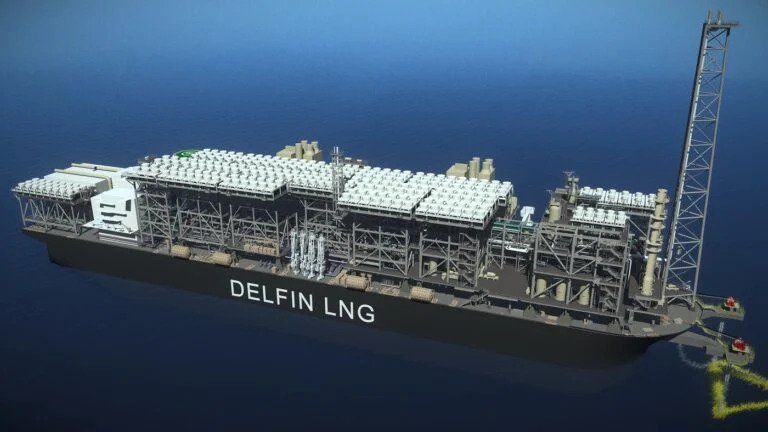
Delfin FLNG 1 is a floating liquefaction vessel designed to operate in the Gulf of Mexico, off the coast of Louisiana. The unit will have an export capacity of 4.4 million tons of LNG per year, equivalent to approximately 6 billion cubic meters of natural gas annually.
Production and exports are expected to begin between 2029 and 2030, after construction is completed by Samsung Heavy Industries. FLNG technology allows natural gas to be liquefied directly at sea or on a floating facility, eliminating the need for extensive onshore transport pipelines and large-scale port infrastructure on land.
Delfin FLNG 1 will be the first project of its kind in the United States, which until now operated exclusively onshore LNG export terminals, such as those in Sabine Pass, Freeport, Corpus Christi, and Sabine Pass.
-
Belgium’s 110-meter ship lift raises vessels weighing up to 1,350 tons the height of a 20-story building without leaving the water.

-
Petrobras Secures $2.2 Billion Contract to Build and Operate Four Support Vessels for Brazil’s Offshore Oil Fields

-
While many ports want to grow, Barcelona has decided to do the opposite and will cut cruise terminals from 7 to 5 after pressure from residents, protests, and crowds.
-
The United States wants to tighten control over submarine cables that carry 99% of international internet, silently cross oceans, total more than 400 routes worldwide, and have become a strategic piece in the competition for data, technology, and suppliers.



Context of American LNG expansion in 2026
The project is part of a wave of approvals for new LNG terminals in the United States in 2026. Three American projects — Phase 2 of CP2 LNG, Commonwealth LNG, and Delfin FLNG 1 itself — reached FID by early June 2026, adding a combined capacity of 31 billion cubic meters per year to the market.
The expansion of American LNG exports occurs in the context of high demand from Europe, which seeks to diversify supply sources after the reduction of Russian gas, and from Asia, where Japan, South Korea, and Southeast Asian countries maintain increasing imports.
Petronas LNG signed a supply contract for up to 2 million tons per year of LNG to Japan for a period of 20 years, starting in 2028, illustrating the long-term demand that supports investments in new export capacity.
The role of Samsung Heavy Industries and the South Korean chain
Samsung Heavy Industries is one of the three main South Korean shipyards specializing in the construction of LNG carriers and offshore platforms, alongside Hyundai Heavy Industries and Daewoo Shipbuilding & Marine Engineering (DSME). The company has an extensive history in building LNG carriers and offshore processing platforms.
The $2.9 billion contract for the construction of FLNG 1 is one of the largest individual shipbuilding contracts in 2026. The shipyard is expected to mobilize engineering teams specialized in cryogenic systems, which operate at temperatures of up to -162°C to keep natural gas in a liquefied state.
Impact on the global LNG market
The approval of Delfin FLNG 1 reinforces the United States’ position as the world’s largest LNG exporter, a position achieved in 2023 and maintained since then. The operation of new American projects between 2028 and 2031 is expected to increase competitive pressure on established exporters like Qatar, Australia, and Russia.
For Brazil, which has significant natural gas reserves in the pre-salt and expanding LNG infrastructure, the American consolidation in the LNG market represents both a technological reference and a price parameter in long-term contracts. Petrobras operates the LNG regasification terminal in Rio de Janeiro and is evaluating LNG export projects associated with pre-salt production.
The commercial viability of Delfin FLNG 1 is supported by long-term LNG purchase contracts signed with European and Asian distributors and utilities. The FLNG model eliminates the need for long-distance onshore pipelines and fixed onshore liquefaction terminals, making the infrastructure more flexible and adaptable to different offshore natural gas fields. The project’s approval signals that FLNG technology, commercially used in Australia and the Persian Gulf, is mature for deployment in the American regulatory context.