Portuguese
  Spanish


American Navy reveals $65.8 billion Golden Fleet plan with 122 ships and 63 unmanned platforms in naval race against China
The United States Navy presented on May 11, 2026, the most ambitious naval budget since World War II: the Golden Fleet program, with an investment of $65.8 billion for fiscal year 2027, according to gCaptain. The American Navy’s 5-year plan foresees 122 manned ships and 63 unmanned platforms between 2027 and 2031.
For fiscal year 2027 alone, the Navy orders 34 manned ships and 5 unmanned platforms. According to the document, the aircraft carrier CVN-82 was moved up from FY2030 to FY2029. In parallel, the program includes a new BBGN (battleship guided missile nuclear) — the first nuclear battleship since the 1950s.
According to Acting Secretary of the Navy Hung Cao: “The United States is at a strategic inflection point, and rebuilding American maritime dominance requires urgency, accountability, and sustained commitment”. The statement summarizes the central motivation — according to the Navy, the US needs to react to the Chinese naval advance, which already surpasses the Americans in absolute number of ships.
-
North Korean Fiasco: Launch of the Largest Warship Ends in Sinking

-
While giant ships still burn heavy fuel and the maritime sector races against climate targets, Maersk and Vale are starting to bet on ethanol as a new route to reduce emissions at sea.

-
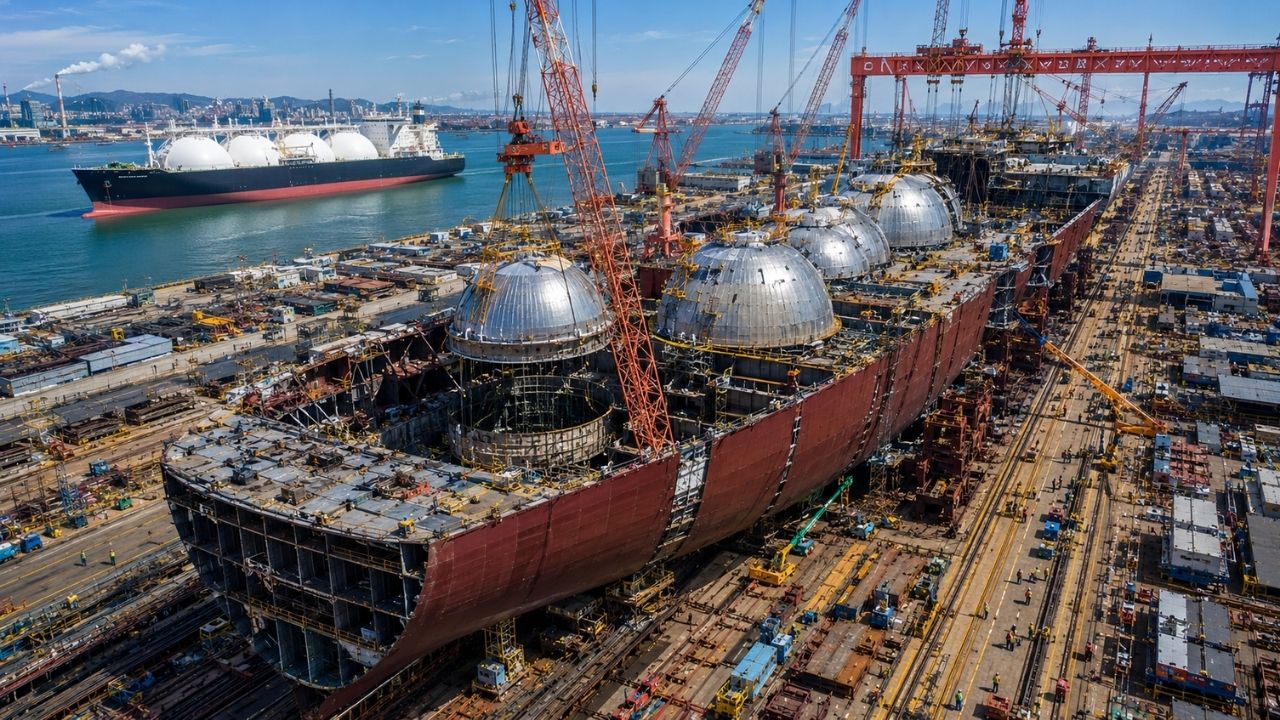
China begins construction of the world’s largest LNG ship, a 344-meter giant capable of supplying 4.7 million homes for a month, carrying 271,000 m³ of gas, and placing QatarEnergy in the largest naval order ever recorded in world history.
-
China is designing a container ship with a thorium nuclear reactor that will operate for 40 years without refueling, and the 25,000-container giant from Jiangnan Shipyard will cross oceans without emitting carbon in an industry that burns 300 million tons of fuel per year.



The composition of the Golden Fleet by ship class
The detailed Golden Fleet plan includes multiple complementary classes. First, 5 Columbia-class ballistic submarines — replacements for the Ohio-class and responsible for the naval nuclear triad. Second, 10 Virginia-class attack submarines with advanced stealth technology.
According to the American Navy, there are also 7 Arleigh Burke-class Flight III destroyers with new SPY-6 radar, capable of intercepting hypersonic missiles. Similarly, 4 Constellation-class frigates of intermediate size join the fleet. In parallel, 23 Medium Landing Ships enhance amphibious capability for operations in the Indo-Pacific.
In parallel, the new BBGN (battleship guided missile nuclear) is the biggest novelty. Compared to classic battleships, the BBGN combines 16-inch guns with vertical missile systems (VLS) and nuclear propulsion. Consequently, it is a hybrid weapon with both conventional and nuclear deterrent functions.

HII Ingalls and Hadrian Factory 4: where the Golden Fleet will be built
The main builders of the Golden Fleet are traditional American shipyards. First, HII Ingalls Shipbuilding in Pascagoula (Mississippi) builds destroyers and LHA. Second, Newport News Shipbuilding (Virginia) builds aircraft carriers and submarines. In parallel, Electric Boat (Connecticut) is a partner of the Virginia-class.
According to the Navy, Hadrian Factory 4 in Alabama receives an investment of $900 million to expand capacity for manufacturing naval components. Similarly, the factory uses autonomous welding robots that increase productivity by 40%. Consequently, it is considered the most advanced shipbuilding factory in the US.
In parallel, the program creates 50,000 direct jobs in shipbuilding and 200,000 indirect jobs in the supply chain. Therefore, the Golden Fleet has bipartisan support in Congress — benefiting electoral districts in at least 15 states. To understand the scale, it is equivalent to the Apollo plan in terms of industrial impact.
Why the US needs to accelerate: the naval race against China
The central motivation is geopolitical. First, the Chinese Navy (PLAN) already has more ships than the American Navy — 340 surface ships and submarines, compared to 290 from the US. Second, Chinese shipyards produce 20 ships/year, compared to 6-8/year from the US.
According to the DNI (Director of National Intelligence), China will build 60+ ships in the next 5 years, including the third aircraft carrier CV-18 with electric propulsion and the Type 076 (nuclear LHD). Similarly, 12+ Chinese nuclear submarines Type 093/094 are projected in the same period.
In parallel, the Indo-Pacific has become a focal point — Taiwan Strait, South China Sea, North Korea. Consequently, the American Navy needs to reinforce its presence in the first island chain (Japan, Taiwan, Philippines) and second chain (Guam, Tinian, Saipan).
- $65.8 billion — FY2027 budget
- 34 ships + 5 unmanned platforms in FY2027
- 122 ships + 63 unmanned in 5 years
- 5 Columbia + 10 Virginia + 7 Arleigh Burke
- 1 new nuclear BBGN
- $900 million in Hadrian Factory 4 Alabama
Unmanned platforms: the submarine and surface revolution
One of the innovations of the Golden Fleet is the 63 unmanned platforms planned. First, there are USV (Unmanned Surface Vessel) like the Sea Hunter and the Vanguard, capable of autonomous patrolling. Second, the UUV (Unmanned Underwater Vehicle) includes the Orca-XLUUV, a 26-meter submarine drone for long-duration missions.
According to the American Navy, these drones represent a paradigm shift. First, they cost 1/10 of an equivalent manned ship. Second, they can be sacrificed without human loss. In parallel, they have autonomy for 60 to 90 continuous days missions.
In comparison, China also invests heavily in naval drones. For example, the 15-meter Chinese JARI-USV has anti-ship and anti-air missile capability. Similarly, the Chinese XLUUV of a class similar to the Orca has been in testing since 2024. Therefore, the race between the US and China includes a parallel unmanned fleet.

Impact for Brazil and Brazilian Navy
For Brazil, the Golden Fleet has an indirect but relevant impact. First, it raises global prices of naval steel and specialized components. Second, Brazilian shipyards like Itaguaí (RJ) and EMGEPRON can benefit from technology transferred via strategic US-Brazil partnerships.
According to the Brazilian Navy, the ProSuB program for the construction of the national nuclear submarine progresses with French technology, but there are discussions about cooperation with the US in auxiliary systems. Similarly, Tamandaré class ships (Brazilian FREMM) use American components via licensing.
In parallel, Brazilian exports of naval steel to American builders may increase. In comparison, China has imposed tariffs on American steel. Consequently, Latin American suppliers gain space in the supply chains of HII Ingalls and Newport News shipyards.

Reservation: doubts about execution and schedule
Although ambitious, the Golden Fleet faces challenges. First, American shipyards suffer from a shortage of skilled labor. Second, previous projects like Columbia-class and Constellation-class accumulate delays of 1 to 2 years.
According to the GAO (Government Accountability Office), 40% of naval programs exceed the budget. Similarly, the learning curve for the nuclear BBGN is uncertain. Consequently, experts warn that 30-40% of the plan may not materialize by 2031. Other coverage of the naval race is in the Click Petróleo e Gás archive. Can the US really reverse the Chinese production trend?