Portuguese
  Spanish


Researchers successfully test the use of humanoid robots in teleoperated surgeries, promising to bring specialized medical assistance to remote locations.
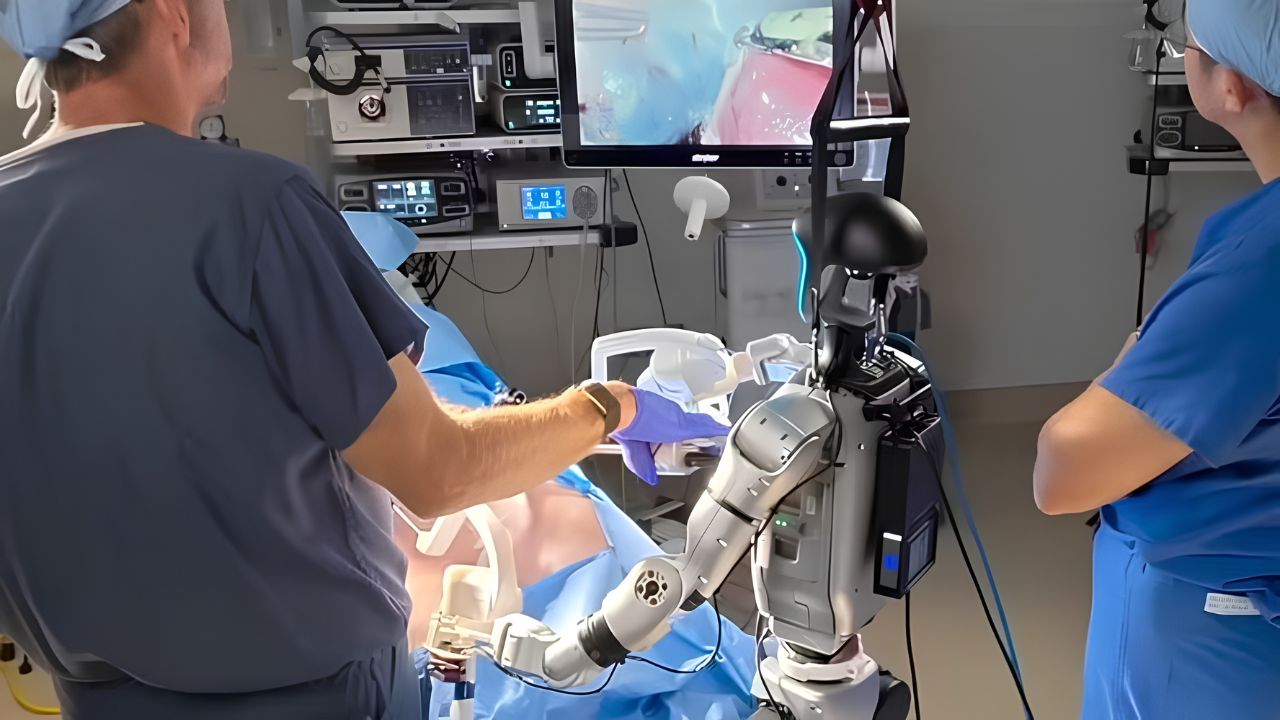
In a historic milestone for contemporary medicine, researchers from the University of California, San Diego (UC San Diego) conducted unprecedented surgeries in July 2026 using remotely controlled humanoid robots. The procedure, which involved the removal of tumors with the aid of the “Surgie” system, demonstrated how 1.5-meter-tall and 27 kg machines can be operated remotely to perform high-precision tasks in hospital environments.
This innovation, which allows both human-machine collaboration and the operation of pairs of robots in tandem, aims to address the critical shortage of specialists in remote regions and emergency scenarios, transforming the dynamics of surgical centers worldwide.
A new era in the surgical center
Modern medicine has just taken a bold step with the introduction of humanoids in the surgical environment. Unlike the heavy mechanical systems that have dominated hospitals for years, the project using units called “Surgie” has already performed successful surgical interventions.
-
A 12-year-old boy from the municipal network of Canoas won gold in the Brazilian Mathematics Olympiad, earning the school’s first national medal in history and standing out in a competition that brought together more than 18 million students, demonstrating how public education can uncover hidden talents in Brazil.

-
Why did a company that was already earning US$ 1 million decide to completely change its strategy? The answer begins with used bottles, worms, and an unexpected decision.

-
Where it almost never rains, residents hung giant nets in the desert mountains and started to ‘fish’ drinking water from the fog: the nets can collect thousands of liters per day directly from the mist.

-
Young people from Minas created a robot without screws or metal parts, betting on a strong and flexible structure to compete against a thousand teams in Houston and took Brazil to the top of world robotics for the first time; Sofia, 15, also made history with an unprecedented leadership award.


Operating both in partnership with human doctors and in automated pairs, these machines demonstrate that agility and humanoid form can redefine access to global health. While traditional systems require robust structures of up to 800 kg and adapted rooms, the Surgie model innovates with its lightness and versatility.
Standing at just 1.5 meters tall and weighing 27 kg, the equipment can move around the environment and perform various physical tasks, functioning as a true assistant.
The ease of integrating these machines into the existing workflow in hospitals was one of the points that most surprised the medical team, who only needed to add adapters for the robots to handle surgical instruments with precision.
Operational advantages of humanoid assistants
Beyond the operating table, versatility is one of the pillars of this project. With a humanoid structure, these assistants can, in the future, help with secondary tasks such as organizing the room, fetching medical supplies, and even post-procedure cleaning.
The idea is that, instead of requiring the hospital to change to accommodate the technology, the machine can naturally adapt to the team and environment where it is inserted, functioning as an integral member of the medical unit.
The strategic benefits of this innovation include:
- Expanded reach: Serving patients in areas with a shortage of qualified personnel;
- Strategic mobility: Ease of transport for emergency or disaster scenarios;
- Operational efficiency: Rapid integration into the current workflow of the surgical team;
- Function versatility: Assistance in various physical demands beyond the surgery itself.
Although it still depends on technical advances, teleoperation with humanoid robots has already reached a level of precision similar to traditional surgical robotic systems. This indicates that, in the future, this type of technology could be incorporated into medical routines.
However, the tests also revealed significant limitations. During experimental surgeries, it was necessary to recalibrate the robots several times, which prolonged the duration of the procedures.
For Shanglei Liu from UC San Diego, this difficulty should be reduced as technology evolves. The researcher highlights that the first robotic laparoscopic surgery took about six hours to complete, while currently, the same procedure is usually performed in just 30 minutes.
Technical challenges and the quest for autonomy
Despite the optimism, researchers admit that the path to the routine use of these machines still requires improvements.
During the tests, the team faced technical obstacles such as latency — that delay between the surgeon’s command and the machine’s response — and the constant need for recalibration of the devices.
Such factors contributed to the initial surgical times being longer than conventional methods, a gap that medical science has historically learned to reduce through experience and technological refinement.
The specialists’ gaze is already fixed on the next horizon: full autonomy. The ultimate goal, according to the group, is not just to perform teleoperated operations, but to create an ecosystem in which robots and humans work side by side in an integrated manner.
If today devices operate under direct command, the goal is to develop assistants capable of performing procedure steps with their own intelligence.
With information from Revista Galileu