






 Portuguese
  Spanish


Researchers capture rare giant squid in high-definition video in the Atlantic Ocean. Check out details about this enigmatic deep-sea creature.
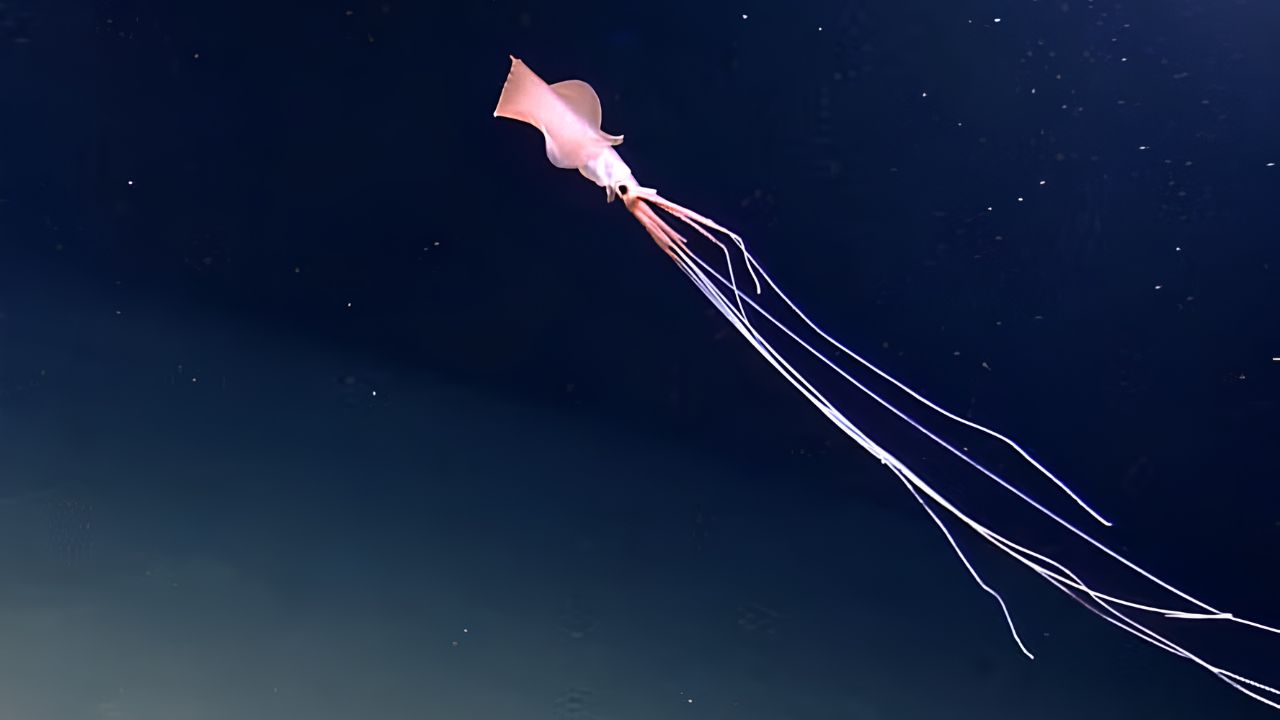
A team from the Schmidt Ocean Institute, USA, captured rare high-definition images of two squids of the genus Magnapinna during a scientific expedition in the Atlantic Ocean in June 2026. The encounter with the giant squid occurred at a depth of 4,300 meters in the region known as the Doldrums Fracture Zone, a vast chain of underwater mountains marked by intense tectonic activity.
The footage, captured by the remotely operated underwater vehicle (ROV) SuBastian, is considered an exceptional achievement, as the species is among the most mysterious and least observed cephalopods by world science.
From internet phenomenon to detailed science
The fame of these creatures began in 2007, after a video recorded near an oil platform in the Gulf of Mexico went viral. Due to the low technical quality of that time, with unstable images and green lighting, the animal was mistakenly associated with extraterrestrial creatures.
-
Three 70 kg 17th-century lead ingots found stacked on the North Sea floor during Hornsea 3 wind farm investigation, 120 km off Norfolk coast

-
From Humble Beginnings in Brazil to Latin America’s Largest Fitness Chain: Smart Fit’s Journey to 5 Million Members Across 14 Countries

-
Ninja’s New Combi Multicooker Revolutionizes Cooking with Superheated Steam and Air Frying, Offering 14 Functions and Full Meals in 15 Minutes
-
Brazilian Multinational WEG and Graal Network Install 47 Fast Chargers on Major Highways, Enhancing Electric Vehicle Infrastructure




The new expedition, however, changed this perspective by using the remotely operated underwater vehicle (ROV) SuBastian.
The high-definition images captured now:
- Offer a clear view of the anatomy of these cephalopods.
- Demonstrate that the “scary” appearance observed in 2007 was merely a result of the technological limitations of that period.
- Allow detailed observation that aids in the biological understanding of the animal.
Characteristics of an enigmatic animal
The unusual appearance of the Magnapinna squid begins with the large fins positioned at the top of the head, a characteristic that inspired its Latin name, meaning “big fin.” These heart-shaped structures allow the animal to move slowly through the ocean depths.
Despite this, the most impressive aspect is the tentacles. Extremely thin and disproportionate to the body, they can extend for several meters, giving the species a unique silhouette among cephalopods.
The largest individual ever recorded by researchers measured 6.4 meters in length, with about 6.1 meters corresponding exclusively to the tentacles. So far, science officially recognizes only three species of the genus — Magnapinna atlantica, Magnapinna pacifica, and Magnapinna talismani.
The importance of investigating the unknown
The sighting of two individuals together is considered an exceptional fact, given that, to date, only a few dozen observations of this genus have been recorded globally. The discovery reinforces that, even in areas studied for decades, the ocean depths remain a frontier of mysteries.
Aaron Micallef, chief scientist of the Doldrums expedition and senior researcher at the Monterey Bay Aquarium Research Institute (MBARI), expressed the significance of the moment in a public statement. According to Micallef, the event confirms that “This expedition showed that even in one of the most remote corners of the ocean, our planet remains alive, dynamic, and full of surprises.”
Thus, the giant squid of the genus Magnapinna continues to fascinate specialists and prove that underwater scientific exploration is vital for understanding terrestrial biodiversity.
With information from Revista Galileu


