





 Portuguese
  English
  Spanish
  5 min of reading


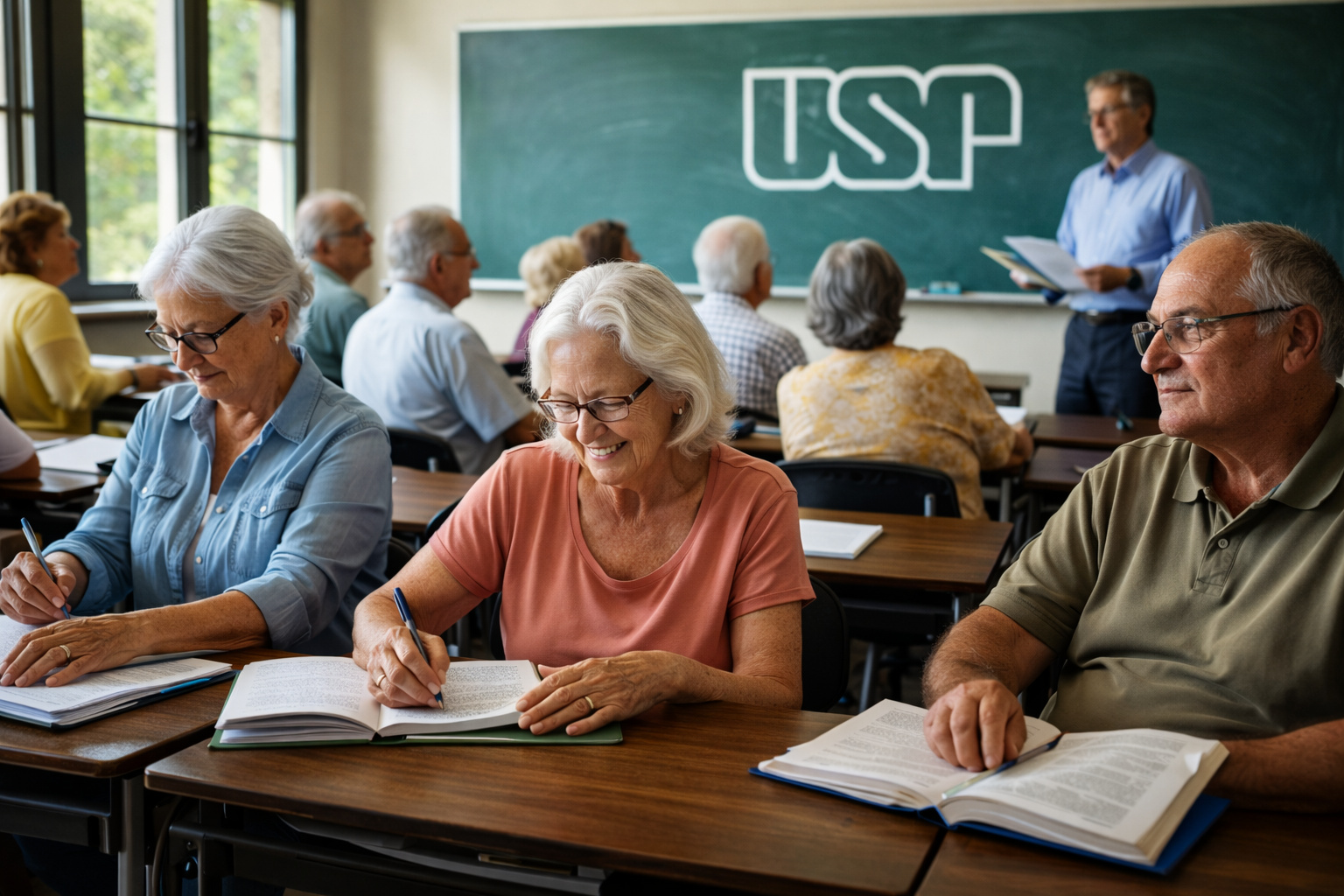
Free Courses at USP for People Aged 60 and Over Strengthen Lifelong Education, Expand Access to Knowledge, and Stimulate Social Participation in the First Half of 2026.
The offering of courses for people aged 60 and over by the University of São Paulo represents more than just an educational initiative. It is a historic movement valuing active aging, connecting academic knowledge, social inclusion, and citizenship. In 2026, the USP 60+ program will offer more than 6,500 vacancies in regular subjects and cultural activities, distributed across different campuses in the state of São Paulo.
Already, this proposal draws attention for expanding the traditional role of public universities. Instead of limiting access to young people of regular undergraduate age, USP reinforces the idea of continued education. Thus, people aged 60 and over begin to occupy classrooms, laboratories, and cultural spaces, interacting with different generations and broadening their experiences.
According to USP itself, the program includes subjects such as Entrepreneurship, Marketing, Musical Language, Business Management, Sports Journalism, Constitutional Law, Artificial Intelligence, Social Psychology, Motor Activity Physiology, and Afro-Brazilian and Indigenous Culture and Education. This way, the diversity of courses reflects the multiple interests of this audience.
-
Federal Institute opens over 700 vacancies in free technical courses in Civil Engineering, Mechanics, Electrotechnics, Computer Science, and Nursing; see how to enroll and study at IFPB.

-
Become a professional in logistics, mechanics, computer science, chemistry, or gastronomy at the Federal Institute: Ifes opens more than 1,000 spots in free technical courses with selection without an exam.

-
Take a 100% online and free course at Itaú: Foundation releases 156 options with certificates, registrations open for all of Brazil, unlimited access, areas such as technology, education, and management, and a flexible schedule without tutoring.

-
Senai will pay up to R$ 700 per month for those who take free technical courses: there are 12,000 open positions across Brazil and training with access to the technology market.


Lifelong Education and the Historic Role of Public Universities
Historically, universities arose as spaces aimed at training intellectual elites. However, throughout the 20th century, this scenario began to change. The expansion of public higher education in Brazil expanded access to knowledge, although for a long time, this access remained concentrated in specific age groups.
With the progressive aging of the Brazilian population, educational policies began to consider learning throughout life. According to data from the Brazilian Institute of Geography and Statistics released over the last decade, the population aged 60 and over has been growing consistently. In this context, initiatives like USP 60+ emerge as a response to a real social demand.
Moreover, programs aimed at the elderly align with international recommendations. Organizations like the World Health Organization have advocated since the early 2000s the concept of active aging, which includes social participation, autonomy, and continuous learning. University courses thus become strategic tools for this goal.
The USP 60+ Program and Its Academic Structure
The USP 60+ program is not limited to recreational activities. On the contrary, it integrates people aged 60 and over into regular university subjects. This means that participants attend classes alongside undergraduate and graduate students, whenever there are no specific prerequisites.
According to information released on USP’s official website, classes take place at the campuses in Bauru, Lorena, Piracicaba, Pirassununga, Ribeirão Preto, São Carlos, and São Paulo. This way, the program’s geographic reach expands, allowing different regions of the state to be served.
Although some courses require prior knowledge, most subjects do not require previous education. Thus, individuals who did not have access to higher education in the past find a new opportunity for learning. This aspect reinforces the inclusive nature of the program, which values diverse trajectories.
Diversity of Courses and Stimulus to Intellectual Autonomy
The variety of courses offered by USP 60+ deserves highlighting. Subjects related to business, communication, technology, health, culture, and rights coexist within the same program. Thus, participants can choose content aligned with personal, professional interests, or simply the desire to learn something new.
At the same time, areas like Artificial Intelligence and Social Psychology demonstrate that the program is not limited to topics traditionally considered suitable for the elderly. The proposal breaks stereotypes, recognizing that individuals over 60 are also interested in contemporary and technological themes.
According to the program’s coordination, this diversity contributes to strengthening intellectual autonomy. Learning, in this context, does not mean merely accumulating information. It means staying cognitively active, expanding repertoires, and participating in current debates.
Social and Cultural Impacts of Participation in University Courses
Participating in university courses generates impacts that go beyond the classroom. Academic studies published since the 2010s indicate that continued education contributes to mental health, emotional well-being, and the expansion of social networks in old age.
Additionally, intergenerational interaction creates important symbolic exchanges. Young students come into contact with distinct life experiences, while older students engage with new languages and perspectives. This meeting of generations strengthens the university environment as a plural space.
According to USP, cultural activities are also part of the program. They include workshops, lectures, and actions integrated into the cultural life of the campuses. Thus, learning is not limited to the formal content of the subjects but extends to the overall university experience.
Historical Context of Aging and New Educational Policies
Brazil is experiencing, in the early decades of the 21st century, an accelerated demographic transition. According to the federal government and official statistical agencies, life expectancy has significantly increased since the 1980s. As a result, the number of people entering old age with health and enthusiasm for new activities is growing.
In this scenario, public policies and institutional initiatives aimed at education gain relevance. USP, by offering free courses for people aged 60 and over, aligns itself with this historic movement, recognizing aging as a productive stage of life.
Furthermore, the program engages in discussions about the social role of public universities. By opening its doors to different age groups, the institution reaffirms its commitment to democratizing knowledge and fostering citizenship.
Registration, Access, and Future Perspectives
According to the official website of the University of São Paulo, registrations for the USP 60+ program occur through specific announcements published each semester. Dates and criteria vary according to the subject and campus, which requires attention from interested parties.
Nevertheless, the continuous growth of the program over the years indicates a trend toward consolidation. Since its inception, the number of vacancies and courses has increased, reflecting the growing demand and institutional recognition of the initiative’s importance.
Looking ahead, education specialists point out that similar programs are likely to expand in other public universities. The experience of USP serves as a reference, demonstrating that higher education can indeed be a space for lifelong learning.
Courses as a Tool for Inclusion and Citizenship
By offering thousands of vacancies in free courses for people aged 60 and over, USP reaffirms that knowledge has no expiration date. Learning, in this context, becomes a continuous right, associated with dignity, autonomy, and social participation.
According to the university itself, the USP 60+ program reinforces its institutional mission to produce and disseminate knowledge for the benefit of society. More than numbers, the vacancies represent stories, journeys, and new beginnings.
Thus, the initiative consolidates itself as an example of how education can keep pace with the demographic and social transformations of the country. In an aging Brazil, investing in courses and lifelong learning is not just an educational choice but a historic necessity.









-

Uma pessoa reagiu a isso.