





 Portuguese
  English
  Spanish
  5 min of reading
  0 comments


In The Clear Ditch At The Side Of The Road In Arizona, Fishers Set Up Light Rods, Bobbers And Worms To Try For Three Species In A Shallow, Noisy Stream. Among Suspicious Fish, Giant Tilapia And Quick Captures, The Scene Reveals An Improvised Urban Fishing Laboratory In Daily Traffic, Without Planning.
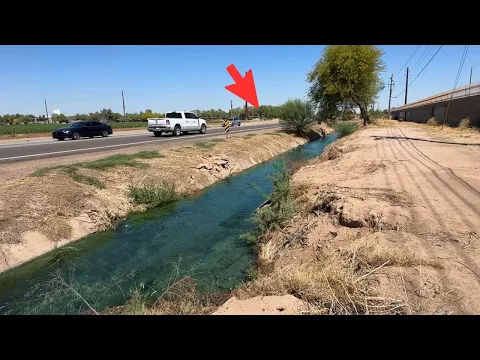
The clear ditch seemed too small to support relevant life, but the transparent water revealed movement and limited depth, around 60 centimeters at the deepest point. In The Midst Of The Asphalt And Constant Noise, fishers arrived at the site after a friend’s recommendation and decided to turn the roadside into an urban catch challenge.
The plan was simple yet difficult: record everything with a camera, choose a basic set of bait, and catch three different species from that narrow water corridor. The Bet On Improvisation Also Brought The Less Photogenic Side Of The Environment: Strong Current, Dense Vegetation, The Presence Of Fire Ants, And The Need To Quickly Release Fish Classified As Protected When They Appeared On The Hook.
Where The Ditch Becomes A Fishing Spot: Roadside, Bridge And Current
The scene is a stretch of roadside in Arizona with a narrow, very clear canal cutting along the bank and passing under a bridge.
-
Country ‘tears’ the sea with 340-meter underwater tunnels beneath the Atlantic to capture saltwater and erect a megaproject capable of producing up to 100 million liters of potable water per day in West Africa

-
End of water scarcity: colossal 4.2 km pipeline in the Mediterranean supplies mega plant capable of producing 200 million liters per day with reverse osmosis, 25 million liter reservoir, and structure to serve 600,000 people in Tunisia
-
The end of the Portuguese language: award-winning writer proposes changing the name of the language and reignites debate on colonial heritage, African culture, and Brazilian identity after highlighting influences from more than 6 African, Indigenous, and Arab languages in the formation of modern Portuguese.
-
Bicycles become a ‘craze’ in SP, synonymous with agility in traffic, but the government wants to limit electric ones to 20 km/h, reduce speed to 6 km/h near pedestrians, and even prohibit circulation on fast lanes after an increase of 212 thousand units in the Brazilian market.


The transparency allowed for seeing fish near the surface, and at times, observing strikes on the bobber, something rare in such exposed and shallow environments.
The clear ditch did not offer the comfort of a stable bank. Access required walking along the bank, risking getting caught in bushes, with traffic as a background sound.
The Decisive Detail Was The Current, which transformed fishing into drifting: the bait needed to “travel” to the fish without alerting the presence of the fishers.
How The Fishers Set Up The Game: Bobber, Worm And Water Reading
To deal with the ultra-clear water, the fishers started with the most predictable and widely accepted method: worm with bobber, supported by split shot weights to control the descent and maintain a stable presentation.
The line used in the main setup was 8 pounds, in fluorocarbon, and the mentioned hook was small, size four, compatible with smaller mouths and quick touches.
The strategy was to cast upstream and let the current take it.
In A Clear Ditch, The Way Of Presenting The Bait Matters As Much As The Bait Itself: any abrupt movement at the roadside tends to “erase” the activity because fish can see easily.
When a fish started attacking the bobber on the surface, the reading changed and an attempt was made with bread on the surface, aiming to trigger surface feeding.
What Fish Appeared In The Shallow Corridor: Grass Carp, Catfish, And Tilapia

The first recorded catch was a grass carp, described as a protected species, which led to immediate release.
The struggle was marked by quick movement along the bank, with the fish seeking vegetation and the current in its favor, requiring fishers to “walk” alongside the line to avoid breaking it.
Next, a catfish appeared, identified as a pleco, after a targeted attempt at another fish observed on the bottom.
And what seemed improbable increased in scale: tilapia appeared in larger size for the environment, with multiple bites along the stretch, including mention of albino tilapia among the school.
The Repetition Of Catches Reinforced That This Was Not An Empty Spot, but a real concentration of fish in that micro-canal.
Why A Clear Ditch Can Support Fish Where No One Looks
The main clue lies in the very dynamics observed: there was current, there was shelter under the bridge, and there was food available in drifting, creating a “corridor” for opportunistic fish.
In such environments, oxygenation tends to be higher than in stagnant pools, and the moving water facilitates both the arrival of organic matter and the movement of fish between micro-refuges.
This does not mean that the system is stable or healthy at all times.
The Clear Ditch Is An Extreme Environment, because any change in flow, temperature, or water quality can quickly reduce the presence of fish.
Still, the record shows that aquatic life can thrive in a place ignored by drivers, precisely because there exists a minimal combination of flow, shade, and hiding places.
Practical Risks And Legal Limits: Urban Fishing At The Side Of The Road
The operation made it clear that fishing at the roadside is conditioned by factors that do not appear in traditional lakes or rivers.
The noise and proximity of vehicles limit the time of stay, and the narrow space increases the chance of getting snagged.
The report also includes fire ants on the bank, loss of lightweight equipment, and even rod breakage in a struggle with a fish that ran to a hard-to-reach spot.
There is also the regulatory component. The capture of grass carp was treated as an immediate catch-and-release, without prolonged handling.
For Fishers, The Responsibility Changes When The Species Is Protected, and this includes recognizing the fish, reducing stress, and quickly ending the interaction.
In urban fishing, where fish are exposed and handling occurs in just a few centimeters of water, this care becomes part of the method.
What The Episode Reveals About City And Water: Hidden Biodiversity On A Small Scale
The case highlights a common contradiction: drainage infrastructure is designed to drain water, but in certain stretches, it starts working as a temporary or permanent habitat.
When fishers find fish in a clear ditch, what appears is not just curiosity, but a signal of water connectivity and ecological opportunities arising in areas not planned for it.
It also becomes evident the need for local observation. Not Every Clear Ditch Has Conditions For Fish, and not every presence of fish indicates environmental quality; sometimes, it just indicates biological persistence in a tight system.
However, the episode suggests that mapping these points, understanding where the water comes from and how it remains can help both urban management and environmental education, without romanticizing a risky scenario.
In practice, the story ends with an uncomfortable question: how many fish populations are “off the radar” because no one looks at the roadside with attention?
In a fast-paced everyday life, the clear ditch becomes a reminder that life organizes itself in gaps, even where common sense would not seek.
If You’ve Ever Found Fish In Unlikely Places, Like Ditches Or Narrow Channels, What Surprised You The Most: The Quantity, The Size, Or The Species? And, In Front Of A Clear Ditch At The Side Of The Road, Would You Consider Fishing Or Would You Pass It Up For Reasons Of Safety And Responsibility?








-

1 person reacted to this.