






 Portuguese
  Spanish


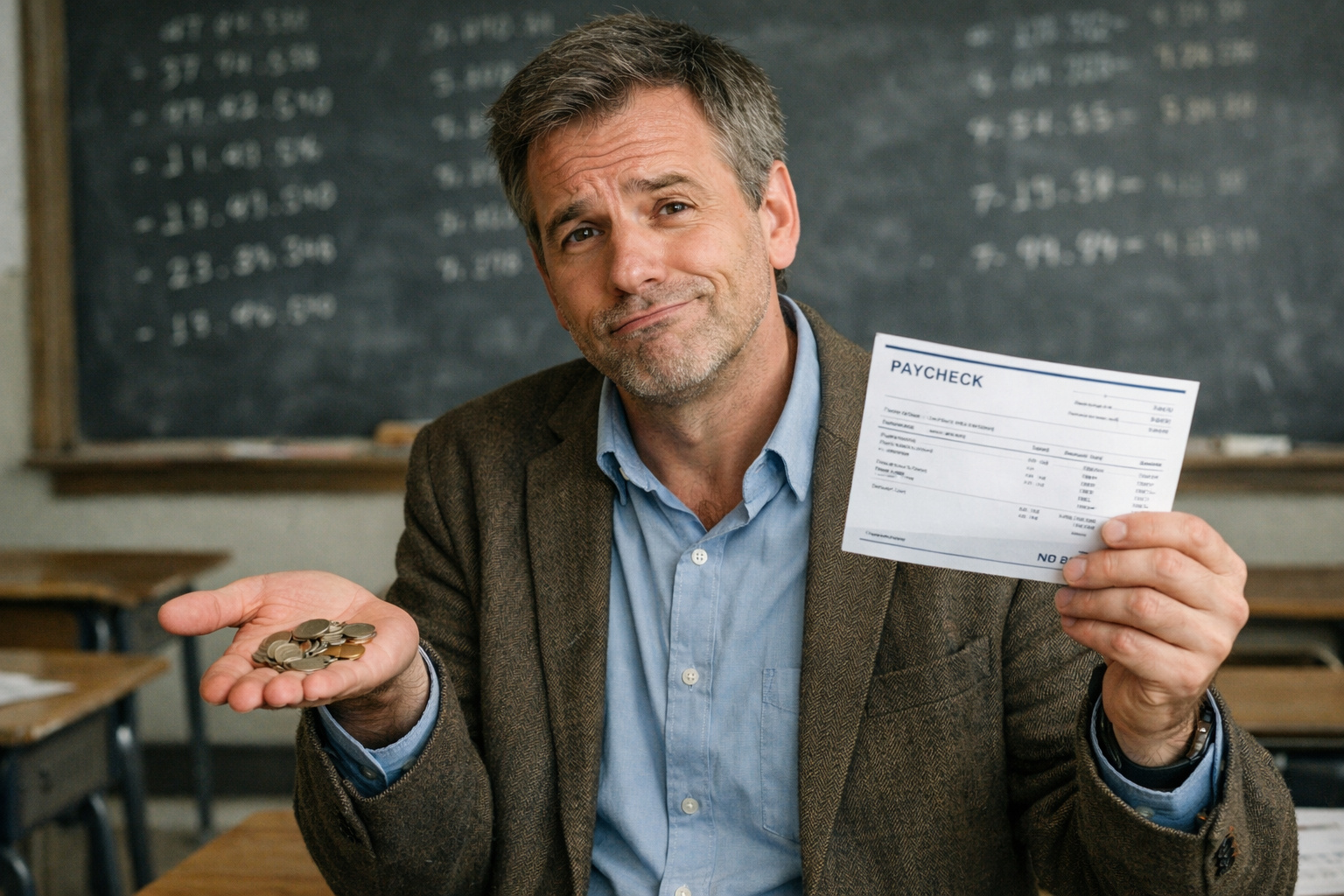


No Consensus Between MEC, States and Municipalities, a 0.37% Pay Increase Is Well Below the Expected Inflation and Reignites Criticism of the Basic Education Financing Model
The national minimum wage for basic education teachers working 40 hours per week is set to be adjusted by only R$ 18.10 in 2026, raising the current amount from R$ 4,867.77 to around R$ 4,885.78. The estimated percentage of 0.37%, however, quickly became the target of criticism for being well below the expected inflation for the period, reinforcing the perception that the so-called appreciation of teachers happens only in discourse.
The information was disclosed by UOL Educação, in a report signed by Ana Paula Bimbati, based on data from Fundeb and official projections. According to the survey, the Ministry of Education (MEC) is expected to formalize the increase by January 31, even without consensus among states, municipalities, and representatives of the category.
Meanwhile, educators reacted with irony and indignation on social media, classifying the adjustment as symbolic and insufficient to cover basic daily expenses.
-
Corn ethanol attracts R$ 23 billion in 21 new plants and prepares for a nearly 50% jump in Brazilian production by 2027, even with high interest rates.

-
A newly opened terminal in the middle of the Amazon has begun transporting soy and corn through Amapá, eyeing the queue of ships that is congesting the ports in the South.
-
Tesla injected an additional $250 million into the German factory, doubled the battery cell target, and opened its own production line for startups.
-
A 180-meter ship with a deck the size of a football field was christened to carry 25,000 tons of giant energy modules around the world.


Increase Is Well Below the Expected Inflation for 2025
The increase of 0.37% strongly contrasts with the official inflation accumulated in 2025. According to the most recent forecast from the Central Bank, the IPCA is expected to close the year around 4.4%, a percentage more than ten times higher than the projected adjustment for teachers’ minimum wage.
In practice, this means that the increase does not even compensate part of the inflationary losses, resulting in a real reduction in the purchasing power of educators. Furthermore, another inflation index calculated by the IBGE, the INPC, is expected to close 2025 at 4.7%, further reinforcing the gap between salaries and the cost of living.
For teachers and representative entities, the scenario highlights a recurring contradiction: even though education is considered strategic for the country’s development, it continues to face structural difficulties in ensuring consistent financial appreciation for professionals in the field.
How the Minimum Wage Calculation Works and Why It Is the Target of Criticism
The calculation for the adjustment of the minimum wage for teachers is defined by the Teaching Law (Law No. 11,738/2008). The methodology takes into account, among other factors, the annual growth per student, an indicator derived from Fundeb, the main financing instrument for basic education in Brazil.
However, educational entities warn that changes made to Fundeb in 2020 have begun to negatively impact this calculation. Additionally, the decline in the number of students enrolled in basic education also puts downward pressure on the index, resulting in increasingly smaller adjustments.
Municipalities, in turn, point to the existence of a real “legislative vacuum”, arguing that the current model does not provide predictability and generates abrupt fluctuations. To illustrate these variations, the minimum wage rose 33.2% in 2022, while last year the adjustment was 6.7% — numbers much higher than those projected for 2026.
Efforts for a New Calculation Collide with Lack of Consensus
In light of the criticism, the federal government has begun working on a proposal for a new calculation model. A working group was created in 2023, gathering representatives from the MEC, Undime, Consed, and CNTE, with the goal of discussing more balanced criteria for the annual adjustment of the minimum wage.
So far, however, the forum has not reached a consensus. One of the most accepted proposals among participants is to use a average between the growth of Fundeb and the inflation measured by INPC. The main obstacle, according to reporting by UOL, lies in defining the weight that each indicator would have in the final formula.
Without an agreement, the Minister of Education, Camilo Santana (PT), has stated on several occasions that a proposed law with a new calculation will only be sent to Congress after consensus among states, municipalities, and representatives of the category.
Political Impact and Concerns About Government Image
In addition to the economic effects, the adjustment of only 0.37% may have political consequences. Education secretaries from both the opposition and the governing base believe that the officialization of the increase could negatively impact President Lula’s image, who will seek reelection.
According to these managers, a large part of the population does not know that the percentage of the adjustment is not a direct decision by the president but the result of a calculation defined by law. Nevertheless, the political strain tends to fall on the federal government, especially on a sensitive issue like the appreciation of education.
In light of this scenario, the question remains that echoes among educators and public managers: is the current financing model capable of ensuring predictability and real appreciation for teachers in the coming years?


