Portuguese
  Spanish


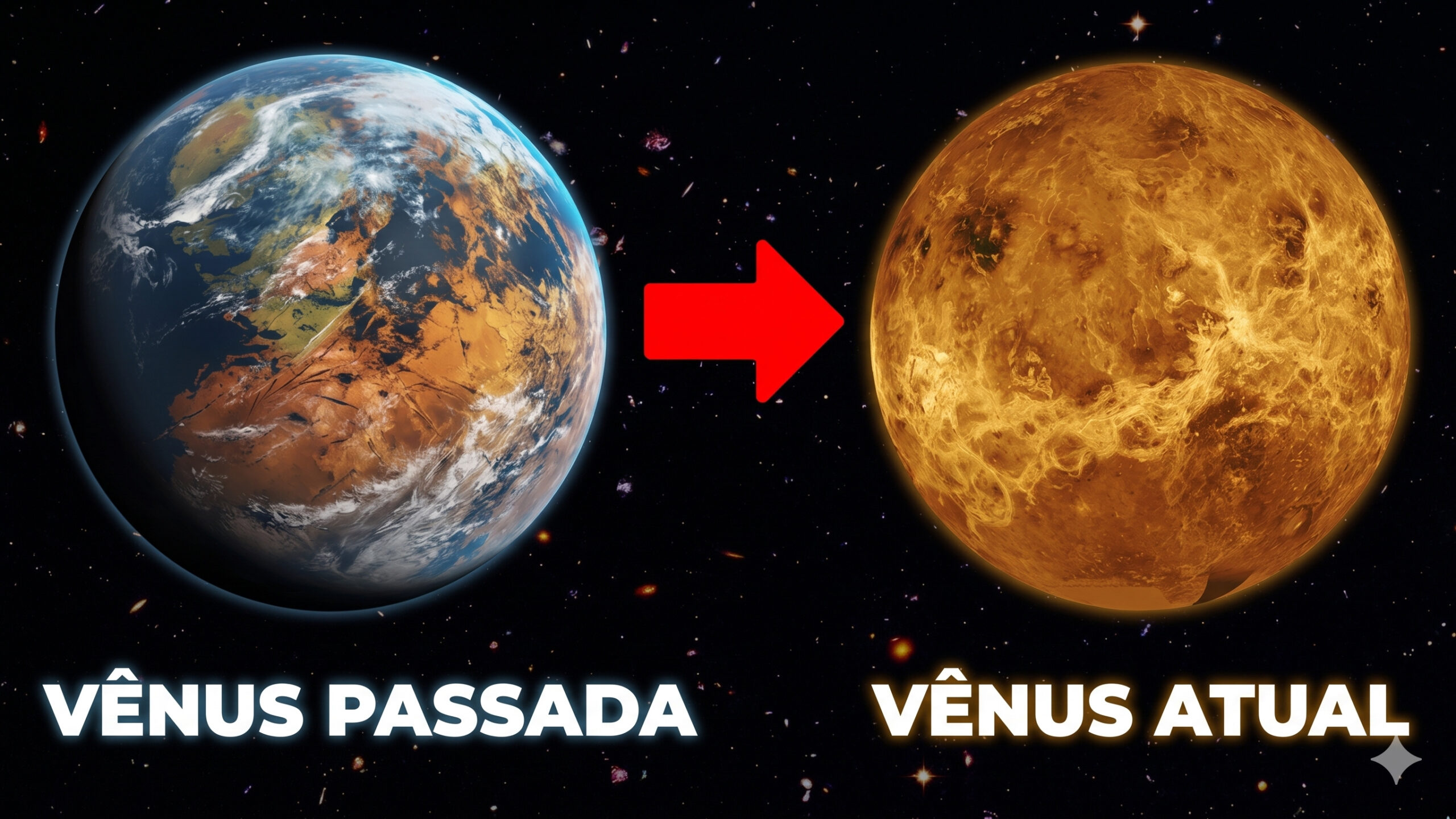

Venus will reach magnitude -4.8 in September 2026 and could shine more than 150 times brighter than Sirius in the evening sky.
According to EarthSky, Venus will reach its greatest apparent illumination of 2026 on the night of September 18, shining at magnitude -4.8 in the sunset sky. The planet will be so bright that dark-adapted eyes may perceive its light casting shadows on white surfaces, while trained observers can locate it in the blue sky during the day if they know exactly where to look. A magnitude of -4.8 places Venus in territory reserved for few celestial objects: the Sun, the Moon, and Venus itself. No star comes close. Sirius, the brightest in the night sky, has a magnitude of -1.46, being more than 150 times less luminous than Venus at its peak. Jupiter, the second brightest planet, reaches a maximum magnitude of -2.9.
What will appear on the western horizon at dusk on September 18, 2026, will not be an ordinary star. It will be a point of light so intense that it defies the intuition of anyone looking at the sky and trying to classify it.
Why Venus Shines Brighter as a Crescent Than as a Full Disk as Seen from Earth
Venus has phases, just like the Moon. The discovery was made by Galileo Galilei in 1610, using his handmade telescope, and was one of the first observational pieces of evidence that planets orbit the Sun, not the Earth. When Galileo saw Venus change from a nearly full disk to a crescent, the consistent explanation was that the planet orbited the Sun in a smaller orbit than Earth’s.
-
From Slicing Cold Cuts at 11 to Leading Tech Firm Verity: Alexandro Barsi’s Journey to Projected $28 Million Revenue by 2028

-
Scientists Discover Super-Earth Just 25 Light-Years Away That Could Support Life Beyond Our Solar System: Meet GJ 3378b
-
17-Year-Old Develops Mind-Controlled Robotic Arm Using AI for Affordable Prosthetics

-
Brazil’s Most Famous Virtual Sales Assistant Drives $100 Million in Sales in 8 Months: Magazine Luiza’s AI-Powered WhatsApp Engages 7.7 Million Users and Triples Conversion Rates Compared to Other Digital Channels


The consequence of this orbital behavior is a photometric paradox: Venus is brighter as a crescent than as a full disk.
When it is fully illuminated from our point of view, it is on the opposite side of the Sun relative to Earth, thus more distant and visually smaller. When it appears as a crescent, it is much closer to Earth, and its apparent disk grows enough to compensate for the smaller illuminated fraction.


The peak brightness occurs when the combination of proximity and phase produces the largest projected illuminated area as seen from Earth.
This point occurs when Venus displays approximately 25% to 28% illumination, a thin crescent, but enormous in angular size. It is called the greatest illuminated extent, associated with the magnitude -4.8 of September 2026.
Venus’s 584-Day Cycle That the Mayans Already Tracked with Astronomical Precision
Venus completes one orbit around the Sun in 225 days, while Earth takes 365 days. Therefore, the relative position between the two planets continuously changes. Every 584 days, approximately 19.5 months, Earth and Venus return to the same relative configuration, in a cycle called the synodic period.
This period has an extraordinary property: 5 cycles of 584 days total 2,920 days, almost the same as 8 Earth years, with 2,922 days. This causes Venus’s appearance patterns to repeat every eight years with minimal deviation, in the same constellations, in the same seasons, and with similar geometry.

The Mayans discovered this cycle through observation. The Dresden Codex, an 11th-century Mayan manuscript, contains detailed tables of Venus’s appearances in 584-day cycles, accumulated over periods of 37 and 104 years. In 2026, Venus repeats notable celestial phenomena last seen in 2018, precisely because the two years are separated by an eight-year cycle of the planet.
What Happens with Venus Between August, September, and October 2026 in the Evening Sky
The September 18 peak does not occur in isolation. It is the climax of an eight-month arc that began in February and ends in October.
Venus emerged from the vicinity of the Sun in mid-February 2026 and gradually rose in the sunset sky. In March, it began setting in a dark sky, appearing as the most luminous object visible after the Moon.

Venus reached its greatest elongation, the greatest angular separation from the Sun, on August 15, at about 46 degrees. The peak brightness on September 18 occurs when the planet will already be relatively low on the western horizon at dusk, about 10 degrees above the horizon at sunset, disappearing approximately an hour and a half after the Sun.
After September 18, Venus will rapidly sink towards the Sun, disappearing from view in early October. On October 24, 2026, it will pass through inferior conjunction, when it will be between Earth and the Sun. After that, it will re-emerge as a morning star on the eastern horizon, reaching a new peak brightness near -4.8 around November 27, 2026.
Magnitude -4.8 explains why Venus can be seen during the day and even cast shadows
The astronomical magnitude scale is logarithmic and inversely proportional to brightness: the smaller the number, the brighter the object. A difference of 5 magnitudes is equivalent to a factor of 100 in brightness, while 1 magnitude corresponds to a factor of 2.512.
With a magnitude of -4.8, Venus will be about 150 times brighter than Sirius, the brightest star in the night sky, about 40 times brighter than Jupiter at its peak, and approximately 6 times brighter than Venus in a common appearance, when it varies between -3.5 and -4.0.

This intensity makes it possible to see it during the day. The safest technique is to use the Moon as a reference when it is visible in the daytime sky and Venus is near it.
At night, in dark, moonless locations, the casting of shadows by Venus can be tested by placing a hand in front of a white sheet, with the planet shining directly, after about 20 minutes of dark adaptation.
Why Venus looks like a star to the naked eye even though it is a planet close to Earth
The planetary nature of Venus is not obvious without equipment. For most people, it appears as a pure point of light, similar to a very bright star. This happens because its angular diameter, even at its closest approach, reaches about 60 arcseconds, a limit close to the resolution of the average human eye.
With quality binoculars, the crescent of Venus can already be seen, especially in the weeks near the September peak, when the planet displays about 22% illumination and an angular size of 50 to 60 arcseconds. With a 60-millimeter telescope or larger, the crescent becomes evident and visually striking.
The extreme brightness comes from its dense atmosphere, composed mainly of carbon dioxide and covered by continuous clouds.
Venus reflects approximately 70% of the sunlight it receives, one of the highest reflectivities in the Solar System. Outwardly, it is the brightest object in the sky after the Sun and Moon. Inwardly, it has a surface temperature of about 464 °C and an atmospheric pressure 92 times greater than Earth’s.
The evening star that guided navigators and helped Galileo overthrow the geocentric model
Before GPS and before the magnetic compass arrived in Europe in the 12th century, Mediterranean and Atlantic navigators used celestial bodies for orientation. The Sun served during the day, stars at night, and Venus, at twilight, appeared as a powerful reference because it was bright enough to be seen against the partially illuminated sky.
The evening star, called Hesperus by the Greeks and Vesper by the Romans, and the morning star, known as Phosphorus or Lucifer, were initially treated as different objects.
The identification of the two as the same planet is attributed to Pythagoras in the 6th century BC, although Babylonian records indicate that Mesopotamian astronomers already knew this identity earlier.
Galileo Galilei made the first precise observation of the phases of Venus in 1610. This discovery helped prove the Copernican theory that planets orbit the Sun, because in the geocentric model Venus could not show the full set of observed phases.
On September 18, 2026, the same planet will reappear as a beacon of magnitude -4.8 in the western horizon, visible without equipment to anyone looking at the sky at the right time.
Venus will be just a luminous dot for many observers, but the inevitable question remains: how many people will look at the horizon in September 2026 without imagining that its glow has already guided calendars, navigators, and a revolution in understanding the Solar System?