






 Portuguese
  Spanish


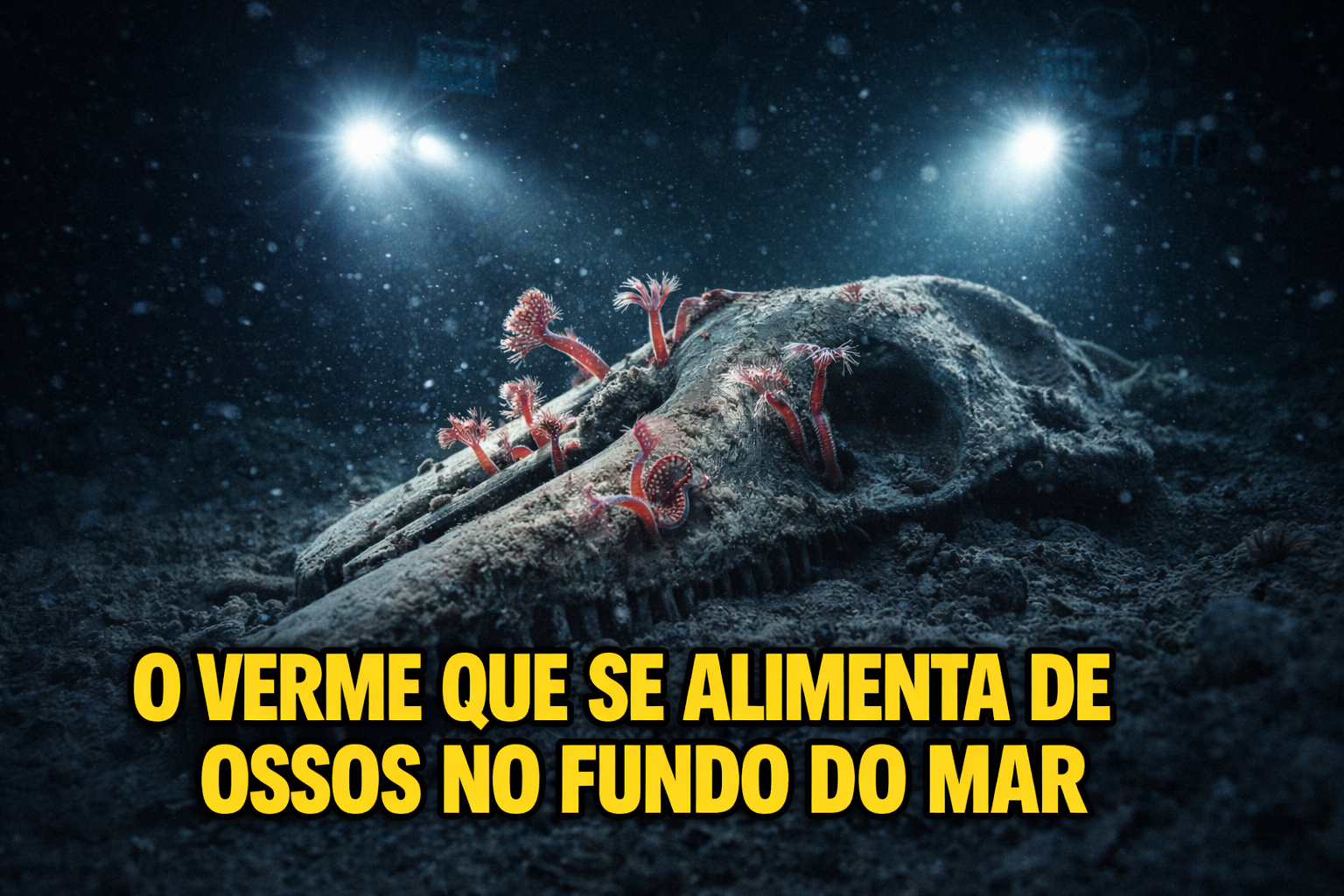


Osedax Worm Discovered in the Deep Sea Drills Whale Bones and Uses Symbiotic Bacteria to Feed at 4,000 Meters Depth.
Few people know that whales that die in the ocean initiate complex ecological chains that can last for decades and support hundreds of species that we would never see in shallow environments. This phenomenon is known by scientists as whale fall, the “collapse” of a whale carcass that sinks and becomes an energy oasis on the seabed. It was in this scenario, about 4,000 meters deep, that researchers found an organism so peculiar that it changed the way we understand marine decomposition: a worm of the genus Osedax, nicknamed the “bone-eating worm.”
This worm, unlike known species in coastal environments, has no mouth or traditional digestive system. It lives inside whale bones, drilling through bony structures with the help of specialized tissues and forming roots that house symbiotic bacteria. The discovery, made in the early 2000s through research involving the Monterey Bay Aquarium Research Institute (MBARI) and other institutions, revealed an unprecedented metabolic strategy in deep sea animals.
Whales, Energy, and the Collapse to the Bottom: The Context of Whale Fall
When a whale dies in the open ocean, the body can fall hundreds or thousands of meters until it reaches the seafloor. The animal represents a significant energy reserve — proteins, lipids, collagen — in an environment where food is extremely scarce. The fall initiates an ecological process divided into stages recognized by marine biology:
-
ChatGPT Alerts FBI to Prevent Planned Murder of 8-Year-Old in Brazil’s Espírito Santo

-
Scientists Discover 125-Million-Year-Old “Pregnant Fossil” with Preserved Embryos and Microscopic Larvae Inside Mollusk in England

-
17-Year-Old Justin Bernstein Develops Bacteria to Produce Glass on Arctic Ice to Reflect Sunlight, Wins $50,000 U.S. Scholarship

-
The 19-Meter Rocket-Helicopter: A Private Industry Prototype That Challenged Space Race Logic



- Mobile Stage, dominated by fish, sharks, and crustaceans;
- Enrichment-Stage Fall, with colonization by opportunistic species;
- Sulfidic Stage, with bacteria capable of metabolizing reduced compounds.

It is mainly in this last stage that the Osedax appears. The deep seabed, usually cold, dark, and low in organic matter, temporarily transforms into a rich environment, attracting highly specialized species.
Osedax: Anatomy, Biology, and an Unusual Way of Life
What makes the Osedax so fascinating is its anatomy. It lacks a mouth, stomach, or intestines like other worms. Instead, it develops root-like structures that infiltrate the bones, forming an intimate interface with symbiotic bacteria. These bacteria are the true agents of digestion: they break down organic compounds found in collagen and proteins of the bone, producing molecules that feed the worm.


This relationship, called nutritional symbiosis, resembles other ecological associations such as termites and protozoa, corals and algae, or ruminants and gut microbiota, but with a surprising detail — it occurs in an extreme environment, under pressure equivalent to 400 atmospheres, without light and with little excess oxygen available.
In addition to the “roots,” the Osedax has small feathery structures that project out of the bone and participate in gas exchange with seawater. Together, these adaptations allow the animal to explore an energy niche that is practically inaccessible to other species.
Discovery, Filming, and the Role of Robotic Vehicles
The modern discovery of Osedax was made possible thanks to the expansion of the use of ROVs (Remotely Operated Vehicles) and AUVs (Autonomous Underwater Vehicles). Before that, the abyssal floor was primarily studied using trawl nets, which destroyed delicate organisms and prevented direct observations.
By deploying an ROV in areas where researchers had placed whale carcasses for controlled study, the MBARI team recorded the presence of colorful worms emerging from bones like small plumes. Some lived in skulls, others in ribs and vertebrae, always associated with bony matter.
The images showed slender, delicate organisms adapted to the stable environment of the seafloor. There were no quick movements or predation behavior. Survival depended on symbiosis and the ability to occupy the substrate before ecological competitors arrived.
Symbiosis and the Chemistry of Depth
The deep sea is an unusual biochemical laboratory. Low temperature and high pressure alter chemical reactions and the metabolism of organisms. In the case of Osedax, the symbiotic bacteria have enzymatic mechanisms capable of breaking down compounds that are difficult to access for most animals.
By drilling into the bone, the worms expose new chemical microenvironments and facilitate the release of reduced compounds that can be utilized by neighboring bacterial communities. In other words, Osedax is not just a consumer, but potentially a facilitator in the final stage of whale fall, promoting the transition to the sulfidic environment.
Although there are gaps, studies indicate that different species of Osedax may coexist on carcasses depending on depth, temperature, and stage of decomposition. This suggests a more complex ecological dynamic than previously thought.
Dimorphism, Reproduction, and Dispersal
Another curious aspect of Osedax is sexual dimorphism. In some species, females establish themselves in the bones while males remain microscopic living inside them. This reproductive strategy reduces the need for encounters in the open environment — something difficult at abyssal depths — and ensures availability of sperm for continuous fertilization.

When the carcass is depleted and the bones are completely explored, larvae disperse through the water column until they find a new bony substrate. It is unclear exactly how long these larvae can survive or how much territory they can cover, but their presence in different oceans suggests a significant capacity for dispersal.
What Is Still Missing to Understand and Why It Matters
Even with advancements in marine biology, many questions remain:
- What is the longevity of Osedax in natural conditions?
- How many species actually exist?
- How does the initial colonization of the bone work?
- What role does this worm play in carbon cycling in the deep ocean?
There is no consensus, as studies depend on rare expeditions, expensive logistics, and sensitive technology. Still, Osedax has already changed the scientific view on the fate of large carcasses in the sea. It shows that marine life is not only based on predators and fish, but also on microscopic, symbiotic, and highly efficient networks.
The case also reinforces that unknown ecosystems are not exceptions, but the rule: a large part of the seafloor remains invisible and unexplored. By discovering a worm that lives inside whale skulls and depends on bacteria to feed, science expands not only the catalog of species but also the notion of how far evolution can go.


