






 Portuguese
  Spanish




Decision Recognizes Degrading Work Conditions and Reinforces Companies’ Duty to Ensure a Safe Environment for Private Security Professionals
Working in armored vehicles has always been associated with high risks, constant tension, and mandatory use of heavy equipment. However, when these conditions become degrading to the point of compromising the worker’s health and well-being, the Labor Court has ruled that there is a direct violation of personality rights. This was precisely the understanding adopted by the Sixth Panel of the Regional Labor Court of Minas Gerais (TRT-MG), when condemning a security and cash transportation company to pay damages of R$ 5 thousand to a former security guard.
The decision was unanimous and overturned a previous ruling from the 6th Labor Court of Belo Horizonte, which had denied the request for compensation. The case draws attention not only for the amount of the compensation, but mainly for the extreme conditions to which the worker was subjected while performing his duties.
Although the activity of surveillance in armored vehicles naturally involves adverse situations, the Court ruled that there are limits that should not be exceeded, especially when the company fails to ensure minimum working conditions.
-
Are Companies Required to Release Employees During Brazil’s World Cup Matches? Understanding Workers’ Rights

-
Brazilian Family’s Homeschooling Success Sparks International Debate: Daughters Read 30 Books Annually and Speak Multiple Languages

-
Piauí Governor Enacts Law Requiring State Contractors to Reserve Jobs for Former Inmates with Minimum Wage and Verification Before Payment
-
Providing Your Tax ID at Supermarkets: A Routine Step That Can Unlock Discounts and Rewards but Also Reveals Your Shopping Habits




Heat of Up to 50 °C Inside the Vehicle Increased Risks to the Guard’s Health
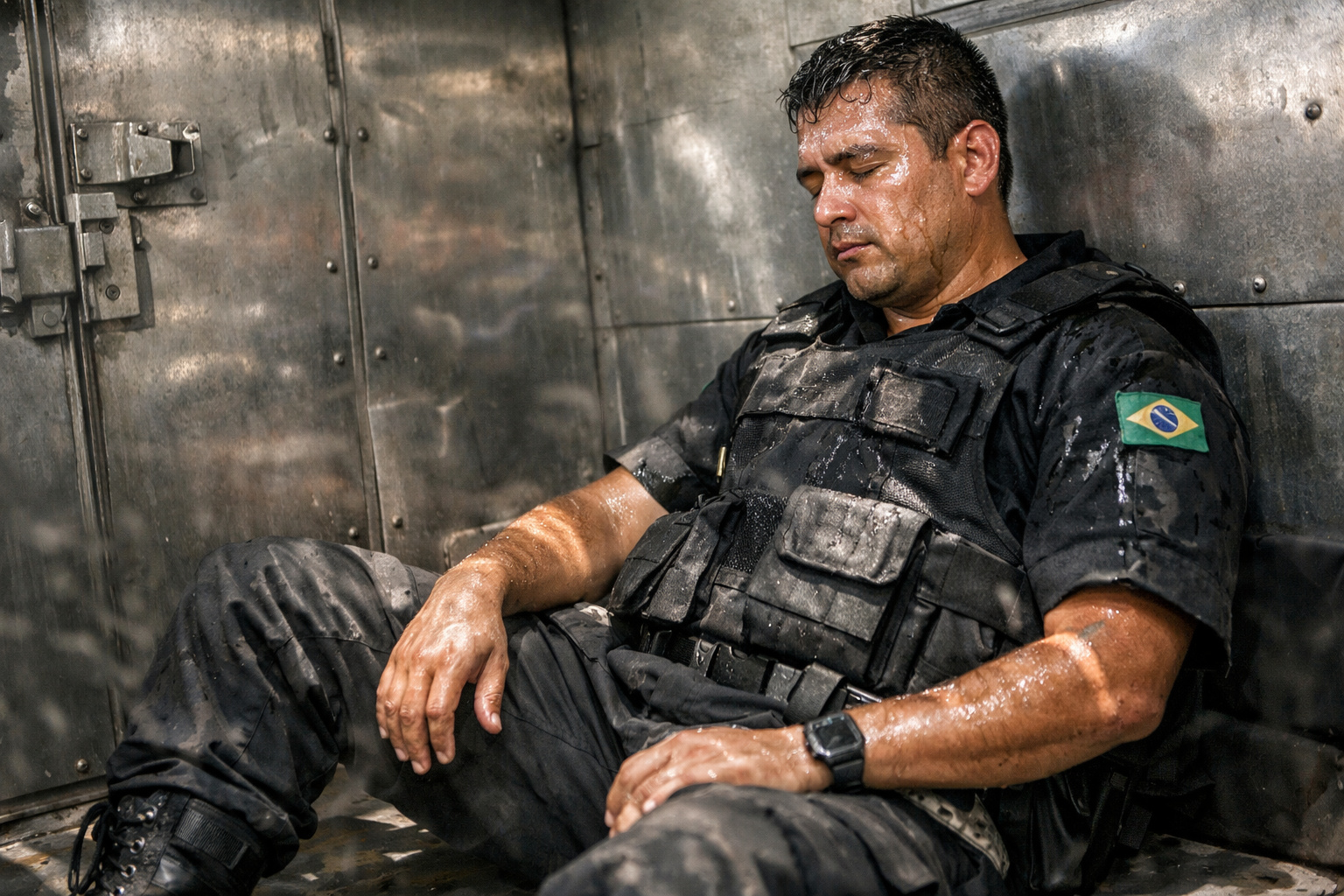
The security guard reported in the process that he performed his duties in an unairconditioned armored vehicle, being required to endure excessive heat for long periods, particularly on hotter days. According to him, the situation directly compromised his health, causing intense discomfort, physical exhaustion, and psychological suffering.
The claims were confirmed by witness testimony, which described the precariousness of the vehicles used by the company. According to this account, the lack of proper maintenance of the armored vehicles caused the internal temperature to reach up to 50 °C, making the environment practically unbearable for the guards.
Additionally, the mandatory use of bulletproof vests, boots, and other protective equipment further aggravated the thermal sensation. These items, while essential for physical safety against robberies, significantly increase thermal discomfort when there is no adequate air conditioning inside the vehicle.
Thus, the Court found that continuous exposure to extreme temperatures exceeds mere discomfort and constitutes an inadequate working condition, with the potential to cause harm to the worker’s health.
Court Recognizes Moral Damage and Company Responsibility
This information was released by the Regional Labor Court of Minas Gerais (TRT-MG), according to a decision reported by the judge Anemar Pereira Amaral. According to the rapporteur, the elements that characterize the obligation to compensate were duly proven, namely: the damage suffered by the worker, the employer’s fault, and the causal link between the company’s conduct and the damage experienced.
In the judge’s assessment, the lack of dignified working conditions, by itself, is already sufficient to characterize an offense to personality rights, regardless of proof of specific illness. The mere fact of subjecting the employee to a degrading and potentially harmful situation to health violates fundamental principles of labor legislation and the dignity of the human person.
The rapporteur further emphasized that it is the employer’s responsibility to ensure a safe and adequate working environment, especially in activities that already involve high risk, such as cash transportation.
Criteria for Setting the Compensation at R$ 5 Thousand
To define the amount of compensation for moral damages, the judges considered various legal and economic criteria. Among them, the degree of culpability of the company, the severity of the damage, the need to deter the repetition of unlawful conduct, and the economic conditions of the employer were particularly highlighted.
The compensatory function of the compensation was also taken into account, that is, the role of alleviating the worker’s suffering without generating undue enrichment. In this context, the amount of R$ 5 thousand was deemed appropriate in light of the principles of reasonableness and proportionality, widely applied by the Labor Court in similar cases.
Thus, the decision reinforces the understanding that companies in the private security sector are not exempt from responsibility when they fail to offer minimum working conditions, even in naturally adverse activities.
Process
The amount of R$ 5 thousand is sufficient to compensate for the damage suffered and deter new abusive practices, or should the Labor Court impose harsher compensations in cases like this?









5 mil reais de indenização é um desaforo ao trabalhador! É um exemplo de que as empresas podem continuar fazendo o que bem entender com o trabalhador pagando esporadicamente uma esmolinha pra um ou outro. Por outro lado, dependendo do porte da empresa esse valor tem um peso relevante, mas não justifica expor pessoas e essas condições de trabalho.
Sou segurança patrimonial mas ja penso em ir para outra categoria
como segurança de carro forte em consideração a justiça do nosso Brasil
5 mil e uma sacanagem com o trabalhador que passou e sofreu danos psicológicos
o valor da multa deveria ser uns 50 mil no máximo!!
Boa tarde pessoal, me desculpem a minha insatisfação, pelo que pude perceber, mas o que vi foi tanto mi mi por um miseréro cinco mil reais, qua isso, se fossem pelo menos uns vinte mil reais, que justiça é essa, miseréro…