






 Portuguese
  Spanish


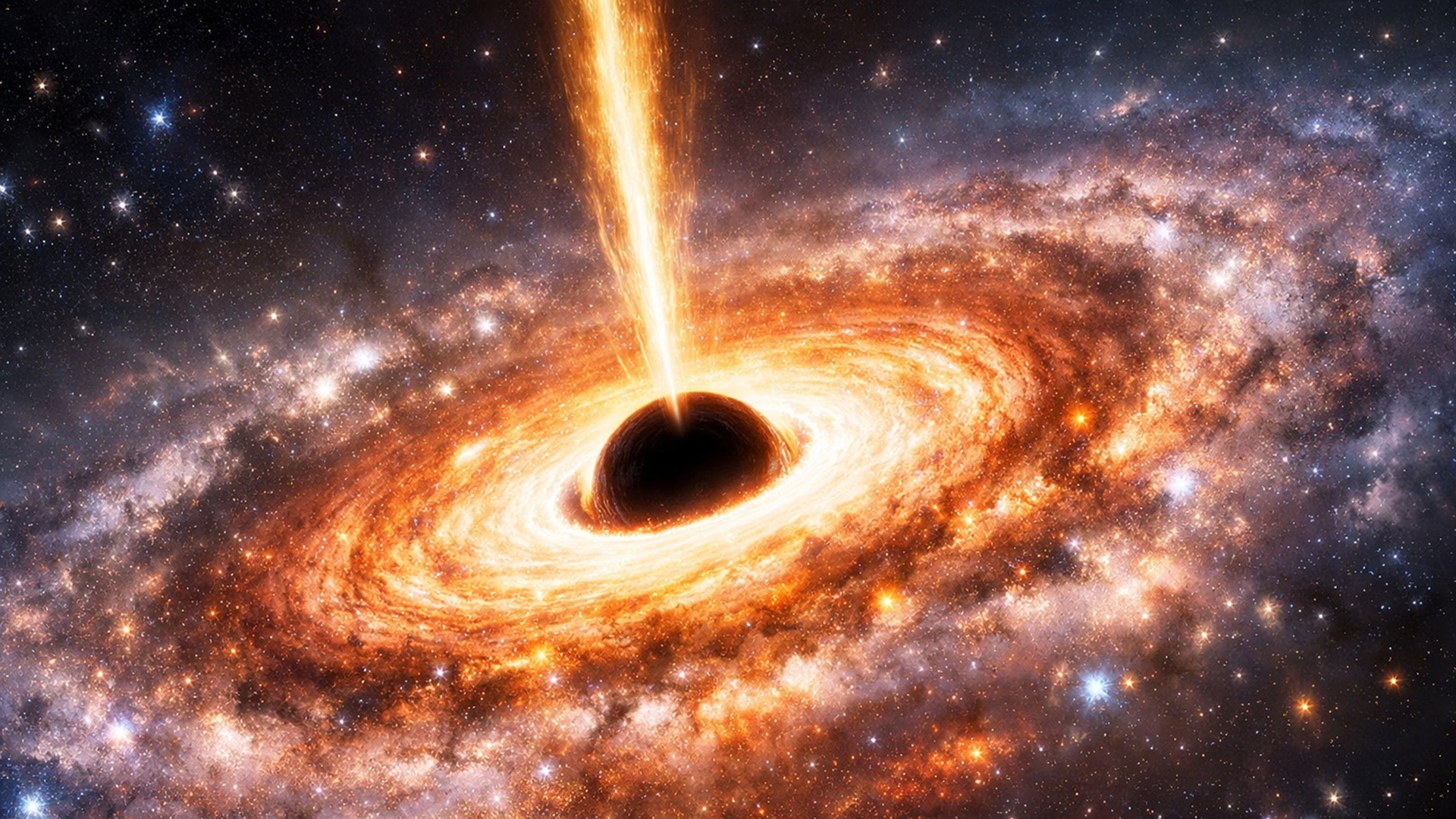


James Webb Data Reveals That Galaxy GS-10578, With 200 Billion Solar Masses, Had Its Star Formation Early Interrupted by the Action of a Central Black Hole That Blocked the Entry of Cold Gas Necessary to Create New Suns Billions of Years Ago
Astronomers identified the dead galaxy GS-10578 3 billion years after the Big Bang. With 200 billion solar masses, the system collapsed when a black hole blocked stellar fuel, reveals data from the University of Cambridge obtained by the Webb and ALMA telescopes.
Astronomers found a “dead galaxy” belonging to the infancy of the universe, located approximately 3 billion years after the Big Bang. The galaxy GS-10578, nicknamed Pablo’s Galaxy, is estimated to have 200 billion times the mass of our Sun.
This is an incredible size for such an early point in time. Data from the James Webb Space Telescope and the Atacama Large Millimeter Array (ALMA) indicate that this massive galaxy was likely strangled by its own central black hole.
-
World’s Most Powerful MRI Machine in France, Weighing 132 Tons and Generating 11.7 Tesla Magnetic Field, Offers Unprecedented Clarity of the Human Brain

-
Hong Kong Converts Former Coastal Landfill into Desalination Plant Producing 135 Million Liters of Drinking Water Daily
-
Texas Teens Win $50,000 at World’s Largest Science Fair for Developing Non-Surgical Brain-Controlled Bionic Prosthesis with 98% Accuracy
-
Samsung Galaxy A27 Launches with 6.7-inch Super AMOLED Display, Full HD+ Resolution, Android 16, Six Years of Updates, Snapdragon 6 Gen 3, and Dust and Splash Resistance; Available for Pre-order in the US for $350


Analysis of Early Stellar Interruption
The University of Cambridge analyzed data collected by these telescopes and discovered that this galaxy lived fast and died young. At three billion years old, it should have been at its peak, vigorously producing new suns.
However, it is dead due to this black hole. Previously, astronomers believed that a galaxy could only die or stop making stars through a violent and sudden event.
The main theories suggested that a massive collision with another galaxy or a single explosion from the black hole would have to physically tear all of the vital gas away at once.
The Slow Starvation Process
This new discovery shows that a galaxy can disappear much more quietly, succumbing to a slow hunger instead of a single cataclysmic explosion. The galaxy appears as a calm, rotating disk, said Dr. Francesco D’Eugenio, co-first author at the Kavli Institute for Cosmology.
This stability suggests that the galaxy was not destroyed by a merger. Instead, it suffered a death by a thousand cuts, as the central black hole repeatedly heated the flow of cold gas.
It stopped forming stars 400 million years ago, while the black hole is still active. The current activity and explosion of gas observed did not cause the shutdown. Repeated episodes likely prevented the return of fuel, D’Eugenio explained.
Absence of Cold Hydrogen
Using the combined power of Webb and ALMA, the team looked for the fuel of life: cold hydrogen gas. They found nothing.
The central black hole constantly reheated the gas around the galaxy, preventing it from cooling.
As stars can only form from cold gas, this persistent heat created a blocked system where no new fuel could enter. The black hole’s energy acted as a permanent barrier.
This eventually starved the galaxy of the raw materials necessary to create new stars, rather than a single explosion. Even with one of ALMA’s deepest observations, there was essentially no cold gas remaining.
Detailed Observations and Gas Flow
This points to a slow starvation rather than a dramatic death blow, said Dr. Jan Scholtz, co-first author at the Cavendish Laboratory at Cambridge and the Kavli Institute for Cosmology.
Although most stars in this galaxy were born in a massive explosion over 11 billion years ago, its productive life was interrupted much faster than expected.
Data from JWST show that the central black hole is currently ejecting the equivalent of 60 suns worth of gas each year at a velocity of 400 kilometers per second.
This aggressive leakage meant that the galaxy drained its remaining fuel in just 16 million years. This represents a fraction of the billion-year lifespan typical for galaxies of this size.
Explanation for Ancient Galaxies and Future Studies
The discovery helps explain why the Webb Telescope is finding so many dead and ancient-looking galaxies in the very primitive universe.
A single cataclysm is not necessary to halt star formation; it is enough to prevent fresh fuel from entering, Scholtz stated.
To confirm this starvation effect, the team from Cambridge received more time with the JWST. The goal is to study hotter gases and define the exact physics of how these black holes interrupt star formation. The findings were reported in the journal Nature Astronomy on January 12.


