






 Portuguese
  Spanish
  3 min of reading
  0 comments


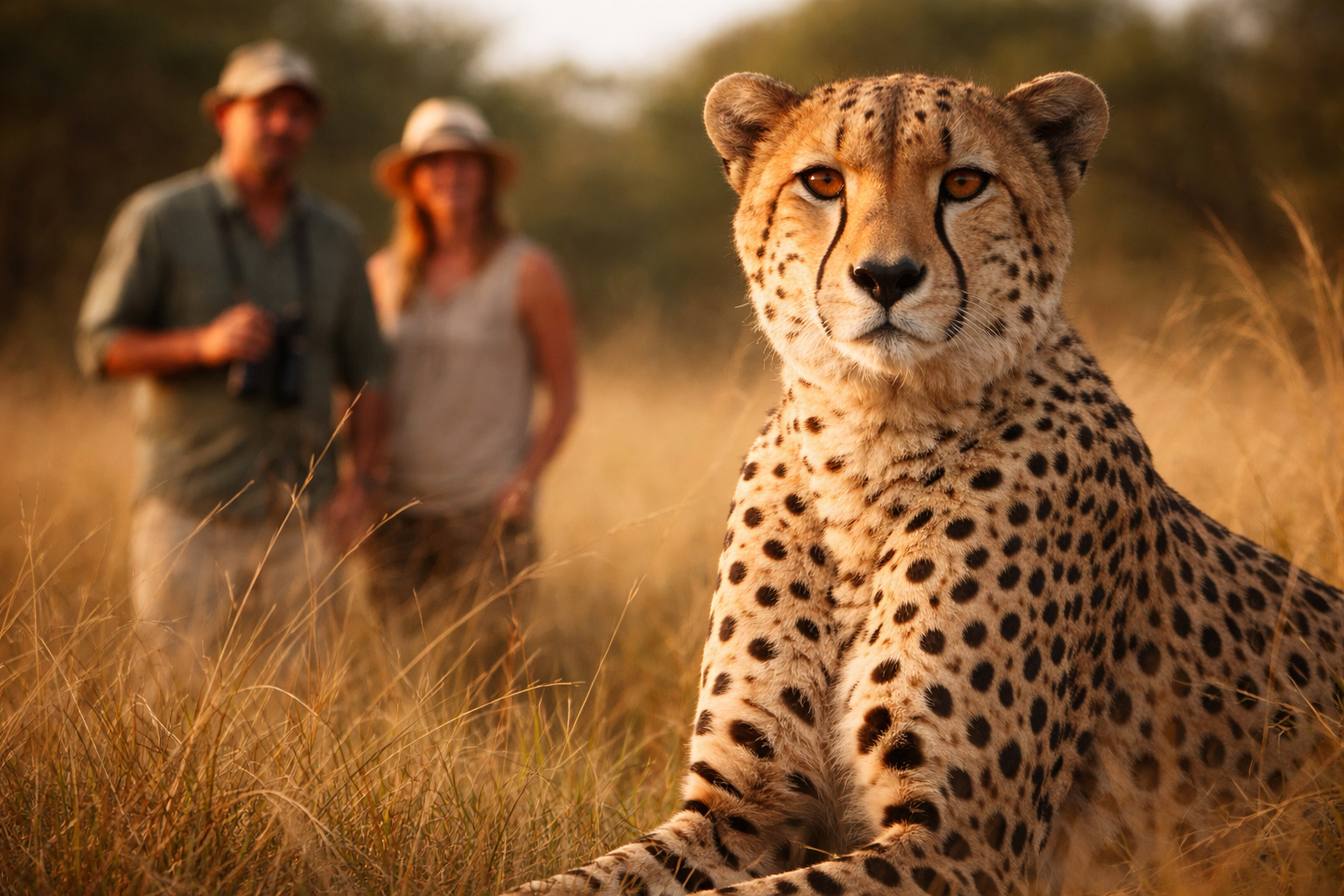
Historical Records, Field Studies, and Scientific Analyses Show That, Until 2024, There Is No Evidence of Cheetah Attacks on Humans Anywhere in the World
Since the end of the 19th century, when systematic scientific records of large felines began, researchers have documented a consistent finding. There is no confirmed case of a cheetah attacking a human. Over time, this information has been reviewed, updated, and reaffirmed. Still, until 2024, the scenario remains unchanged, reinforcing an extremely rare behavioral pattern among large predators.
Throughout the 20th century, especially from the 1950s onward, when field studies intensified in Africa, scientists observed a recurring behavior. Whenever they sense human presence, cheetahs choose to flee. Instead of confrontation, the species retreats, hides, or changes its route. Therefore, this reaction is not occasional but rather an evolutionary strategy based on caution.
Documented Behavior in Natural Habitats Over the Decades
Since the first recorded observations in the early 20th century, cheetahs maintain an active distance from areas occupied by people. Thus, in environments monitored by researchers between 1950 and 2000, the species consistently demonstrated avoidance of direct contact. Consequently, this posture reduces conflicts and increases their chances of survival in shared regions.
-
Helicopter Drops 180 Tons of Sand and Gravel on Swedish River to Revive Ecosystem Damaged by Decades of Exploitation

-
Brazilian Company Launches Retro Smartphone with 48 MP Camera, T9 Keyboard, and Privacy Features for Social Media-Free Use

-
Self-Taught Chinese Farmer Builds 5-Ton Submarine from Scrap, Launches It in Anhui River
-
Invisible Induction Technology Enables Wireless Power for Blenders, Coffee Makers, and Air Fryers, Reducing Countertop Cables






Additionally, behavioral studies conducted between the 1970s and 2000 reinforced a central point. The cheetah does not recognize humans as prey or as a direct threat. Therefore, by prioritizing evasion, the animal conserves energy and minimizes risks. As a result, the historical coexistence between cheetahs and humans remains marked by the absence of serious incidents.
Scientific Analyses Reinforce Pattern of Extreme Caution
Animal behavior specialists emphasize that this profile has remained stable over more than 100 years of documented observations. From the first formal records of the 19th century to recent surveys of the 21st century, there has been no significant change in this pattern. Thus, the cheetah has consolidated its reputation as one of the large felines with the least history of conflict with people.
According to analyses published by specialized institutions in wildlife conservation, the absence of attacks does not represent a historical coincidence. On the contrary, it reflects the direct survival of a species that has always been linked to discretion, caution, and systematic flight in the presence of humans.
Defensive Instinct Explains the Absence of Historical Conflicts
Over the past few decades, researchers have reinforced that the cheetah’s defensive instinct is based on evasion, not confrontation. By avoiding unnecessary disputes, the species reduces risks and conserves energy, a crucial factor for its survival. Consequently, this behavior helps explain why, to this day, there are no confirmed records of attacks on humans.
Given this consistent history, experts point out that the cheetah remains a unique case among large felines, demonstrating that not all apex predators pose a direct threat to people.
After all, how has such a fast and powerful species maintained this pattern of caution for over a century even with human expansion into its natural habitats?





-

-

-

-

-

-

37 people reacted to this.