Portuguese
  Spanish


Strategic Uranium Reserves Remain Untouched in Brazil While Billion-Dollar Mining Projects Await Investments and Regulatory Advances. Nuclear Sector Sees Opportunities for Clean Energy and National Independence.
Brazil occupies a prominent position in the global scenario by holding the sixth largest uranium reserve in the world, a strategic resource essential for nuclear energy production and for the energy transition towards less polluting sources.
Despite this potential, mines that have been mapped and cataloged for decades remain unexplored, while the state monopoly controls the entire uranium cycle, an element increasingly coveted internationally due to growing demands for clean and sustainable energy.
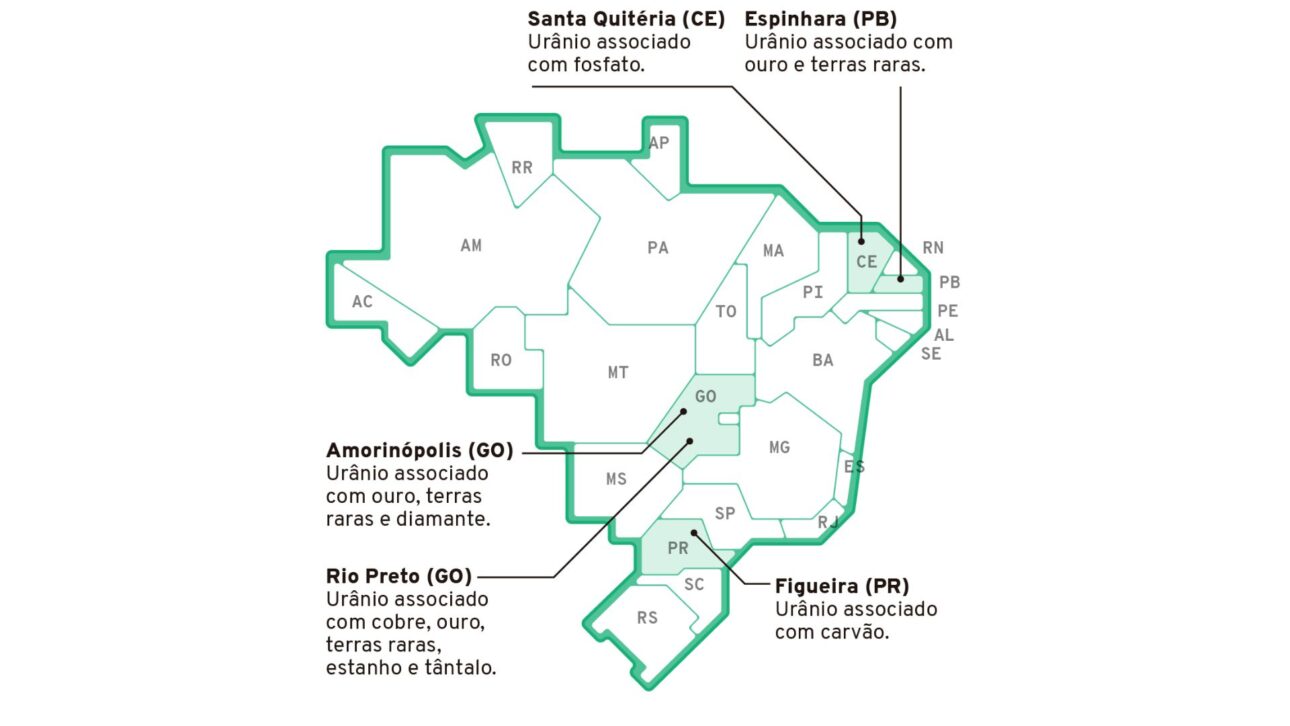
These deposits of uranium, known as “forgotten mines,” are located in the states of Paraná, Goiás, Paraíba, and Ceará.
-
Volvo’s New Loaders Feature Obstacle Detection, Automatic Braking, and 360-Degree Operator View

-
Chinese Manager Accused of Whipping Worker Sparks Protest by 1,200 Employees at Major Brazilian Factory

-
France Revamps 530 Social Housing Units with Large Balconies and Glass Facades Without Demolishing Existing Buildings

-
10-Year-Old Max Makes History with Paris Fashion Show, Launches Own Brand, Hires Staff, and Sets World Record as Youngest Runway Designer





In many of these locations, uranium is associated with other valuable minerals such as gold, copper, diamonds, and rare earths.
Even in the face of this promising scenario, public and private investments for the development of these areas have been insufficient, perpetuating the billion-dollar potential still unexplored.
Indústrias Nucleares do Brasil (INB), the company responsible for managing national uranium, announced that it intends to launch calls for partnerships in the exploration and separation of these metals in the second half of 2025.
Uranium will continue to be the exclusive responsibility of the state-owned company, as required by Brazilian legislation.
Among the priority mines are Figueira (PR), Espinhara (PB), Amorinópolis (GO), Rio Preto (GO), and the strategic Itataia project in Santa Quitéria (CE).

Opportunities for the Brazilian Nuclear Sector
According to the Brazilian Association for the Development of Nuclear Activities (Abdan), Brazil gathers the essential conditions to capture a significant share of the global uranium market, in a context where several countries are revising their energy policies and reassessing the use of nuclear energy.
“The country has reserves, technical knowledge, and the capacity to produce nuclear fuel,” says Abdan president Celso Cunha.
He also emphasizes that, while nations like China dominate the technology, few have the mineral resource in abundance, which increases international interest in Brazilian uranium.
The Minister of Mines and Energy, Alexandre Silveira, even compared the map of national deposits to the pre-salt oil, referring to the dimension and economic potential of these projects for both internal supply and export.
The global market closely follows the next steps of the sector, given the growing appetite for alternative energy sources with lower environmental impact.
Awaited Calls and Regulatory Barriers
Despite the expectations, the advancement of partnerships depends on the launch of exploration calls, which have been awaited since January 2023, the beginning of the current federal administration.
INB confirmed that Figueira, Espinhara, Amorinópolis, and Rio Preto are part of the Pró-Urânio program, which foresees private sector participation for joint exploration with the state-owned company.
The Itataia project in Ceará is considered a priority, with operations expected to commence by 2029, according to the company itself.
The Itataia mine, located in Santa Quitéria, stands out not only for its uranium volume but also for the amount of phosphate, a key input for fertilizer production.
Currently, about 87% of the national demand for phosphate fertilizers is met by imports, which increases the strategic importance of the project for Brazil.
The company responsible for phosphate extraction will be Galvani Fertilizantes, which is expected to produce 1 million tons of fertilizers and 220,000 tons of dicalcium phosphate for animal nutrition annually.
Uranium, in turn, will be primarily directed to the nuclear power plants in Angra dos Reis, and may also supply the international market due to the expected surplus.
Changes in Legislation and Expectation for Advances
A significant change occurred at the end of 2022, when Brazilian legislation began to allow private sector participation in the research and mining of nuclear minerals, which was previously restricted to the State.
The change, sanctioned by then-president Jair Bolsonaro, represents a milestone for opening the sector to cooperation with specialized companies, although control of extracted uranium remains with the Union.
According to Celso Cunha, “it makes no sense for the government to act directly in extraction, which is a typical private sector activity.”
Even with the new legislation, the operationalization of partnerships has not yet materialized.
The nuclear sector has been awaiting the publication of calls to formalize private companies’ participation in projects since 2023, with expectations of advances still in 2025.
According to industry sources, the national uranium “pre-salt” remains a promise awaiting bureaucratic and environmental unlocking.
Nuclear Energy and New Uses for Brazilian Uranium
The global demand for uranium is growing, driven primarily by small nuclear reactors, a technology spreading in various countries to support industrial decarbonization and ensure continuous energy supply, including for data centers.
Nuclear energy, considered one of the few truly clean thermal alternatives, provides stability to the electrical system and reduces dependence on intermittent sources such as wind and solar.
Data from Abdan indicate that over US$ 75 billion in energy projects are stalled at the Brazilian Institute of Environment and Renewable Natural Resources (Ibama), awaiting environmental licenses — among them the unprecedented project in Santa Quitéria.
Once operational, the Ceará project could fully supply the Angra 1, 2, and 3 plants, in addition to generating a surplus for export.
The already cataloged uranium reserves in Brazil would ensure internal supply for at least two centuries, according to sector estimates.
The advancement of nuclear energy could also generate cross-sector benefits, such as hydrogen production, water desalination, and decarbonization of other activities, especially in mining, which remains heavily dependent on diesel generators.
Furthermore, the nuclear industry has a direct interface with medicine, providing radioisotopes essential for cancer diagnosis and treatment.

Itataia: A Strategic Mining Site for the National Future
After more than ten years of research, Galvani Fertilizantes developed unprecedented technology in Brazil to separate phosphate and uranium present in Itataia, where 99.8% of the volume corresponds to phosphate and 0.2% to uranium.
The enterprise can reduce Brazil’s dependence on imported fertilizers and meet 25% of the national phosphate fertilizer market and half of the demand for dicalcium phosphate in the North and Northeast regions.
The extracted uranium will be enriched by INB from its natural grade to 4.5%, the international standard used in nuclear reactors.
Despite the enormous potential, challenges remain.
Environmental licensing, the need for robust investments, and the pace of bureaucratic procedures limit the transformation of the uranium “pre-salt” into reality.
The topic returns to the center of national debate amid the search for energy security, self-sufficiency, and new economic opportunities for Brazil.