Portuguese
  Spanish


Experimental station at USP tests a Brazilian route to produce renewable hydrogen from ethanol, focusing on clean mobility, use of existing infrastructure, and technical evaluation in real vehicles.
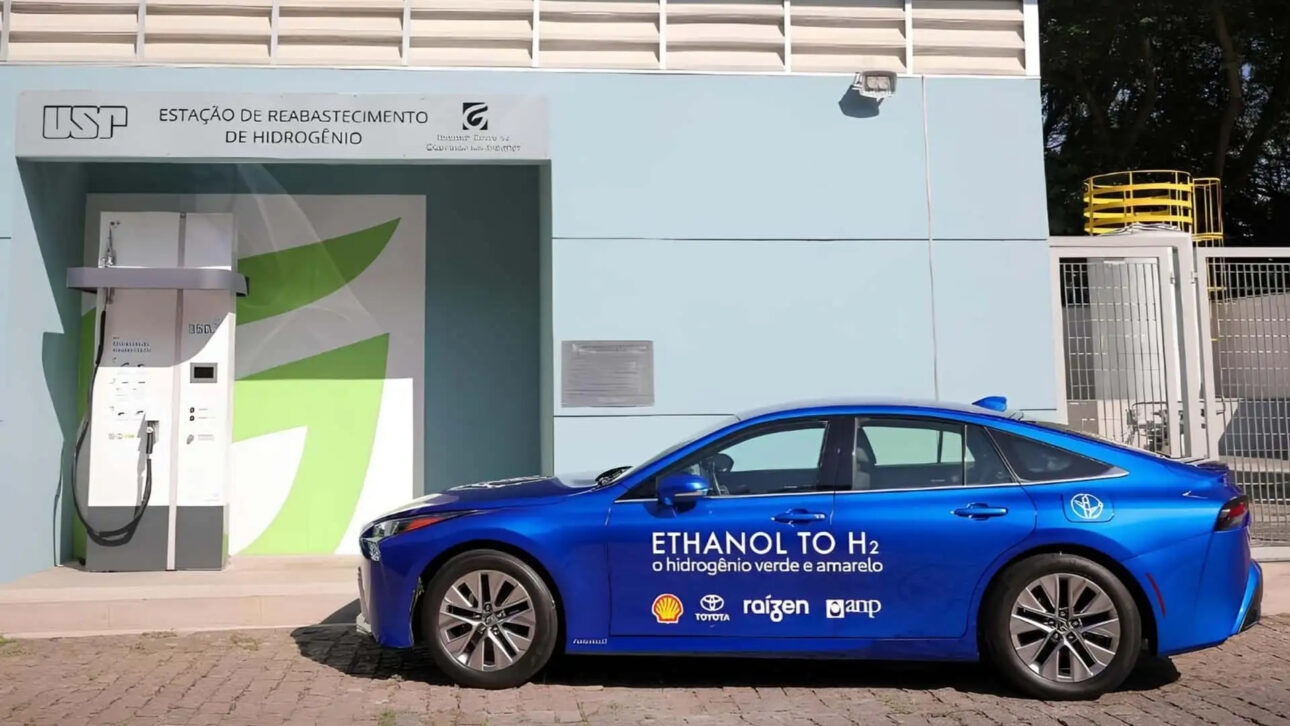
The world’s first experimental station dedicated to the production of renewable hydrogen from ethanol is in the testing phase at the University of São Paulo’s University City, in the capital of São Paulo.
The pilot plant has the capacity to produce up to 100 kilograms of hydrogen per day and was designed to supply buses and light vehicles powered by fuel cells, without relying on traditional H2 stations.
Conducted by the Research Centre for Greenhouse Gas Innovation at USP, known by the acronym RCGI in English, the project is part of a research and development initiative aimed at energy transition.
-
Boat Made from 10 Tons of Plastic and 30,000 Discarded Flip-Flops Sails Along African Coast, Serving as a Floating Classroom on Ocean Pollution

-
Welder Discovers 16th-Century Diamond Ring in England After 7 Hours with Metal Detector; Gold Jewel Linked to Edward I Pattern Auctioned for £17,000
-
Former Merchant Marine Captain Invents Fuel-Free Barrier, Removes 20,000 Tons of Trash from Chennai Rivers
-
14-Year-Old Maxim Harris Turns School Project into Anti-Rage Gaming Accessory, Sells 1,000 Units Across 46 U.S. States, Donates 20% of Profits to Charity



The proposal is to verify, on an experimental scale, if ethanol can function as a vector to generate renewable hydrogen at the fueling site itself.
The choice of ethanol is linked to the existing structure in Brazil for the production, distribution, and use of biofuel, especially from sugarcane.
By converting this input into hydrogen within the station itself, researchers are analyzing an alternative that takes advantage of part of this network, instead of relying exclusively on new infrastructure for H2 transport and storage.
How the USP station transforms ethanol into hydrogen
The plant uses steam reforming of ethanol, a chemical process in which ethanol reacts with water at high temperatures.
The reaction allows for the obtaining of hydrogen and also generates carbon dioxide.
In the case of sugarcane ethanol, the CO₂ is classified as biogenic, as it is associated with the plant’s growth cycle, which absorbs carbon during cultivation.
In practice, the station was developed to produce hydrogen in the same environment where the fuel can be used.
This point is relevant for the research because H2 requires specific conditions for transport, storage, and refueling, especially when compressed at high pressure or kept in liquid form.
With local production, the project aims to evaluate a way to reduce logistical steps associated with hydrogen supply.
The testing phase should indicate whether the system can operate with stability, efficiency, and safety in real mobility applications.
In addition to the chemical conversion, researchers also monitor the behavior of the fuel in vehicles.
The analysis includes consumption, yield, and operational performance, necessary indicators to understand the technical limits of the technology.
Buses and cars in tests with renewable hydrogen
The hydrogen produced at the station will be used in three buses and two light vehicles, including the Toyota Mirai and Hyundai Nexo models, both powered by fuel cells.
Tests are also planned with public transport buses operating in the USP environment.
In this stage, the focus is on collecting data on the ethanol-to-hydrogen conversion rate and vehicle consumption rates.
The results should help determine whether the solution can advance to new studies outside the experimental environment.
The station does not operate as a commercial enterprise.
It is an applied research platform, on a scale larger than a laboratory, created to validate technical parameters before any discussion on expansion.
Therefore, the data obtained will be used in evaluations of efficiency, operational cost, safety, continuous performance, and possible adaptations for other applications.
Without these results, it is still not possible to state whether the technology will be viable on a large scale.
Partnership brings together USP, industry, and public transport
The station received an investment of R$ 50 million and brings together companies, research institutions, and transport-related bodies.
Shell Brasil, Raízen, Hytron, currently part of the Neuman & Esser Group, Senai Cetiqt, and USP itself, through RCGI, are participating in the initiative.
Toyota, Hyundai, Marcopolo, and the São Paulo Metropolitan Urban Transport Company, EMTU, are also associated with the project.
Each participant is involved in a stage of development.
Hytron is responsible for the reformer used in the conversion of ethanol into hydrogen.
Raízen provides sugarcane ethanol.
Senai Cetiqt contributes with computational simulations aimed at equipment efficiency, while RCGI coordinates scientific research and the collection of operational data.
The scientific director of RCGI, Julio Meneghini, stated that the Brazilian ethanol infrastructure can favor the evaluation of this technological route.
“We are promoting a revolution in the energy matrix by demonstrating that it is possible to produce sustainable hydrogen from ethanol, with great logistical efficiency,” said the researcher.
According to Meneghini, the technology can also be studied for sectors with high emissions, such as steelmaking, cement, chemical industry, petrochemicals, fertilizers, and heavy transport.
The statement refers to the potential application pointed out by the researcher, not to an existing commercial operation in these segments.
Ethanol and hydrogen enter the same research route
USP’s project combines two energy chains on the same research platform: ethanol and hydrogen.
The first is already used in Brazil as a large-scale liquid fuel.
The second is studied for applications where battery electric vehicles may face limitations related to range, weight, or recharge time.
In fuel cell vehicles, hydrogen reacts with oxygen to generate electricity.
This energy powers the electric motor, and the main byproduct of the vehicle’s operation is water vapor.
The carbon footprint of the complete cycle, however, depends on how the hydrogen is produced.
For this reason, the origin of H2 is one of the central points of the research.
USP’s station tests a route based on ethanol, different from water electrolysis with renewable energy, which also appears among the alternatives for low-carbon hydrogen production.
The analysis seeks to indicate whether the use of ethanol as an intermediary can be technically suitable in places where the biofuel is already available.
This evaluation involves parameters of efficiency, logistics, emissions, and performance in real vehicles.
Scale, cost, and performance still depend on tests
Although it is an unprecedented initiative in its experimental configuration, the station still depends on consolidated data before any commercial expansion.
The capacity of up to 100 kilograms per day allows tests with buses and cars, but it does not equate to large-scale industrial production.
There is also, so far, no consolidated public disclosure about the cost per kilogram of hydrogen produced at the plant, the final efficiency of the process in prolonged operation, and the system’s performance in different usage cycles.
This data is necessary to compare the technology with other H2 production routes.
The rector of USP, Carlos Gilberto Carlotti Junior, stated that universities have a role in creating technologies for the energy transition.
“The role of universities is to develop technologies that do not yet exist to enable Brazil to make an energy transition,” he said.
In the rector’s assessment, the rapprochement between academic research and companies can contribute to transforming scientific knowledge into applied innovation.
The statement was made in the context of the presentation of the plant and the partnership between university, industry, and the public sector.
The University City station also inserts Brazilian ethanol into the debate on new renewable energy chains.
For researchers involved in the project, the experience accumulated by the country with biofuels can serve as a basis for testing decentralized hydrogen production models.
The next results should indicate whether the conversion of ethanol into H2 can meet technical requirements for safety, efficiency, and regularity.