






 Portuguese
  Spanish


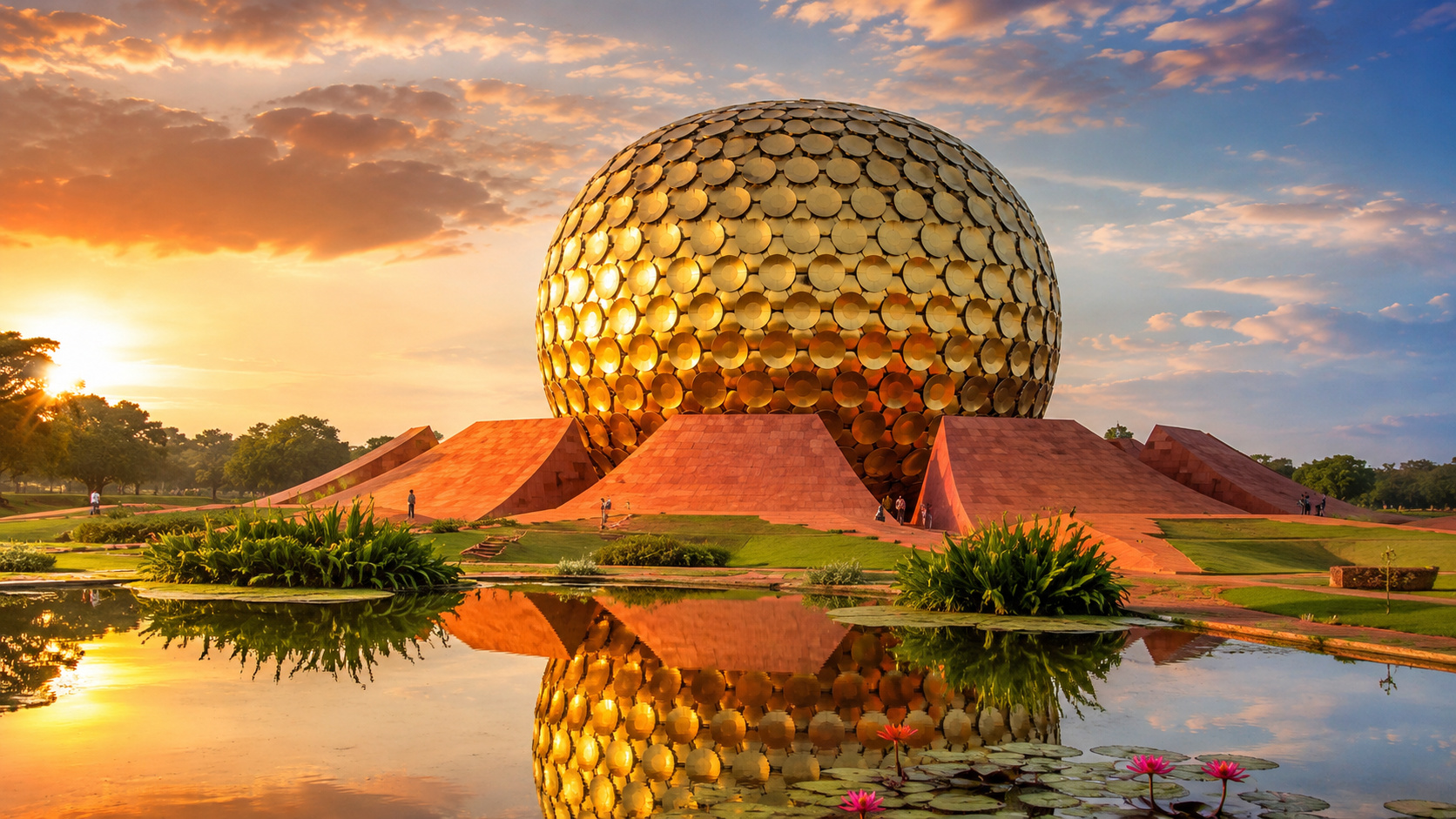


The golden sphere of the Matrimandir in Auroville combines curious architecture, 1,415 golden discs, decades of work, and a system that directs sunlight to the inner center of the construction, creating one of the most impressive projects in India for those who enjoy visual engineering and unconventional constructions
A giant golden ball in the middle of gardens in India looks like a spaceship landed in Auroville, but it was built piece by piece. The Matrimandir draws attention for its spherical shape, intense shine, and the coating made with 1,415 golden discs.
The information was released by Auroville, the institutional site of the community that houses the Matrimandir. The construction uses discs with gold leaf applied over stainless steel pieces and also features a system that brings directed sunlight to the inner center.
The visual impact is immediate. The work mixes architecture, geometry, constructive patience, and light control, without relying solely on size or shine. The result is one of the most curious constructions in Auroville.
-
U.S. City Builds Tiny Home Village on Water Company Land to House 136 Homeless People: Inside the Social Housing Units

-
Woman Turns Shipping Container into Home, Embraces Rural Life to Cut Monthly Expenses to Just Over $330
-
France Revamps 530 Social Housing Units with Large Balconies and Glass Facades Without Demolishing Existing Buildings

-
Facing high rent, couple transforms parents’ garage into a fully functional apartment, creating a complete home at a fraction of the market cost.




How the golden sphere of the Matrimandir was assembled with 1,415 discs
The Matrimandir did not receive a common covering. The sphere was coated with 1,415 golden discs, creating the appearance of a large shiny metallic skin over the construction.


These pieces form the most well-known visual of the building. When viewed from afar, they create the image of a single luminous sphere. Up close, they reveal an assembly formed by many individual elements.
The use of gold leaf over stainless steel pieces helps explain the visual effect. The surface reflects light intensely and transforms the construction into a highlight in the middle of the gardens.
The strength of the project lies precisely in this combination. The form is simple to understand, but the execution requires precision, repetition, and care in each part of the coating.
Why the golden discs have two different shapes
The golden sphere of the Matrimandir was not covered with identical pieces. The assembly consists of 954 smaller convex discs and 461 larger concave discs.
Convex is the outward curved shape. Concave is the inward curved shape. This difference helps create depth, shadow, and variation of brightness on the surface.
Auroville, the institutional site of the community that houses the Matrimandir, detailed these numbers in the project’s technical documentation. The division between smaller and larger pieces shows that the golden effect depends on planning and not just on a beautiful coating.
In practice, the different discs make the light behave in various ways over the sphere. This makes the construction more visually alive, especially when the sun changes position throughout the day.
How sunlight reaches the silent center of the construction
Besides the golden appearance, the Matrimandir draws attention for the use of directed sunlight. The construction was designed to channel sunlight to the inner center.
This feature transforms lighting into part of the architecture itself. The light does not appear just as a decorative detail. It is part of the visual experience created inside the building.
For those observing the project from outside, the golden sphere dominates the landscape. For those who understand the internal functioning, the most curious point is realizing that natural light was also incorporated into the design of the work.
The idea makes the Matrimandir different from constructions that rely solely on lamps or striking facades. Here, the sun directly participates in the result.
Why the work took decades to be completed
The construction of the Matrimandir went through a long process. The installation of the golden discs was completed in 2007, and the building was completed in 2008.
This time helps to understand the complexity of the project. A sphere covered by thousands of pieces, with a golden finish and solar light system, requires many stages of assembly and adjustment.
The delay also shows that the Matrimandir was not a work made just to cause a quick impact. The project depended on continuity, manual work, precision, and technical solutions.
Therefore, the construction draws attention not only for its brilliance. It also impresses with the patience needed to transform an architectural idea into a real structure.
What makes Auroville’s golden sphere so impressive
The Matrimandir is often remembered for its symbolic value, but its constructive side is enough to arouse curiosity. The sphere combines geometry, gold, stainless steel, and controlled sunlight.
The construction also shows how a simple form can hide a complex process. At first glance, it seems like just a giant golden ball. Upon closer inspection, the discs, the different shapes, the materials, and the calculated use of light appear.
This contrast explains why the work has so much visual potential. It is easy to recognize, strong in images, and full of details for those who enjoy unconventional architecture.
In the center of Auroville, the Matrimandir has become a visual landmark of India precisely because it combines striking appearance and careful construction.
The golden sphere of the Matrimandir impresses because it transforms a simple idea into a work full of precision. There are 1,415 golden discs, completion of the discs in 2007 and completion of the building in 2008.
More than a beautiful construction, the project shows how geometry, materials, and light can work together. What catches your attention the most: the golden discs, the use of sunlight, or the decades of work behind this sphere?










Meditation requires humility, but the atmosphere here feels intensely exclusive and superior. Beautiful buildings and art—like those found in the MET or the Louvre—remain relevant after centuries because they carry with them a divine and accessible energy distilled in each work of art. This giant golden ball feels different. It feels like a display of architectural arrogance. The polished dome screams exclusivity rather than spiritual peace, proving that fancy aesthetics cannot substitute true spiritual experience.
Yes it looks more like a casino in Las Vegas !