Portuguese
  Spanish


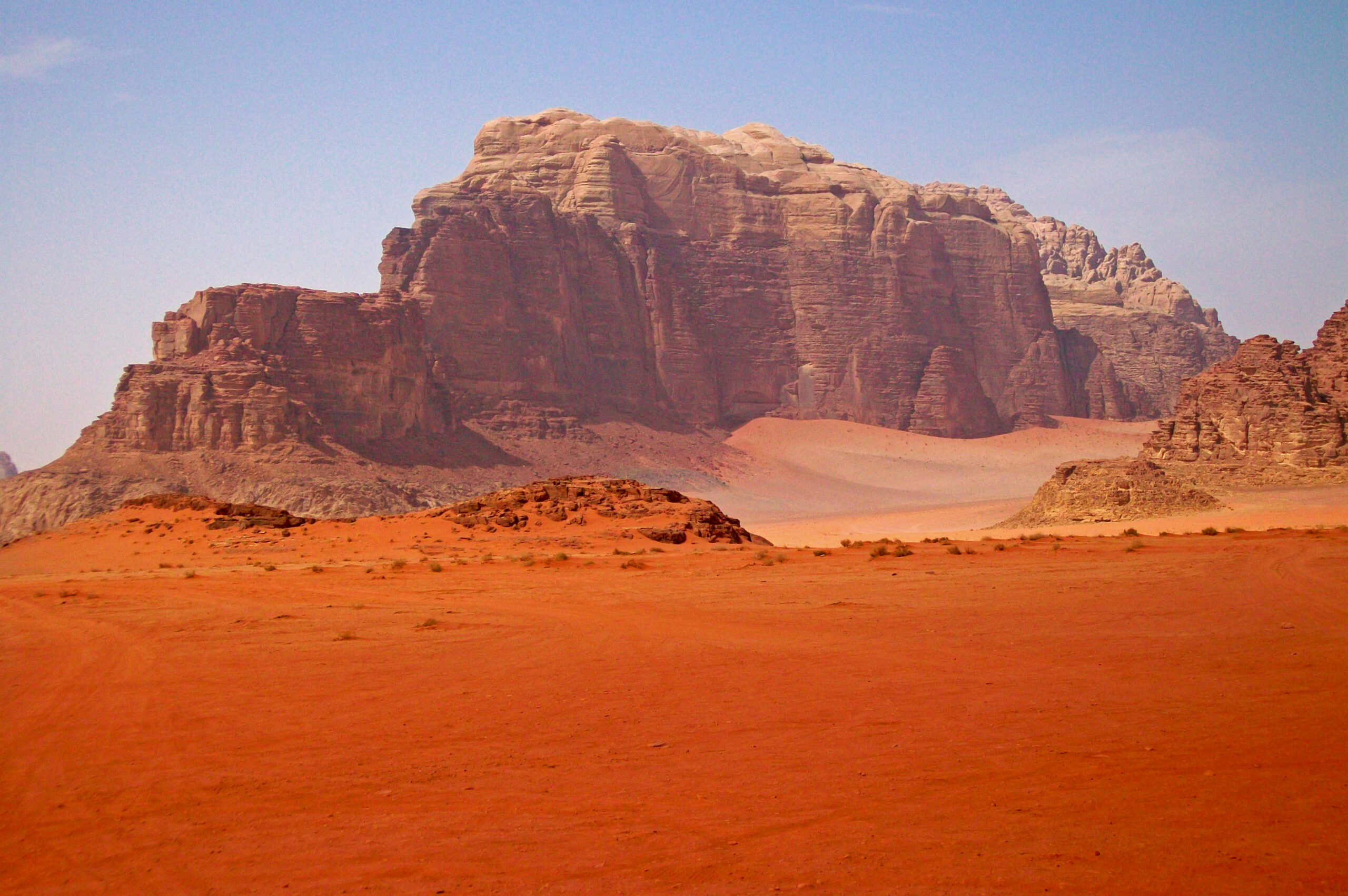

Wadi Rum impresses with the grandiosity of its rock formations, millennia of history preserved in ancient inscriptions, and landscapes that reveal the interaction between nature, time, and human presence in the Jordanian desert.
In records analyzed throughout the 2010s by researchers and published by institutions such as the NASA Earth Observatory and the UNESCO, a region in southern Jordan began to attract attention for its unusual configuration when viewed from above. Amid the Arabian Peninsula desert, dominated by relatively homogeneous surfaces, emerges a complex of reddish tones, carved by narrow corridors, steep walls, and isolated rock formations that resemble a natural labyrinth.
This scenario corresponds to Wadi Rum, a protected area located about 60 kilometers east of the Gulf of Aqaba, near the border with Saudi Arabia. Viewed from space, the region stands out for the intensity of its colors and the irregular geometry of the formations, a direct result of millions of years of erosive processes acting on sedimentary rocks.
The visual impact is so expressive that Wadi Rum has become a global reference in remote sensing studies, frequently used to analyze patterns of erosion, sediment transport, and the interaction between wind and relief in arid environments.
-
Pennsylvania Mine Creates Ice in Summer Heat and Melts in Winter, Turning a Mountain Crevice into a Reverse Natural Refrigerator

-
China Accelerates Global Expansion of Robotics: From Smart Vacuums to Industrial and Humanoid Machines, Millions Exported to Over 150 Markets
-
Polar Air Mass to Hit Brazil: Temperatures to Plummet in Nine States, Near Freezing in the South with Frost Risk Until Monday
-
Chinese “dark factories” produce electric cars 24/7 with minimal human intervention, as Zeekr assembles 800 units daily, raising concerns in Brazil.





Giant walls and extreme relief explain the formation of the labyrinth
The most striking element of Wadi Rum lies in the scale of its formations. The region is dominated by sandstone cliffs that can exceed 1,700 meters in height, interspersed with narrow valleys and natural corridors sculpted over geological eras.
These structures are the result of a long process that combines sediment deposition, compaction, and subsequent erosion. During ancient periods, the region was covered by marine and fluvial environments that deposited successive layers of sediments. Over time, these layers consolidated into rocks.

The continuous action of the wind, combined with intense thermal variations and rare rain events, has sculpted these rocks, creating complex shapes such as natural arches, isolated towers, and narrow passages. This combination of factors resulted in a highly irregular relief, where elevated areas coexist with deep depressions, forming what, viewed from above, appears to be a true system of interconnected natural corridors.
Intense red color reveals mineral composition and oxidation processes
The characteristic coloration of Wadi Rum is not just aesthetic. The dominant reddish tone is directly linked to the presence of iron oxides in the sandstone rocks. Over time, exposure to oxygen and moisture has led to the oxidation of these minerals, creating the hue that today defines the landscape.
This process is similar to what occurs in other desert regions of the planet, but in Wadi Rum, it manifests in a particularly intense way. This color, combined with direct sunlight and the absence of significant vegetation cover, amplifies the visual contrast of the region, making it easily identifiable in satellite images.
12,000 years of human presence preserved in the rocks
In addition to its geology, Wadi Rum holds one of the most complete sequences of human occupation in desert environments. Archaeological studies indicate that the region has been intermittently inhabited for at least 12,000 years.
This history is recorded in thousands of rock inscriptions and petroglyphs scattered across the rock walls. These records include representations of animals, human figures, and symbols associated with different cultures that have passed through the region.

Among the most relevant remains are inscriptions in ancient languages of the Arabian Peninsula, as well as records associated with historical trade routes that crossed the desert. The presence of these elements transforms Wadi Rum into a true open-air historical archive, where one can trace the evolution of human occupation in an extreme environment.
Extreme arid environment contrasts with long human occupation
Despite its current aridity, Wadi Rum has not always been so dry. Geological evidence indicates that the region once had wetter conditions in the past, with greater availability of water and vegetation.
These climatic variations were crucial in allowing human presence over time. Even with the reduction of humidity, groups continued to use the area as a passage point, taking advantage of limited natural resources and strategic routes.
This contrast between an extremely arid environment and a long history of occupation reinforces the unusual character of the region.
Landscape serves as a reference for studies on Mars
The visual and geological similarity between Wadi Rum and certain regions of Mars has led the area to be used as a study field for research related to space exploration.
The combination of sedimentary rocks, terrain sculpted by erosion, and the absence of significant vegetation creates an environment that can be compared, in some aspects, to the conditions observed on the red planet.

This analogy contributes to studies on landscape formation in extreme environments and helps interpret data obtained by probes and rovers on Mars.
Natural dynamics continue to shape the landscape to this day
Even though it is a landscape associated with ancient processes, Wadi Rum continues to transform. The action of the wind remains one of the main agents of change, redistributing sediments and enlarging cavities in the rocks.
The temperature variations, which can be intense between day and night, also contribute to the fragmentation of the rocks, accelerating the erosion process. This set of factors keeps the landscape active, even though on a timescale that is not perceptible in daily life.

One of the most studied deserts on the planet brings together geology, history, and science
Wadi Rum brings together, in a single environment, characteristics that rarely coexist so evidently. The combination of giant cliffs, active geological processes, ancient human records, and international scientific relevance transforms the region into one of the most complete settings for studies on the interaction between nature and human occupation.
The area was recognized as a World Heritage Site by UNESCO precisely because of this set of attributes, which include both natural and cultural aspects.
Now I want to know your opinion: do you believe that landscapes like this can still reveal important discoveries about ancient civilizations, or have we already explored everything that this type of environment has to offer?