






 Portuguese
  Spanish


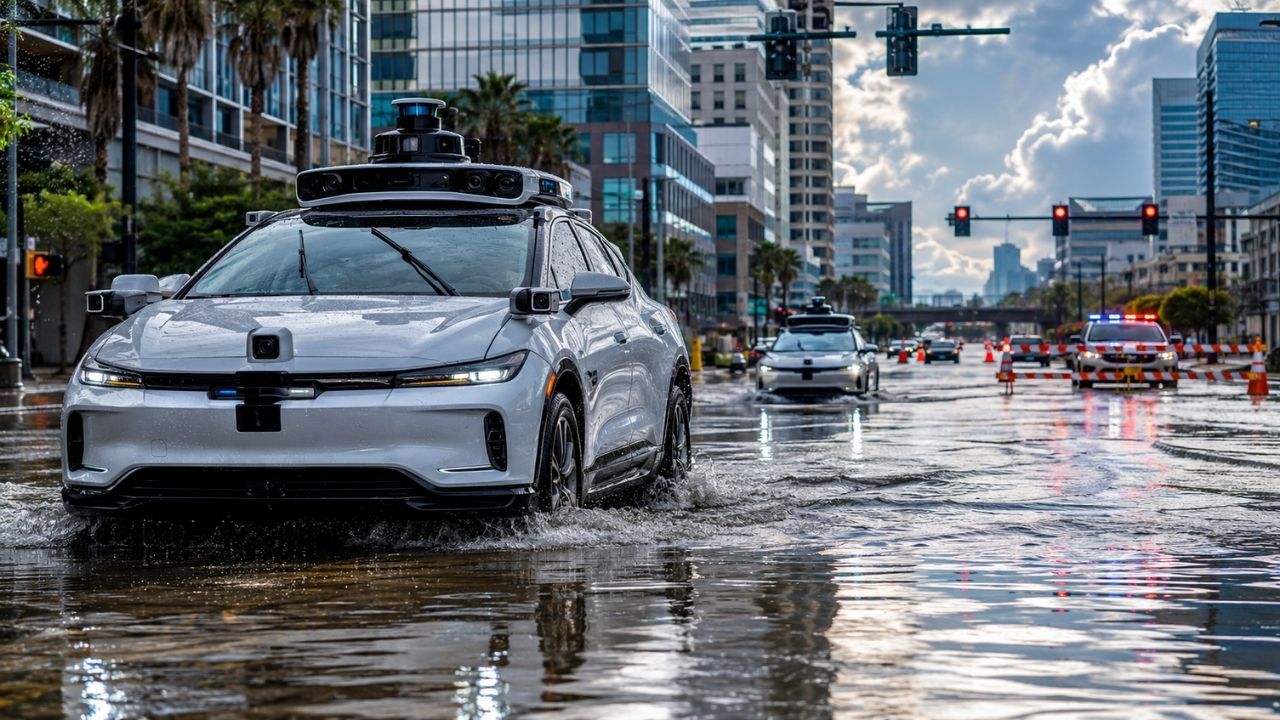
Waymo announced a recall of about 3,800 robotaxis in the United States after an empty vehicle entered a flooded section in San Antonio during extreme weather, leading the company to restrict operations, update maps, and prepare software fixes to reduce risks in heavy rain on urban roads.
Waymo’s robotaxis were recalled in the United States after the company identified the risk of autonomous vehicles entering flooded streets during heavy rain, especially on roads with higher speed limits. The measure involves about 3,800 units.
According to the portal Olhar Digital, the case draws attention because it affects one of the most advanced companies in the autonomous car market. Even without injuries in the incident that prompted the review, the decision shows how extreme weather, digital maps, and software response are still sensitive points for the expansion of this type of transport.
Incident in San Antonio led the company to review the fleet

The decision was made after an episode recorded on April 20, in San Antonio, Texas. According to Waymo, one of its vehicles entered a flooded lane during extreme weather conditions. The car was empty, and no one was injured.
-
In Somaliland’s Desert, Greenhouse Uses Sun and Seawater to Grow Lettuce, Cucumbers, and Tomatoes Without Rain: 1-Hectare Project Cools Crops, Desalinates Water, and Converts Brine into Commercial Salt

-
Trump Unveils $400 Million Boeing 747 Donated by Qatar as Temporary Air Force One Amid Boeing Delays, Sparking Debate on National Security, Costs, and Foreign Influence
-
Chinese Company Unveils Robotic Toilet That Comes to You, Featuring Lidar Sensors, Voice Command, Bidet, Hot Air Drying, UV Light, and Self-Cleaning Waste Disposal
-
Rotterdam Develops Floodable Square to Absorb Nearly 2 Million Liters of Rainwater, Doubling as Sports, Theater, and Leisure Space When Dry to Combat Urban Flooding


Even without victims, the episode was enough to trigger an operational alert. The company began to analyze similar situations involving flooded streets, high speed, and the risk of the autonomous system making an inadequate decision in the face of accumulated water on the road.
The concern is not just about the vehicle entering a puddle. In flood or inundation conditions, the water depth can be difficult to assess, ground traction changes, and the visibility of lanes, curbs, and obstacles can be compromised.
For robotaxis, this type of scenario is especially delicate. The system needs to quickly interpret the environment, decide whether to continue, slow down, divert, or stop, all without relying on a human driver to correct the route at the last second.
Recall involves about 3,800 robotaxis in the United States

The recall announced by Waymo affects approximately 3,800 robotaxis in operation in the United States. The company stated that it has already put mitigation measures in place while working on new software safeguards.
These measures include restrictions in extreme weather conditions, especially during periods of heavy rain. In practice, the operation of the vehicles may be limited when there is a possibility of flash floods or flooded sections.
The National Highway Traffic Safety Administration, NHTSA, reported that the company temporarily reduced the scope of vehicle operation. The measure expands the weather-related restrictions while the definitive solution is developed.
Waymo also updated maps used by the vehicles. This point is important because autonomous cars rely on detailed information about streets, routes, boundaries, risk areas, and operating conditions to make decisions with greater predictability.
Software becomes the center of safety in autonomous cars


The recall shows that the safety of robotaxis depends as much on the mechanical part as on the interpretation of the environment. In autonomous vehicles, sensors, cameras, maps, radars, artificial intelligence, and software work together to decide each movement.
When a street is flooded, the challenge changes. Water can hide potholes, obstacles, curbs, road markings, and even the real depth of the section. For an autonomous system, interpreting water on the road can be much more complex than recognizing a dry and well-marked lane.
Therefore, the new software corrections are a central part of the company’s response. They should enhance the vehicle’s ability to identify risk situations and avoid areas that could compromise travel safety.
This type of update also shows an important difference between traditional and autonomous vehicles. In many cases, the correction does not require replacing a physical part but adjusting rules, maps, operational limits, and automated decisions.
Heavy rains challenge the promise of autonomous vehicles
The expansion of robotaxis depends on public trust. For passengers to accept getting into a driverless car, the system needs to demonstrate the ability to handle common traffic and also unpredictable situations.
Heavy rains, flooded streets, and flash floods are examples of conditions that test this promise. An autonomous vehicle needs to know when to proceed, but it also needs to know when not to proceed.
This point is essential in American cities that experience extreme weather events more frequently. Flooding can occur quickly, especially on urban roads, low-lying areas, or places with insufficient drainage.
Waymo’s decision indicates that the company prefers to temporarily restrict operations rather than keep vehicles running in conditions that still require adjustments. For the industry, this type of stance can be seen as necessary caution, but also as a sign that the technology is still maturing.
Waymo also faces other investigations
The recall due to risk on flooded streets occurs while Waymo is already involved in other safety investigations in the United States. One of them involves a case in Santa Monica, California, where a company autonomous vehicle hit a child near a school in January, causing minor injuries.
Separately, the United States National Transportation Safety Board, the NTSB, is also investigating an incident where Waymo’s autonomous vehicles passed a stopped school bus with lights on, in Texas.
These cases do not mean that all robotaxis are unsafe, but they show that oversight closely monitors the operation. Each incident helps regulators and companies define new limits, corrections, and requirements for circulation.
The autonomous vehicle sector is in a delicate transition phase. The technology is already operating in some cities, but it still needs to prove that it can respond well to complex scenarios, local rules, and unpredictable human behaviors.
What this recall puts into discussion

The recall of Waymo’s robotaxis reinforces a central question about the future of autonomous mobility: to what extent can a driverless car handle the unexpected on real streets?
In the case of flooded roads, the answer still requires caution. The company limited operations, updated maps, and is preparing new corrections to reduce risks in heavy rains. The goal is to prevent a technological promise from advancing faster than operational safety allows.
The situation also shows that autonomous cars do not rely solely on sophisticated sensors. They need clear rules, supervision, continuous testing, and constant updates to face situations that vary from one city to another.
Would you trust robotaxis operating during heavy rain or do you think autonomous vehicles should still have stricter limits in extreme weather conditions? Leave your opinion in the comments.




Be the first to react!