






 Portuguese
  Spanish


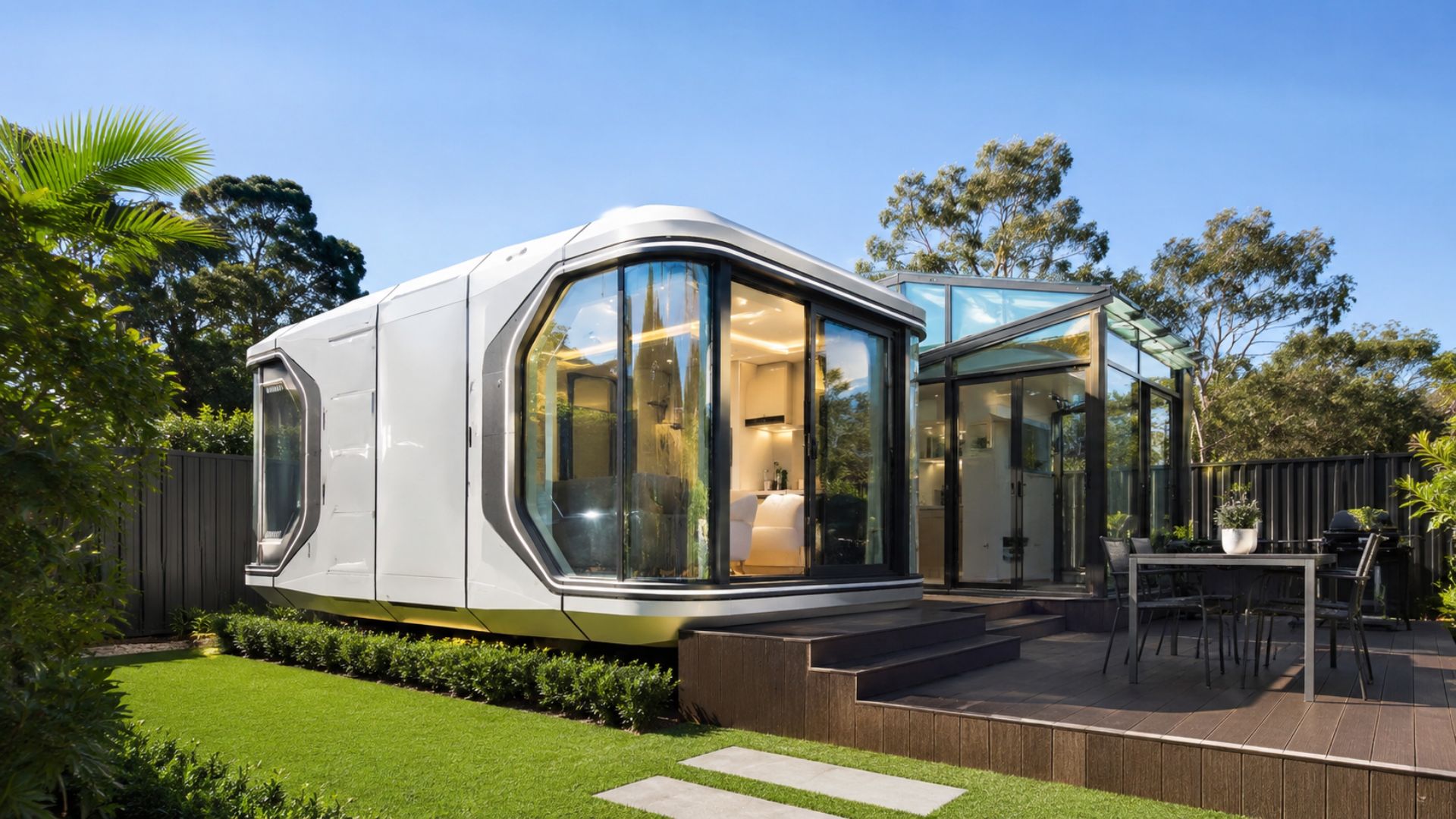
A Chinese prefabricated house, assembled in a few hours for about 12,500 Australian dollars, has won over residents of Australia tired of budgets over 100,000 dollars. The case illustrates the global expansion of China’s modular construction, driven by companies like Broad Group, which erects buildings in a few days.
A prefabricated house from China, capable of unfolding and being ready in a few hours, has become a craze among residents of Australia. This is what happened with Anna, a Chinese woman living in Perth: while researching a backyard shed, she came across a video of a white, foldable house being opened by four workers until it became a complete 70-square-meter property.
The reason for the enchantment is simple: the house cost only 12,500 Australian dollars, about 8,957 US dollars, while local builders were asking for more than 100,000 Australian dollars and still required six months just to start the work. Anna’s case is a portrait of how modular construction from China is advancing around the world.
Why the Chinese prefabricated house seduces Australia and the world

According to the Xinhua portal, for Anna, the calculation was easy to make. She summarized that the Chinese prefabricated house is quick and economical, and that it’s hard not to be attracted to it. Faced with a local budget more than eight times higher and a six-month wait, the imported option from China became irresistible, especially for those in need of a simple and immediate housing solution in Australia.
-
In Somaliland’s Desert, Greenhouse Uses Sun and Seawater to Grow Lettuce, Cucumbers, and Tomatoes Without Rain: 1-Hectare Project Cools Crops, Desalinates Water, and Converts Brine into Commercial Salt

-
Trump Unveils $400 Million Boeing 747 Donated by Qatar as Temporary Air Force One Amid Boeing Delays, Sparking Debate on National Security, Costs, and Foreign Influence
-
Chinese Company Unveils Robotic Toilet That Comes to You, Featuring Lidar Sensors, Voice Command, Bidet, Hot Air Drying, UV Light, and Self-Cleaning Waste Disposal
-
Rotterdam Develops Floodable Square to Absorb Nearly 2 Million Liters of Rainwater, Doubling as Sports, Theater, and Leisure Space When Dry to Combat Urban Flooding



And she is not alone. At a real estate fair held in May in Guangzhou, in southern China, Russian broker Mark, with years of experience importing Chinese furniture, was looking for modular units for his clients. Models shaped like space capsules or cabins are popular in tourist spots in Russia, where they become photo attractions. The demand, according to observers, is driven in rich countries by the high cost of labor and materials and the housing shortage, and in developing countries by the lack of stable industrial chains and skilled labor.
Exports on the rise: the numbers of China’s modular construction
The data shows the size of the phenomenon. Chinese exports of prefabricated buildings jumped from 1.47 billion dollars in 2015 to about 4.34 billion dollars in 2025. In just the first quarter of 2026, the value grew 45% year-on-year, according to the General Administration of Customs of China. The main destinations are the United States, Indonesia, Malaysia, Russia, and Australia.
The pace is expected to continue. According to Qin Zhanxue, president of the China Building Materials Circulation Association, the country’s prefabricated market is growing rapidly and is expected to have, in 2026, a compound annual growth rate above 15%, driven by public policies, demand, and technology. According to him, the sector is moving from old temporary structures to high-performance, smart, and sustainable solutions, which reinforces the bet on modular construction as a model for the future.
The building erected in nine days and the technology of Broad Group


The most impressive example came from the Philippines. In October 2024, a 12-story building with 24 two-bedroom apartments, already with air conditioning and built-in purifiers, was erected on the island of Mindanao in just nine days, compared to the 12 to 18 months of a traditional construction. The structure was built by the Broad Group, within its Holon building line, with modular pieces that fit together like Lego blocks.
The secret lies in industrialization. Li Shun, deputy general manager of Broad Group’s Holon subsidiary, states that 95% of the work is done in the factory, in China, leaving only 5% for on-site assembly. The company invested more than 1 billion dollars over a decade and developed the B-core slab, made of two stainless steel plates with thin tubes at the core. The material increases resistance to earthquakes and typhoons, promises a lifespan 20 times longer than reinforced concrete, and would reduce carbon emissions by 80% to 90%.
Government Support and Future Plans
The rise of the Chinese prefabricated house is also supported by the State. In October 2025, when Broad Group sent components for a project in the United Arab Emirates, the customs in Yueyang, Hunan province, set up a tailored plan that cut more than 10 days of processing and about 440 dollars per container. Cities like Shanghai, Beijing, Guangdong, and Shanxi have also created incentive policies, aligned with the green transition goals of China’s 15th Five-Year Plan, which runs from 2026 to 2030.
Looking ahead, the ambition is great: Broad Group plans to erect a Holon building with 258 floors and 1,037 meters high in a tourist city abroad by 2027, with design and wind tunnel tests already completed. Still, balance is key. It is a rapidly expanding sector with strong government support from China, but regulatory acceptance and the durability of these constructions outside the country will still be tested on a large scale, a decisive factor in determining whether modular construction will indeed establish itself as a global standard.
Houses that arrive folded and are ready in hours, for a fraction of the price, are already a reality from Australia to the Philippines.
Tell us in the comments if you would live in a Chinese prefabricated house or if you still trust traditional construction more.





Be the first to react!