






 Portuguese
  Spanish


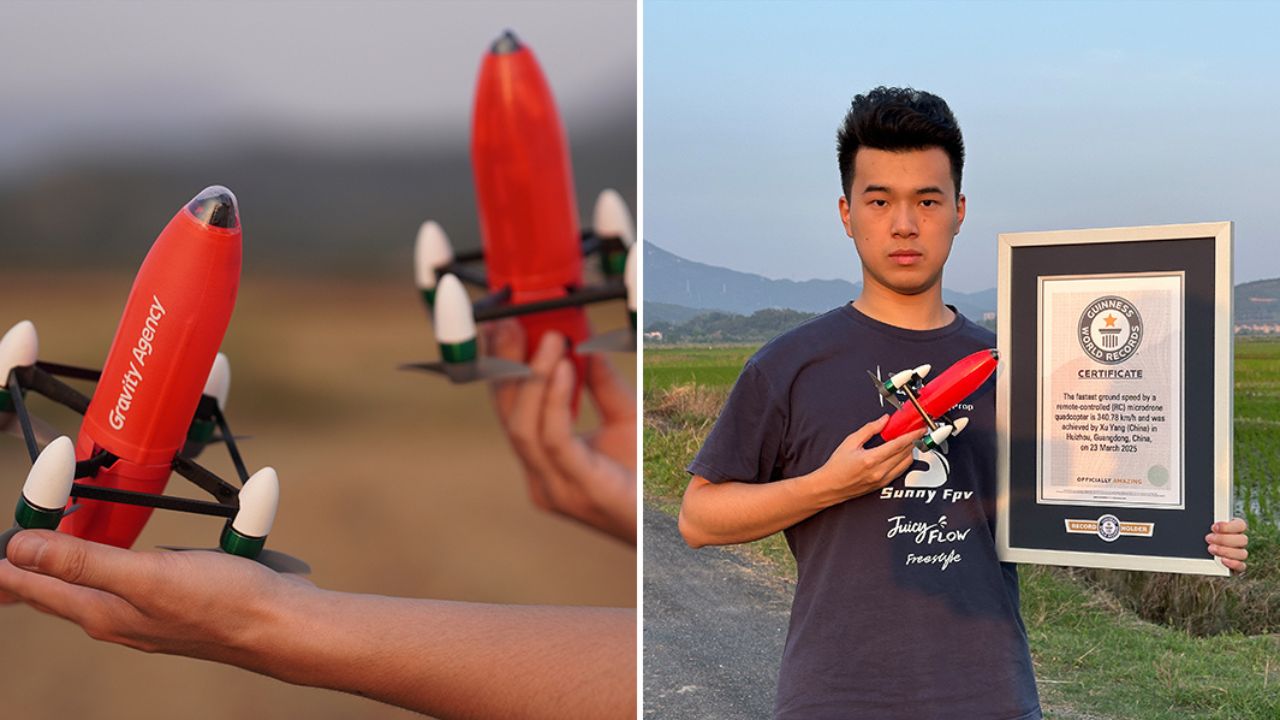

Microdrone weighing only 250 g, with 3D printed parts, reaches 340.78 km/h and enters the Guinness, showing how far independent engineering can go.
In 2025, the microdrone Prowess, developed in China by Xu Yang, gained international recognition after Guinness World Records, in an article published on May 23, 2025, officially recognized the equipment as the fastest microdrone quadcopter in the world. According to the record, the device, weighing less than 250 grams, reached 340.78 km/h on March 23, 2025, setting an extreme benchmark for a drone of this category.
The Guinness report itself describes the project as the result of lightweight engineering, successive testing, and radical optimization of propulsion and aerodynamic design. In a statement published on May 13, 2025, CUHK-Shenzhen reported that Xu Yang, a student of the institution, designed and built the equipment that achieved the record, reinforcing the experimental and high-performance nature of the Prowess.
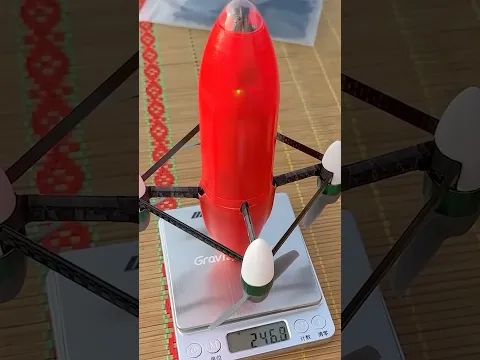
The central fact supporting the topic is straightforward: an ultralight drone, with a weight similar to that of a high-end smartphone, operating at speeds close to those of racing cars and high-speed trains. More than an isolated achievement, the record shows how compact drones have already surpassed the recreational field and have begun to function as platforms for extreme engineering.
-
Entrepreneur Turns Neighbor’s Coffee Grounds Waste into Eco-Friendly Pellets, Earning Up to $40,000 Monthly in Brazil

-
In China, Six-Armed Humanoid Robot Revolutionizes Washing Machine Factory, Boosting Efficiency by 30%

-
Engineers Uncover Rain’s Role in Airflow Mystery at Brazilian Underground Facility

-
Brazilian Engineers Lead $200 Million Project to Bring Water from São Francisco River to Transform Supply in Northeastern Cities


Structure weighing less than 250 g requires extreme engineering to withstand speeds of 340 km/h
The limit of 250 grams is not just a technical detail, but a strategic parameter. In many countries, drones below this weight face fewer regulatory restrictions, making this category highly explored by enthusiasts and engineers.
In the case of the Prowess, this limit was taken to the extreme. The drone’s structure was designed with an absolute focus on mass reduction and increased strength, using materials such as ultra-light carbon fiber, with structural parts weighing around 22 grams.

Additionally, the casing was developed with a thickness of approximately 0.4 millimeters, which reduces aerodynamic drag without completely compromising structural integrity.
This combination of lightness and strength is essential to withstand intense forces generated at speeds above 300 km/h, where any vibration or instability can result in the immediate destruction of the equipment.
3D printed propellers were decisive in reaching extreme speeds
One of the most critical elements of the design was the propellers, developed with high-strength resin 3D printing technology.
Unlike conventional propellers, the design was optimized to operate in extreme rotational regimes, where:
- The centrifugal force is extremely high
- The airflow becomes highly turbulent
- Small imperfections can cause catastrophic failures
3D printing allowed fine adjustments to the shape and geometry of the blades, something difficult to achieve with traditional manufacturing methods.
This level of customization was one of the factors that allowed the drone to reach speeds close to 341 km/h, maintaining enough stability for record validation.
Sequence of failures and destruction of prototypes was part of the process
The record was not the result of a single attempt. The development of Prowess involved a long process of experimentation, with multiple prototypes being tested and, in many cases, destroyed.
Reports associated with the project indicate that: Previous prototypes suffered structural failures; Propellers broke at high rotation, and the drone lost stability at high speeds
This cycle of trial and error is common in high-performance projects, especially when operating outside conventional engineering limits.

Each failure served as a basis for progressive adjustments, allowing refinements in structure, electronics, and aerodynamics.
Speed achieved places microdrone close to race cars and sport motorcycles
The mark of 340.78 km/h is not only impressive within the category of drones. It becomes even more relevant when compared to full-scale vehicles.
For comparison:
- Production supercars rarely exceed 350 km/h
- High-performance motorcycles operate in the range of 300 km/h
- Speeds at this level require advanced aerodynamics and precise control
The fact that a microdrone the size of a smartphone can reach this level places the project at an extremely high technical standard, even when compared to much larger and more complex machines.
Extreme performance requires precise control and highly optimized electronics
Operating a drone at speeds exceeding 300 km/h demands more than just power. An electronic system capable of responding in real-time to any stability variation is necessary.
This involves: Flight controllers with a high processing rate; Accurate sensors for orientation adjustment; and Rapid response systems for trajectory correction
Any delay or inaccuracy in these systems can result in loss of control. The stability of the Prowess at extreme speeds indicates an advanced level of integration between hardware and software, even as an independent project.
Microdrone category increases relevance of the record
The record set by the Prowess specifically applies to the category of microdrone quadcopters, generally defined by a weight of less than 250 g. This category is particularly relevant because:
- It is widely used by enthusiasts and professionals
- It has more severe physical limitations
- It requires greater efficiency in each component
Reaching 340.78 km/h within this weight limit significantly amplifies the impact of the record, as it demonstrates the maximum potential of an extremely compact class of devices.
Project reinforces the role of independent engineering in technological innovation
One of the most relevant aspects of the agenda is the fact that the project is not linked to a large company or industrial program.
The Prowess was developed independently, focusing on experimentation and continuous optimization. This type of initiative demonstrates that:
- Innovation is not restricted to large corporations
- Individual projects can achieve extreme levels of performance
- The maker culture and independent engineering continue to advance
This movement has been gaining strength globally, driven by access to technologies such as 3D printing, affordable electronic components, and online technical communities.
Record resets the limits of what is possible with compact drones
Until recently, speeds above 300 km/h were associated with larger drones or specific aircraft. The Prowess demonstrates that, with proper engineering, it is possible to achieve this level of performance in extremely compact devices.
This redefines the technical limit of the category, opening up space for new research and applications. Although the project is experimental, the knowledge generated can influence areas such as: Small-scale aerodynamics, High-speed electric propulsion, and Ultralight materials.


